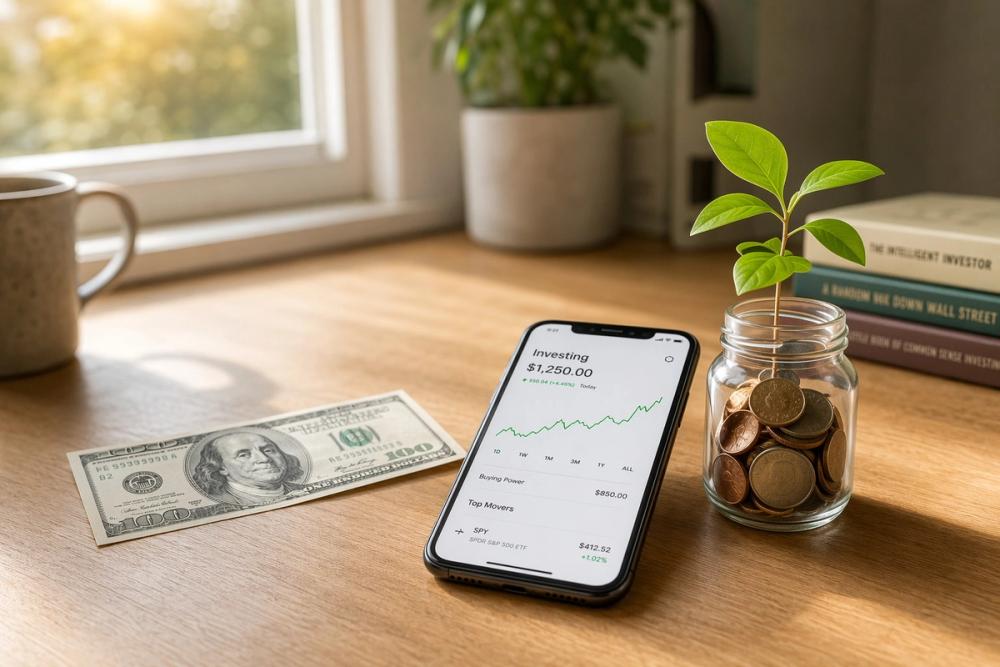
You get as far as the deposit screen. There's a box asking how much you want to transfer, and the number in your head is one hundred. It feels like showing up to a dinner party with a bag of chips.
That hesitation is the real barrier. Not the money — the suspicion that a hundred dollars isn't a serious amount and that real investing starts somewhere north of a thousand. It doesn't. Account minimums quietly disappeared years ago, and fractional shares finished the job. You can open an account this week and own a piece of the market by Friday.
Why $100 Is Enough to Start Investing
Two changes did most of the work here.
The first is fractional shares. A single share of a broad-market ETFA fund holding a basket of investments that trades on an exchange like a single stock, usually tracking an index at low cost. might cost several hundred dollars. Ten years ago that priced you out entirely — you either bought the whole share or you bought nothing. Now most major brokerages sell you a slice. Put in $100 and you own $100 worth. Your returns are proportional either way.
The second is the collapse of trading commissions. In 2019 the big brokerages dropped per-trade fees to zero. Before that, a $7 commission on a $100 purchase meant a 7% loss the moment you clicked buy. You'd need a strong year just to break even. That penalty on small investors is gone.
So investing with little money isn't a workaround anymore. It's the normal way to begin.
What $100 Realistically Buys You in Year One
Here's the honest math. At a 7% average annual return, $100 earns about $7 over a year. Some years it'll lose money instead.
That's not the point, though. The opening deposit isn't the investment — the habit is. Put in $100 a month at that same 7% and thirty years later you're near $122,000. Roughly $36,000 of that is money you contributed. The rest is time doing what time does. Run the numbers on a compound interestInterest earned on both your original money and the interest already added to it, which makes balances grow faster over time. calculator and watch what happens when you drag the timeline out. The curve barely moves for the first decade, then it gets steep.
Your first hundred dollars buys you tuition. You learn how a brokerage works, what a market drop feels like in your stomach, and how to place an order — all while the stakes are small enough to be survivable.
Choosing Where to Put Your First 100 Dollars
The account type matters more than most beginners expect. Four options are worth knowing.
A taxable brokerage account gives you total flexibility. Deposit anything, withdraw anytime, no penalties. You pay tax on gains when you sell. This is the right home for money you might need in the next few years.
A Roth IRAA retirement account funded with after-tax dollars where qualified withdrawals, including all growth, come out tax-free. is funded with money you've already paid tax on, and everything it earns after that grows tax-free. You can pull your contributions back out at any time without penalty. The 2026 limit is $7,500 a year, and you need earned income to contribute.
A 401(k)An employer-sponsored retirement account that lets you invest part of your paycheck before taxes, often with a matching contribution. with an employer match beats both when a match is on the table. A 50% match is an immediate 50% return. Nothing else in finance offers that.
A robo-advisorAn automated service that builds and maintains a diversified portfolio for you based on a short questionnaire, for a low annual fee. builds and rebalances a portfolio for you, usually around 0.25% a year. Worth it if the alternative is stalling out on the decision for six months.
The order is straightforward. Capture the employer match first. Then a Roth IRA. Then taxable.
What to Actually Buy
Buy a broad-market index fundA fund that mechanically tracks a market index rather than picking stocks, giving broad exposure at very low cost.. Total US market or S&P 500 — one purchase, hundreds of companies, no stock-picking required.
Check the expense ratioThe annual percentage of your investment that a fund charges to operate, deducted automatically from returns. before you buy. Anything under 0.10% is standard now, which on $100 works out to ten cents a year. If you'd rather make one decision and stop, a target-date fundA single fund that holds a whole diversified portfolio and shifts automatically from stocks toward bonds as its target year approaches. adjusts its own mix as you age.
Skip individual stocks, crypto, and options for now. A concentrated bet on $100 teaches you the wrong lesson whether it wins or loses. Investor.gov and FINRA's fund analyzer are useful for checking anything before you commit.
The Four Steps, Start to Finish
- Pick a brokerage. Three criteria: no account minimum, no trading commissions, fractional shares available. Several large firms clear all three.
- Open the account. About fifteen minutes. You'll need your Social Security number, address, employment details, and a bank connection.
- Transfer the money and place the order. This is where people stumble. Deposited cash sits there as cash until you actually buy something. Uninvested money earns nothing.
- Automate the next contribution. Set a recurring transfer, even $25 a month. Repetition matters far more than the opening balance.
Three Mistakes That Cost Beginners the Most
Checking the balance every day. A 5% drop on $100 is five dollars. It feels much larger than it is, and people who watch closely tend to sell at exactly the wrong moment.
Waiting for a better entry point. Nobody calls the bottom reliably. Buying steadily through good stretches and bad ones outperforms sitting in cash while you wait for clarity.
Investing money you'll need soon. Build a small cash cushion first. Clear high-interest debt second. A credit card at 22% outruns any realistic market return, so paying it down is the better investment.
Start Small, Start Now
The hundred dollars isn't really the investment. The open account and the recurring transfer are. Consistency compounds — opening balances don't.
This week: open the account, buy one index fund, set the automatic transfer. That's the whole thing.
This article is for general education and isn't personalized financial advice. Contribution limits, expense ratios, and brokerage terms change — verify current figures before acting.