You open your 401(k)An employer-sponsored retirement account that lets you invest part of your paycheck before taxes, often with a matching contribution. menu for the first time. Twenty fund names stare back, each one a string of words that sounds vaguely reassuring and means almost nothing. Somewhere in that list is a choice worth tens of thousands of dollars over your working life.
Here is the good news. Most of the confusion in the index fundsA fund that mechanically tracks a market index rather than picking stocks, giving broad exposure at very low cost. vs. mutual fundsA pooled investment holding a portfolio of securities on behalf of many investors, priced once a day after the market closes. debate comes from a single mislabeled comparison. Clear that up and the rest falls into place quickly.
The Category Error Behind "Index Funds vs. Mutual Funds"
A mutual fund is a legal structure. Many investors pool their money, a professional firm administers the portfolio, and shares are priced once each trading day at net asset value.
An index fund is a strategy. It tracks a benchmark, holds what that benchmark holds, and changes as little as possible.
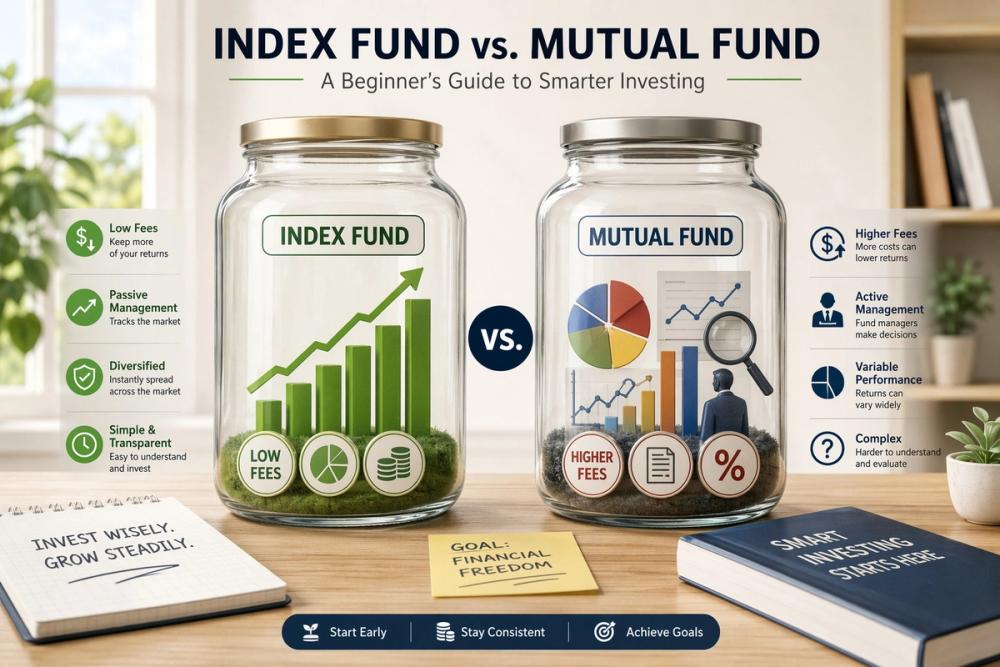
These are not opposites. Most index funds are mutual funds. The real distinction is between passive funds that track an index and actively managed funds where a manager selects holdings. That is the comparison worth your attention.
One wrinkle to note and set aside: index strategies also come packaged as ETFsA fund holding a basket of investments that trades on an exchange like a single stock, usually tracking an index at low cost., which trade throughout the day like stocks. The underlying logic is identical. Only the wrapper changes.
What Actively Managed Funds Are Selling
An active manager employs analysts, builds financial models, and makes judgment calls about which securities to buy and when to sell them. The pitch is straightforward. Skilled selection should beat a blind index, particularly in falling markets or in corners of the market where information travels slowly.
That pitch is not unreasonable. Research teams, frequent trading, and specialized mandates all cost money though, and those costs land on you as an annual fee.
Why Index Funds Do So Little on Purpose
An index fund buys the benchmark and holds it. When the index adds or drops a company, the fund follows. Nothing else happens.
That inactivity produces two quiet advantages. Trading costs stay low because the fund rarely trades. Taxable distributions stay low for the same reason, which matters enormously if you invest outside a retirement account.
You are no longer trying to identify winners. You simply own the market — roughly 500 US companies in an S&P 500 fund, covering about 80% of available market capitalizationA company's share price multiplied by its shares outstanding — the standard measure of how large a public company is..
Cost: The Only Variable You Control
Nobody can promise you a return. Everybody can tell you the fee in advance.
According to the Investment Company Institute's 2025 fee report, the average expense ratioThe annual percentage of your investment that a fund charges to operate, deducted automatically from returns. for equity mutual funds held steady at 0.40%, while index equity ETFs also stayed flat at 0.14%. Those averages understate the real gap. A quarter of actively managed domestic equity funds charge less than 0.71%. The equivalent quartile for index domestic equity funds sits at 0.15%.
Run that difference through three decades. Invest $10,000 at a 7% annual return over 30 years. At a 0.05% expense ratio you finish with roughly $75,000. At 1.00% you finish with roughly $57,000. The market delivered the same return in both scenarios. The fee took the difference.
Use a compound interest calculator with your own numbers before you decide anything. The result tends to be more persuasive than any argument.
What the Performance Record Shows
Fees would be forgivable if active managers reliably earned them back. The evidence is unkind.
S&P Dow Jones Indices publishes the SPIVA Scorecard, the standard benchmark for this question. In 2025, 79% of active large-cap US equity funds underperformed the S&P 500 — worse than 2024's 65% rate and the fourth-worst showing in the scorecard's 25-year history. Stretch the window and the picture darkens further. Over 20 years, roughly 92% of domestic funds trailed their benchmarks.
The persistence data is more damaging still. Among active domestic equity funds ranking in the top half in 2021, only a handful stayed in the top half over the following four years. For large-cap funds the outcome was worse than random chance would predict. Yesterday's star manager is a poor guide to tomorrow.
In fairness, the methodology is contested. The Investment Adviser Association's Active Managers Council has sponsored academic research arguing that SPIVA understates how actively managed funds actually perform. Worth knowing. It does not overturn a two-decade pattern.
How to Choose
Default to index funds when you are building long-term core holdings, investing in a taxable account, or simply unwilling to re-evaluate a manager's record every year.
Consider an active fund when you want exposure a broad benchmark does not offer cleanly, or when your employer's plan menu genuinely lacks a low-cost index option.
Before buying anything, find five numbers on the fund's page: expense ratio, benchmark, turnover, minimum investment, and any load fee. The SEC's investor education site explains each one plainly.
Common Questions
Can a fund be both an index fund and a mutual fund?
Yes, and most are. Index describes the strategy. Mutual fund describes the structure.
Are index funds safer?
No. They carry full market risk. They are cheaper and more predictable, which is a different thing.
Which belongs in a 401(k)?
Whichever broad index option your plan offers at the lowest expense ratio, in most cases.
Do one thing this week. Open the page for whatever fund you already own, find the expense ratio, and compare it to a broad index alternative in the same account. That number is knowable today. The returns are not.