You're staring at a bill — or a big purchase — and the question hits you: do I put this on the card or take out a loan?
Most people just go with whatever feels familiar. The card is right there in your wallet. A loan sounds complicated. So the card wins by default — even when it's the wrong tool for the job.
Here's the thing: personal loans and credit cards aren't competing products. They're different financial instruments designed for different situations. Once you understand what each one is actually built for, the decision gets a lot easier.
What's the Real Difference?
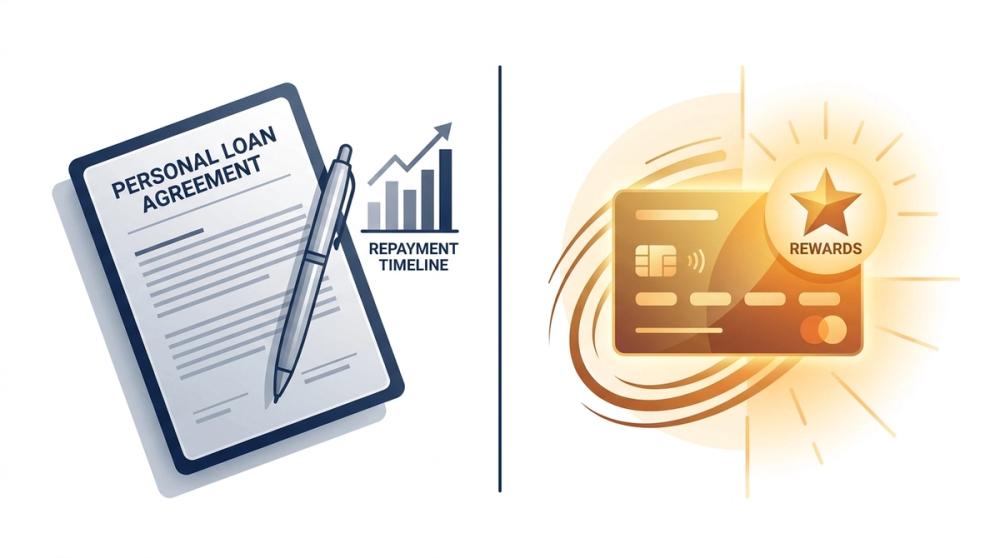
Think of a personal loan as a financial contract with a finish line. You borrow a fixed amount, get a set interest rateThe percentage charged for borrowing money or paid for depositing it, quoted as an annual figure. and a fixed monthly payment, and you know exactly when it's paid off. There's a beginning, a middle, and an end.
A credit card is more like a tap. You can use it, pay it down, use it again. It's revolving credit — flexible, open-ended, always available. That flexibility is its greatest strength. And honestly, it's also its biggest risk.
Neither is better. They're just built for different jobs.
When a Personal Loan Makes More Sense
You're dealing with a large, one-time expense
Say your furnace dies in January and the replacement costs $6,000. That's not a "pay it off next month" kind of purchase — that's a debt you're going to carry for a while. In that case, a personal loan is the smarter move.
Why? Because it locks in a fixed interest rate and spreads the cost over a predictable timeline. You know exactly what you owe every month. No surprises.
The same logic applies to things like medical bills, home repairs, or consolidating multiple high-interest debts into a single payment.
The interest rate is lower
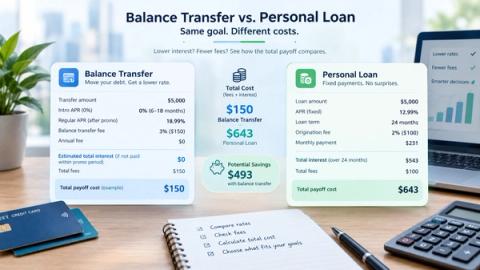
This is often the deciding factor. Personal loans — especially for borrowers with decent credit — typically carry lower APRs than credit cards. The average credit card APRThe yearly cost of borrowing, expressed as a percentage that includes the interest rate plus most lender fees. in the U.S. hovers around 20–24%, while personal loan rates can range from 7–15% for qualified borrowers. On a large balance carried over months, that gap adds up fast.
You want structure — and you need it
Some people do better with a defined repayment plan. If open-ended debt makes you anxious or you know you're prone to only paying the minimum, a personal loan removes the temptation. The payment is fixed. The timeline is fixed. You just follow the plan.
When a Credit Card Makes More Sense
You can pay it off quickly
If you're buying something you'll genuinely pay off in one or two billing cycles, a credit card wins. You get the convenience, possibly some rewards, and if you pay in full, you pay zero interest. That's a hard deal to beat.
Think: a $400 car repair you can cover with your next paycheck. Don't take out a loan for that.
You want rewards and protections
This is where credit cards get genuinely interesting. Cash back, travel points, purchase protection, extended warranties, fraud liability — these are real, tangible benefits that personal loans simply don't offer.
Used responsibly, a credit card can actually pay you to spend money you were going to spend anyway. That's a meaningful advantage.
You need flexibility
Sometimes you don't know exactly how much you'll need — or when. A credit card gives you access to a revolving line you can draw on as needed. For month-to-month fluctuations or unexpected expenses, that flexibility is often more valuable than a fixed loan structure.
The Tricky Middle Ground
There are situations where either could work — and this is where you have to be honest with yourself.
Debt consolidationReplacing several debts with a single new loan, ideally at a lower rate and with one payment instead of many. usually favors a personal loan. Rolling multiple credit card balances into one lower-rate loan can save real money in interest.
0% APR promotional cards can beat a loan — but only if you're confident you'll pay the full balance before the promo period ends. If you don't, the deferred interest can hit hard.
And the most important question in all of this? Will I actually pay this off — or will I let it ride? That question matters more than any interest rate comparison.
The Bottom Line
A personal loan is a plan. A credit card is access.
Use the loan when you need structure, a lower long-term rate, and a clear payoff date. Use the card when you need speed, flexibility, or short-term coverage you know you'll handle quickly.
The right choice isn't about which product sounds better. It's about matching the tool to the situation — and being honest about your own habits while you're at it.