
Why a Market Crash Feels So Personal
A market crash is not just a chart falling on a screen. It feels like your future got shoved into a storm without warning. Retirement plans look smaller. College funds feel less certain. Even experienced investors start wondering whether “this time is different.”
A crash usually means a sharp, fast decline across major stock indexes. It differs from normal volatility because fear spreads quickly. Prices fall before most people can think clearly. Headlines get louder. Social media turns into a panic machine. And suddenly, long-term investors feel pressure to make short-term decisions.
That pressure is the real danger.
Markets recover unevenly. Some companies survive and grow stronger. Others do not. Your job during a market crash is not to predict every move. Your job is to protect your financial foundation, avoid emotional errors, and make decisions that still make sense when the panic fades.
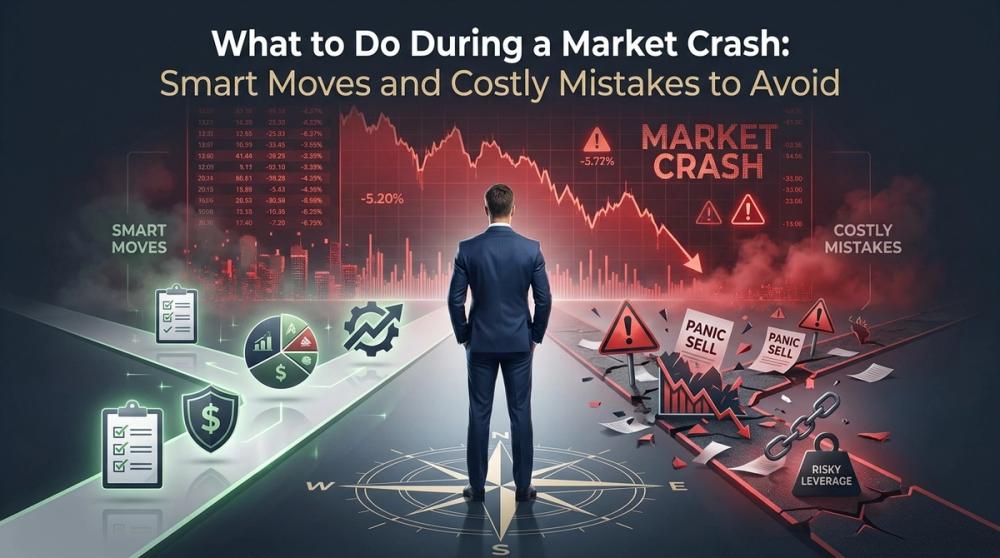
What to Do During a Market Crash
Stay Calm Before You Touch Your Portfolio
The first smart move during a market crash is boring but powerful: pause.
Do not sell because your stomach dropped. Do not buy because someone online says stocks are “on sale.” Before acting, ask three questions:
- Has my financial goal changed?
- Has my time horizon changed?
- Has the quality of my investments changed?
If the answer is no, then your investment plan may not need dramatic surgery. It may just need discipline.
Investor education resources like Investor.gov emphasize planning before panic for a reason. A strong plan gives you something solid to hold when markets feel unhinged. Without one, every headline becomes an instruction.
Check Your Cash Position First
Before thinking about buying the dip, look at your cash.
A market crash often overlaps with broader economic stress. Job losses rise. Business revenue may slow. Credit conditions can tighten. That means your emergency fundCash set aside in an accessible account to cover unexpected expenses or a loss of income without taking on debt. matters more than your watchlist.
Review your short-term needs:
- Rent or mortgage payments
- Food and utilities
- Insurance premiums
- Debt payments
- Medical costs
- Planned expenses over the next 12 months
If you may need money soon, do not expose that money to heavy market risk. Cash does not deliver exciting returns. But during a crash, cash gives you something better: options.
The investor who has enough cash can wait. The investor without cash may have to sell at exactly the wrong time.
Revisit Asset Allocation With Clear Eyes
A market crash reveals your true risk tolerance. When stocks rise, almost everyone claims they can handle volatility. When portfolios fall 25%, people discover what risk actually feels like.
Asset allocationHow you divide a portfolio among stocks, bonds, cash, and other asset types — the single biggest driver of its risk and return. means how you divide money among stocks, bonds, cash, and other assets. A younger investor with decades ahead may hold more stocks. Someone nearing retirement may need a more conservative balance.
During a crash, compare your current portfolio with your intended allocation. If stocks fell sharply, your portfolio may now hold less equity exposure than planned. RebalancingPeriodically buying and selling to return a portfolio to its target mix after market moves have shifted it. can restore the original mix.
For example, if your target is 70% stocks and 30% bonds, a crash might push you to 60% stocks and 40% bonds. Rebalancing could involve buying stocks while prices are lower. That feels uncomfortable. But disciplined investing often feels uncomfortable in the moment.
FINRA offers a useful primer on asset allocation and diversification for investors who want a practical framework.
Keep Investing If Your Situation Supports It
If your income is stable, your emergency fund is healthy, and your time horizon is long, continuing to invest can be rational.
This is where dollar-cost averagingInvesting a fixed amount on a regular schedule regardless of price, which smooths out your average purchase cost. helps. Instead of trying to guess the bottom, you invest a fixed amount at regular intervals. Sometimes you buy before another drop. Sometimes you buy before a rebound. Over time, the strategy reduces the pressure to make one perfect decision.
Think of it like walking down a steep trail in fog. You do not leap to the bottom. You take controlled steps.
This works best for retirement investors, long-term index fundA fund that mechanically tracks a market index rather than picking stocks, giving broad exposure at very low cost. investors, and people who can tolerate further declines. It works poorly for anyone using rent money, borrowed money, or cash needed next month.
Focus on Quality Rather Than Cheap Prices
A lower price does not automatically mean a better investment.
During a market crash, weak companies may fall because their business models cannot survive tighter financial conditions. Strong companies may fall simply because investors are selling everything. The opportunity lies in knowing the difference.
Look for signs of resilience:
- Consistent cash flow
- Manageable debt
- Durable demand
- Strong competitive position
- Honest leadership
- Healthy margins
- Ability to survive a recession
A stock that falls 50% can still be expensive if earnings collapse. Conversely, a high-quality business may become attractive after broad panic drags down its price. The difference comes from analysis, not excitement.
What NOT to Do During a Market Crash
Do Not Panic Sell Without a Real Reason
Panic selling feels like taking control. In reality, it often converts temporary losses into permanent ones.
Selling can make sense if your goals changed, your risk tolerance was misjudged, or an investment’s fundamentals deteriorated. But selling simply because prices fell is not a strategy. It is a stress response wearing a business suit.
The market does not need your emotional surrender to recover. Sometimes the best move is no move at all.
Do Not Try to Call the Exact Bottom
Every market crash creates a crowd of confident bottom-callers. Most are guessing.
To time the market perfectly, you need two correct decisions. You must know when to sell and when to buy back. That second decision is harder than people admit because markets often rebound while the news still looks terrible.
By the time the economy feels safe again, prices may have already moved. That is why many long-term investors focus on staying invested, rebalancing, or buying gradually instead of waiting for a magical signal.
Do Not Abandon Diversification
When fear spikes, concentration becomes tempting. Some investors run entirely to cash. Others throw money into one beaten-down stock, one hot sector, or one speculative asset.
DiversificationSpreading money across many investments so that a loss in any one of them does limited damage to the whole portfolio. is not designed to make you look brilliant every month. It exists to keep one bad decision from wrecking the whole plan.
A diversified portfolio may include broad stock funds, bonds, cash, and other assets depending on your goals. It will not eliminate losses. But it can reduce the odds that one sector, company, or economic shock destroys your financial progress.
Do Not Borrow Money to Buy the Dip
Leverage turns a market crash into a loaded weapon.
Borrowing to invest may look clever when prices are falling. But markets can fall much further than expected. If you use margin, a broker can force you to sell after prices drop. If you use personal loans or credit cards, interest costs can crush the potential upside.
Never risk solvency for opportunity. A great investment bought with fragile financing can still become a disaster.
Build Your Market Crash Plan Before the Next One
The best time to create a crash plan is before you need it.
Write down rules such as:
- Keep three to six months of expenses in cash.
- Rebalance when allocations drift beyond a set range.
- Continue retirement contributions unless income changes.
- Avoid selling broad-market funds because of headlines.
- Review investments monthly, not hourly.
Also match every dollar to a time horizon. Money needed soon belongs in safer places. Money meant for decades can usually tolerate more volatility.
A market crash punishes improvisation. It rewards preparation.
FAQs
What should I do first during a market crash?
Check your cash needs before adjusting investments. If your emergency fund is weak, focus on liquidity before buying more assets.
Is it smart to buy stocks during a market crash?
It can be smart if you have stable income, a long time horizon, and a diversified plan. Avoid using borrowed money or short-term cash.
What is the biggest mistake investors make during a crash?
The biggest mistake is panic selling without a clear reason. Fear alone should not replace a well-built investment strategy.