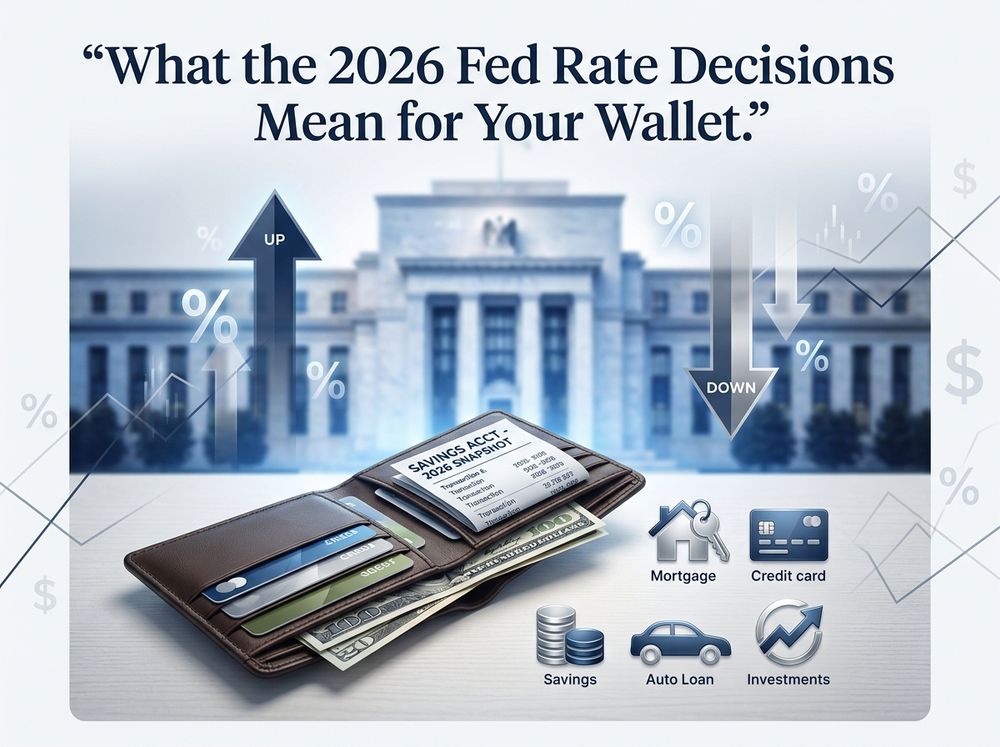
You don’t feel the Federal Reserve in a marble building in Washington.
You feel it when your credit card statement lands and the interest charge looks rude. You feel it when a mortgage quote changes your monthly payment by hundreds of dollars. You feel it when your savings account finally earns something again — or when your car loan makes you wonder if the car is buying you.
That’s why the 2026 Fed rate decisions matter. Not because everyone needs to become a monetary policy expert. Most people don’t. But because the Fed’s choices ripple through the stuff we actually live with: debt, savings, mortgages, auto loans, retirement accounts, and the quiet stress of trying to make the month work.
In early 2026, the Federal Reserve kept its target federal funds rate in the 3.50% to 3.75% range, while continuing to watch inflationThe general rise in prices over time, which steadily reduces what each dollar of savings can buy., employment, energy prices, and broader economic risks. In plain English: the Fed isn’t slamming on the brakes anymore, but it’s not exactly flooring the gas either.
So what does that mean for your wallet? Let’s break it down.
What the 2026 Fed Rate Decisions Actually Mean
The Fed’s main interest rateThe percentage charged for borrowing money or paid for depositing it, quoted as an annual figure. — the federal funds rate — is the rate banks charge each other for overnight lending. That sounds distant from everyday life, I know. But it acts like a financial gravity point.
When the Fed raises or holds rates high, borrowing usually stays more expensive. When it cuts rates, some borrowing costs can ease. Not instantly everywhere, and not equally for everyone, but the direction matters.
The 2026 Fed rate decisions show a central bank trying to balance two problems at once:
- Inflation is still above the Fed’s comfort zone.
- The job market has cooled, with slower job gains.
Think of it like driving on a wet road. The Fed wants to slow down enough to stay safe, but not so much that the whole car stalls.
How the 2026 Fed Rate Decisions Affect Credit Cards
If you carry credit card debt, this is probably where the Fed hits hardest.
Most credit cards have variable interest rates tied, directly or indirectly, to benchmark rates influenced by Fed policy. So when rates are elevated, credit card APRs tend to stay painful. And when the Fed holds rates steady, your APRThe yearly cost of borrowing, expressed as a percentage that includes the interest rate plus most lender fees. usually doesn’t magically fall.
That means a balance can sit there quietly growing in the background. You make the minimum payment, feel like you’re doing the responsible thing, and then the next statement shows barely any progress. Honestly, that’s one of the most frustrating parts of high-rate environments. You’re paying, but the debt doesn’t seem to move.
What to do now
If you have credit card debt, focus on it before almost anything else.
- Pay more than the minimum whenever possible.
- Target the highest-interest card first.
- Ask your issuer for a lower APR, especially if you’ve paid on time.
- Consider a 0% balance transferMoving credit card debt onto a new card with a promotional low or 0% rate, so payments attack the balance instead of the interest., but only if you can pay it off before the promo period ends.
- Avoid using cards as emergency funding unless there’s truly no other option.
What Fed Rate Decisions Mean for Mortgages in 2026
Here’s where things get a little misunderstood: mortgage rates do not move in perfect lockstep with the Fed.
The Fed controls short-term interest rates. Mortgage rates are longer-term and are influenced by Treasury yields, inflation expectations, investor demand, lender margins, and what markets think the Fed will do next.
So yes, the 2026 Fed rate decisions matter for mortgages. But a Fed pause doesn’t automatically mean mortgage rates freeze. A Fed cut doesn’t automatically mean mortgage rates drop the next morning either.
Markets are always looking ahead.
For homebuyers
The real question isn’t, “What’s the Fed doing?”
It’s: Can I afford the payment if rates don’t fall soon?
That matters because buying a home based on hoped-for future refinancingReplacing an existing loan with a new one, usually to lower the rate, change the term, or convert equity into cash. can get dangerous. Maybe rates fall. Maybe they don’t. Maybe home prices rise while you wait. Maybe inventory tightens. There are a lot of maybes, and your monthly payment is not a maybe — it’s due every month.
Before buying, stress-test the payment. Look at taxes, insurance, maintenance, HOA fees if applicable, and a cushion for repairs. The mortgage rate is only one part of the bill.
For homeowners thinking about refinancing
Don’t refinance just because headlines say rates are moving lower. Do the break-even math.
If refinancing saves you $150 a month but costs $5,000 upfront, it takes about 33 months to break even. If you’re likely to move before then, the refinance may not be worth it.
Boring math? Maybe. Useful? Absolutely.
How the Fed’s 2026 Rate Path Affects Savings Accounts and CDs
Now for the better news.
Higher interest rates aren’t all bad. If you’re a saver, the 2026 Fed rate environment can still work in your favor. High-yield savings accountsA federally insured savings account paying a much higher rate than a typical bank account, with full access to your money., money market funds, Treasury billsShort-term US government debt sold at a discount to face value, maturing in a year or less and backed by the Treasury., and CDsA deposit account that locks your money in for a fixed term at a fixed rate, with a penalty for taking it out early. may continue offering meaningful yields compared with the near-zero-rate years.
But there’s a catch: your bank may not automatically reward you.
Some traditional savings accounts still pay almost nothing, even when competitive online banks and credit unions offer much better rates. That’s money left on the table. Quietly. Every month.
What savers should do
- Compare your savings account APYThe yearly return on savings including the effect of compounding, which makes it the honest number for comparing deposit accounts..
- Keep emergency funds liquid and safe.
- Consider CDs only for money you won’t need immediately.
- Use a CD ladder if you want flexibility.
- Don’t chase yield so aggressively that you take risks with short-term cash.
Still, it shouldn’t be napping in an account earning pocket change.
What 2026 Fed Rate Decisions Mean for Auto Loans and Personal Loans
Auto loans and personal loans are also affected by Fed policy, though your credit scoreA three-digit number, typically 300 to 850, that lenders use to estimate how likely you are to repay borrowed money., income, loan term, and lender matter a lot.
When rates remain elevated, monthly payments can stay high. And with cars already expensive, stretching a loan to six, seven, or even eight years can be tempting.
But that’s where people get trapped.
A longer loan can make the monthly payment look manageable while increasing the total interest you pay. Worse, you can end up owing more than the car is worth for a long time.
Smart borrowing moves
Before taking out an auto loan or personal loan:
- Get preapprovedA lender's conditional commitment to a loan amount after reviewing your finances — stronger than a prequalification, short of an approval. before shopping.
- Compare banks, credit unions, and online lenders.
- Avoid focusing only on the monthly payment.
- Check the total cost of the loan.
- Don’t use a personal loan for debt consolidation unless it truly lowers your interest and helps you stop adding new debt.
How Fed Rate Decisions Affect Investments and Retirement Accounts
The Fed doesn’t control the stock market. Let’s be clear about that.
But Fed rate decisions do affect how investors think about risk. When rates are higher, safe assets like cash and Treasury bills become more attractive. Bonds offer different yields. Stock valuations can come under pressure because future profits are discounted at higher rates.
That sounds technical, but here’s what it means: when money has a higher “safe” return, investors become pickier about risky returns.
For retirement investors, though, the biggest mistake is usually overreacting.
A single Fed meeting should not blow up your long-term plan. If you’re investing for retirement 10, 20, or 30 years from now, your asset allocation matters more than whatever happens at one press conference.
Better approach
- Keep short-term money out of volatile investments.
- Rebalance if your portfolio has drifted.
- Stay diversified.
- Avoid making emotional trades based on Fed headlines.
- Match your investments to your timeline, not the news cycle.
Should You Wait for Fed Rate Cuts in 2026?
This is the big wallet question.
Should you wait to buy a house? Wait to finance a car? Wait to move savings? Wait to invest?
Sometimes waiting makes sense. If you’re refinancing and rates are clearly trending lower, patience may help. If you’re buying a car and your current one runs fine, waiting could save money.
But waiting is not always a strategy. Sometimes it’s just stress wearing a nicer outfit.
Don’t wait to pay down high-interest debt. Don’t wait to move cash into a better savings account. Don’t wait to build an emergency fund. And don’t wait to create a budget that reflects today’s prices, not the prices you wish still existed.
A Simple 2026 Fed Rate Checklist for Your Wallet
Here’s the practical version:
- Pay down credit card debt aggressively.
- Shop for better savings yields.
- Keep emergency cash safe and accessible.
- Compare loan offers before borrowing.
- Stress-test mortgage and auto payments.
- Refinance only when the math works.
- Keep investing based on your goals.
- Don’t build your financial life around guessing the Fed perfectly.
Bottom Line: The Fed Sets the Weather, But You Choose the Jacket
The 2026 Fed rate decisions shape the financial climate. They influence what you pay to borrow, what you earn on savings, and how markets think about risk.
But they don’t make every decision for you.
Your best move is to build flexibility. Less high-interest debt. Better cash yields. Smarter borrowing. A portfolio that doesn’t need perfect conditions to survive.
Because the real goal isn’t predicting the Fed’s next move.
It’s making sure your wallet can handle whatever comes next.