You know you should diversifySpreading money across many investments so that a loss in any one of them does limited damage to the whole portfolio., but when you open your brokerage account, the sheer number of choices freezes you in place. Should you pick individual stocks? How many funds? What percentage in bonds? Most advice on diversification for beginners assumes you already understand the basics, leaving you paralyzed between doing nothing and buying everything that sounds good.
The truth is simpler than the investing industry makes it sound. You don't need to master modern portfolio theory or track dozens of holdings. A handful of straightforward rules will get you 90% of the benefit with 10% of the complexity. By the end, you'll know exactly how to build a diversified portfolio that matches your timeline, keeps costs low, and doesn't require constant attention.
Start with a target-date fund or three-fund portfolio
If you want diversification without analyzing dozens of investment options, use a target-date fundA single fund that holds a whole diversified portfolio and shifts automatically from stocks toward bonds as its target year approaches. or build a three-fund portfolio.
Target-date funds pick a year close to when you plan to retire. A 2060 fund holds mostly stocks now, then gradually shifts toward bonds as 2060 approaches. The fund rebalances automatically. You buy one fund and get diversification across thousands of stocks and bonds.
A three-fund portfolio splits your money across three index fundsA fund that mechanically tracks a market index rather than picking stocks, giving broad exposure at very low cost.: U.S. total stock market, international stocks, and bonds. You control the mix. A common starting allocation is 60% U.S. stocks, 30% international stocks, and 10% bonds.
Both strategies work because simple diversification you actually implement beats a complex plan you never finish building.
Know your risk tolerance before you invest
Risk tolerance determines how much volatility you can handle emotionally and financially. Before you pick investments, ask yourself how you'd react if your portfolio dropped 20-30% in a year. If that would make you sell everything in a panic, you need a more conservative mix.
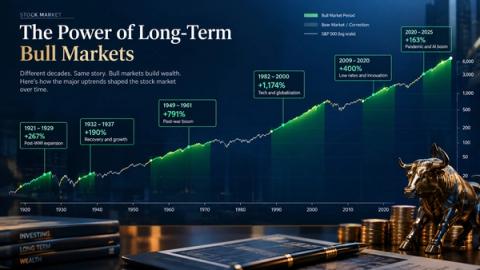
Younger investors can typically hold more stocks because they have decades to recover from market drops. Someone investing at 25 can ride out multiple bear marketsA decline of 20% or more from a recent market high, and the stretch of falling prices that follows it. before retirement. Someone at 55 has less time to make up losses.
Your asset allocationHow you divide a portfolio among stocks, bonds, cash, and other asset types — the single biggest driver of its risk and return. should match your actual risk tolerance, not what investing guides say you should do. A portfolio you can stick with through volatility beats a theoretically optimal one you'll abandon when markets fall.
Spread investments across asset classes
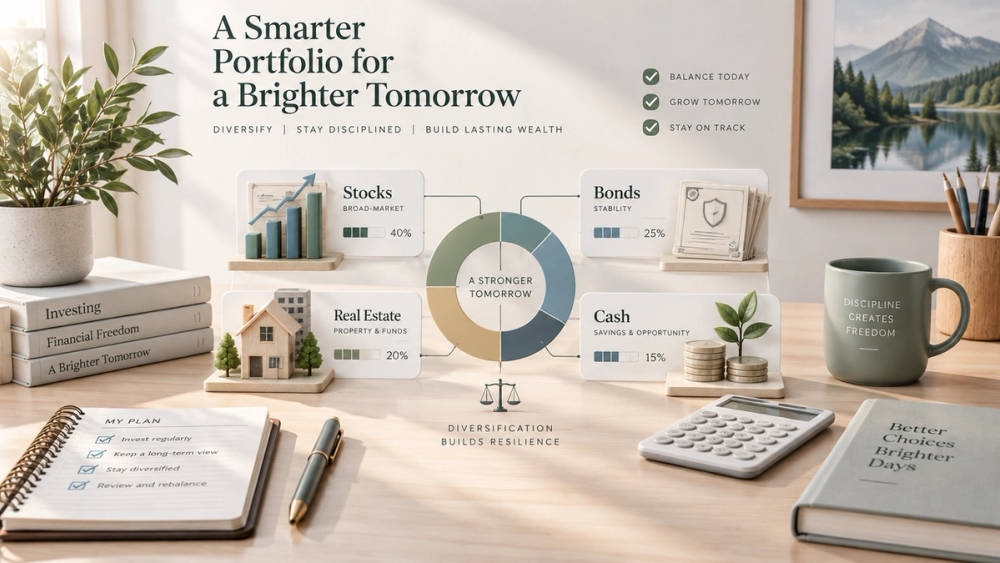
Asset classes include stocks, bonds, real estate, and cash equivalents. Each responds differently to economic conditions: when stocks drop during a recession, bonds often hold steady or rise. When inflationThe general rise in prices over time, which steadily reduces what each dollar of savings can buy. runs high, real estate can preserve value while cash loses purchasing power.
A basic allocation combines stocks for growth and bonds for stability. A 30-year-old saving for retirement might hold 80% stocks and 20% bonds. Someone retiring next year might reverse that to 30% stocks and 70% bonds.
The right mix depends on your timeline and risk tolerance, not universal rules. If you need the money in three years, heavy stock exposure is reckless. If you have 30 years, holding too much in bonds costs you decades of compoundingInterest earned on both your original money and the interest already added to it, which makes balances grow faster over time. growth.
Avoid home country bias
US investors often hold 80% or more of their stock allocation in domestic companies, despite the US representing roughly 60% of global market capitalizationA company's share price multiplied by its shares outstanding — the standard measure of how large a public company is.. This over-concentration creates unnecessary risk: if the US economy underperforms or a domestic policy change hurts American businesses, your entire portfolio suffers.
International stocks provide protection against country-specific problems while giving you exposure to growth in Europe, Asia, and emerging markets. Historical data shows that adding global stocks has reduced portfolio volatility without lowering long-term returns.
A reasonable starting point is 20-40% of your stock allocation in international funds. A total international stock index fund gives you broad exposure without requiring you to pick countries or regions.
Diversify within asset classes, not just between them
Owning stocks and bonds isn't enough if you hold only five companies and one government bond. A broad stock index fund gives you ownership in hundreds or thousands of businesses across sectors and sizes. If one company collapses, it represents a fraction of a percent of your holdings rather than 20%.
The same principle applies to bonds. Spread your fixed income across government and corporate bonds with different maturity dates. Short-term bonds behave differently than long-term bonds, and treasuries move independently of corporate debt.
Individual stock picking increases risk without reliably increasing returns for beginners. Broad index funds provide better protection because poor performers get diluted by the rest of the portfolio.
Rebalance once or twice a year
Your portfolio drifts over time. If stocks gain 20% while bonds stay flat, a 70/30 portfolio becomes 75/25 without any action on your part. RebalancingPeriodically buying and selling to return a portfolio to its target mix after market moves have shifted it. brings it back to your target.
Pick a schedule and stick to it. Once a year works for most investors. Twice a year is fine if you prefer more control. Avoid reacting to market swings or rebalancing monthly; the extra trades cost you money in taxes and fees without improving results.
Rebalancing forces discipline. When stocks surge, you sell some at high prices and buy bonds. When stocks fall, you buy them at lower prices. You are systematically buying low and selling high, which is exactly what you want.
Keep costs low with index funds and ETFs
High fees erode returns over time through compound effects. A fund charging 1% annually removes roughly 25% of your returns over 30 years, while a fund charging 0.10% removes less than 3%.
Index funds and ETFsA fund holding a basket of investments that trades on an exchange like a single stock, usually tracking an index at low cost. typically charge 0.03% to 0.20%, compared to 1% or more for actively managed funds. The difference compounds: on a $10,000 investment growing at 7% annually for 30 years, a 1% fee costs you about $50,000 in lost returns compared to a 0.10% fee.
Lower costs mean more money stays invested and working for you instead of paying fund managers. Cost is one of the few factors you can control and predict in investing, making it a reliable way to improve your outcomes.
Your next step with diversification
Diversification for beginners comes down to three decisions: pick a simple starting point, match your stock-to-bond split to your actual risk tolerance, and include international exposure. If you're unsure where to begin, a target-date fund gives you instant diversification in a single investment. If you prefer more control, a three-fund portfolio covering US stocks, international stocks, and bonds provides the same benefit with minimal complexity. Once you've chosen your approach, set a yearly rebalancing reminder and leave it alone. The portfolio that you actually build and stick with will always outperform the perfect portfolio you never start.