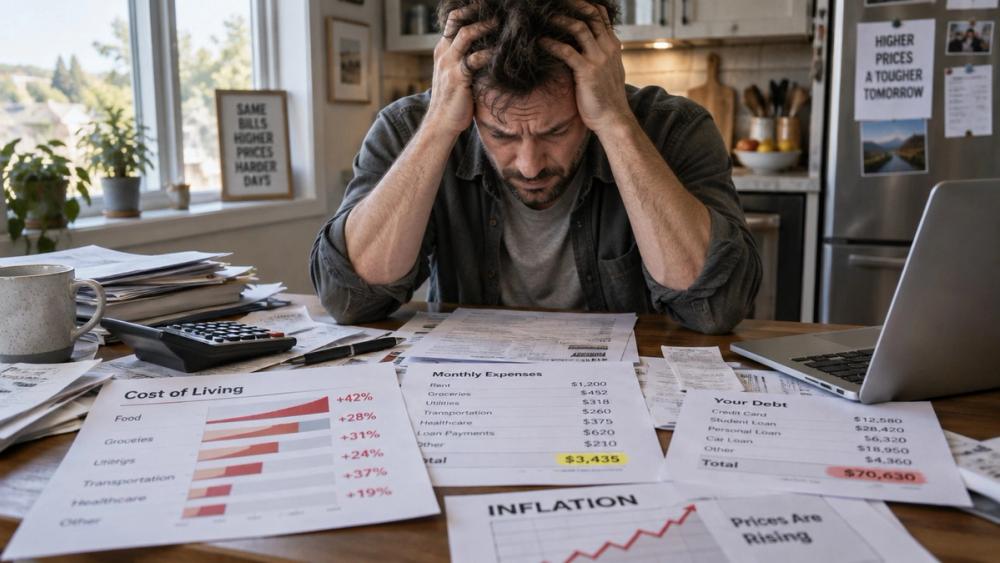
Your grocery bill keeps climbing while your fixed-rate loanA mortgage whose interest rate is locked for the entire term, so the principal and interest payment never changes. payment stays unchanged. Does that mean inflationThe general rise in prices over time, which steadily reduces what each dollar of savings can buy. makes your debt easier to manage?
Inflation can help people with existing fixed-rate debt by reducing its purchasing-power value. However, it can hurt borrowers when living expenses rise, income stagnates, or variable interest ratesThe percentage charged for borrowing money or paid for depositing it, quoted as an annual figure. increase.
The answer depends on your loan terms and household budget. Understanding the difference between debt’s economic value and its monthly affordability helps explain why.
How Inflation Changes the Real Value of Debt
Inflation means prices rise broadly across the economy, reducing what each dollar can buy. That change affects the purchasing power of future loan repayments.
Does Inflation Reduce Debt—or Just Its Value?
Your nominal debt represents the dollar amount you owe. Your real debt reflects that amount’s purchasing power after accounting for inflation.
Suppose you owe $10,000 payable one year from now. With 5% inflation, that future payment represents approximately $9,524 in today’s purchasing power. This simplified example excludes interest, fees, and repayments during the year.
You still owe $10,000. Inflation does not cancel principal or rewrite your loan agreement.
Nevertheless, unexpected inflation can benefit borrowers because they repay lenders with money worth less than anticipated. The Federal Reserve Bank of St. Louis describes this effect as a wealth transfer from lenders to borrowers. 2
When Does Inflation Help People With Debt?
Existing fixed-rate loans offer the clearest potential advantage, particularly when household income also increases.
Fixed-Rate Debt Keeps Contractual Payments Predictable
A fixed-rate loan locks in its interest rate under the agreement’s terms. Inflation does not directly increase that contractual rate.
Consequently, an existing fixed-rate mortgage or auto loan can become less burdensome in purchasing-power terms as prices rise. Unexpected inflation creates the clearest benefit because lenders can account for anticipated inflation when pricing new loans. 2
However, predictable loan payments do not guarantee predictable ownership costs. A mortgage’s principal-and-interest payment may stay unchanged while property taxes, insurance, and maintenance costs increase.
Rising Income Can Improve Payment Affordability
Consider a hypothetical $1,200 monthly loan payment against $4,000 in monthly take-home income. The payment consumes 30% of that income.
If take-home income rises to $4,400, the unchanged payment consumes about 27%. That creates potential breathing room.
The improvement depends on other expenses. Higher food, housing, and transportation costs could absorb the entire raise. Inflation also does not guarantee that your employer will increase wages.
When Does Inflation Hurt People With Debt?
Inflation becomes especially challenging when borrowing costs and essential expenses rise faster than household income.
Variable-Rate Debt Can Become More Expensive
Unlike fixed-rate loans, variable-rate debts can change their interest rates according to contractual benchmarks.
Central banks may raise policy rates to combat inflation. Related market-rate increases can then push borrowing costs higher, although inflation does not automatically raise every loan rate.
Credit-card agreements often link variable APRs to the prime rate. For example, a CFPB-hosted card agreement explicitly states that its APRThe yearly cost of borrowing, expressed as a percentage that includes the interest rate plus most lender fees. varies with that benchmark. The agreement illustrates the mechanism rather than current market pricing. 3
A rising APR can increase interest charges on an outstanding balance. Adjustable-rate mortgagesA mortgage whose interest rate is fixed for an opening period and then adjusts periodically against a benchmark index. and variable-rate credit lines also require attention to reset dates and contractual limits.
Higher Expenses Can Overwhelm the Benefit
Even inexpensive fixed-rate debt becomes difficult to manage when necessities consume more income.
Borrowers with stagnant wages may have less money available for repayments. Those who charge essential purchases can accumulate additional balances and interest.
A smaller real debt burden does not necessarily mean healthier cash flow. Purchasing-power calculations offer little comfort when you cannot cover next month’s payment.
How Inflation Affects Different Types of Debt
The loan’s structure matters more than its label:
- Fixed-rate mortgages: Principal-and-interest payments remain predictable while other housing expenses can rise.
- Credit cards: Variable APRs and additional purchases can outweigh inflation’s purchasing-power benefit.
- Fixed-rate auto loans: Payments stay stable while fuel, insurance, and maintenance strain the budget.
- Adjustable-rate mortgages and HELOCsA revolving credit line secured by your home that you draw on as needed, usually at a variable rate.: Benchmark changes may affect payments, subject to reset schedules and rate caps.
- Student loans: Check the specific interest rate and repayment terms before assuming inflation helps.
What Should Borrowers Do During Inflation?
Protect Cash Flow Before Chasing an Inflation Benefit
Start with decisions you can control:
- Review every debt. Record balances, APRs, minimum payments, and whether rates can change.
- Identify rate exposure. Check upcoming resets and introductory-rate expiration dates.
- Protect essential payments. Keep a workable emergency cushion rather than committing every available dollar to extra repayments.
- Prioritize expensive balances. After required payments, direct affordable extra money toward higher-interest debt.
- Evaluate refinancingReplacing an existing loan with a new one, usually to lower the rate, change the term, or convert equity into cash. carefully. Compare fees, repayment length, and total interest—not just the monthly payment.
- Seek help early. Contact lenders before rising expenses cause missed payments.
Do not borrow more simply because inflation might reduce debt’s future purchasing-power value. Interest charges and repayment obligations remain real.
Bottom Line: Does Inflation Help or Hurt People With Debt?
Inflation can favor existing fixed-rate borrowers, especially when their incomes rise. It can hurt households facing higher variable rates or shrinking budget flexibility.
Before assuming inflation helps, examine your loan terms, income changes, and essential spending. A sustainable repayment plan matters more than whether your debt becomes cheaper in inflation-adjusted dollars.