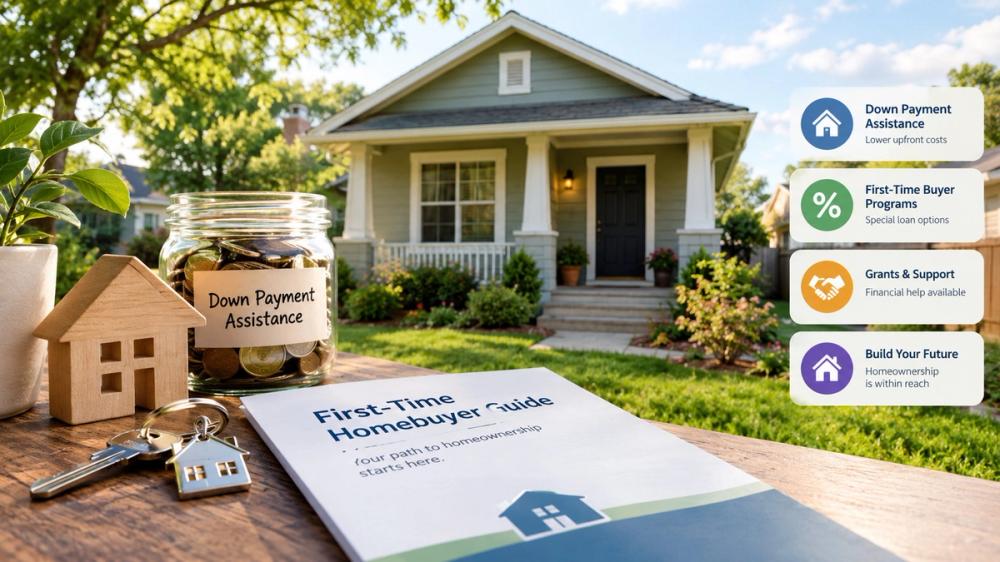
Ads for a free down payment still circulate, yet the help that remains is narrower and easier to use once you know the source. First-time homebuyer down payment help that still exists comes from state and local programs, plus loans that accept gifts, grants, and second mortgages. No single national grant waits for every buyer. The money is local, funded in cycles, and tied to income, price, occupancy, and an approved lender. Find an open program and match it to a loan that program will fund. A larger cash contribution can also change the rate and the chance of approval.
What down payment help still exists
Down payment assistance is cash toward the down payment and sometimes the closing costsThe fees and prepaid items due when a property sale or refinance completes — typically 2% to 5% of the loan amount for a buyer.. It may arrive as a grant, a deferred loan, a forgivable loan, or a low-rate second mortgage. A program name on a website does not prove that funds are open this month, because old pages often remain after a pause. Keep two products separate in your comparison. One product reduces the cash due at closing. The other lets you borrow with less of your own money. Fannie Mae HomeReady is the second kind and allows a down payment as low as 3 percent. USDA Section 502 can go further for eligible rural buyers.
Where first-time homebuyer down payment help still comes from
State housing finance agencies
Each state operates a housing finance agency for affordable home loans. That agency, not a federal grant desk, is the usual source of first-time buyer help. A typical package pairs a below-market first mortgage with a second lien or a grant. Income caps and price caps come from that state rather than from a national chart. The National Council of State Housing Agencies publishes a directory and does not run the programs. Start with that list and ask whether the current allocation is open.
Local and lender-delivered programs
Cities, counties, and nonprofits often stack a second layer onto a state loan. Some lenders offer assistance only through a participating originator. National roundups map the names and rarely show whether funding is live. Treat a published dollar amount as a lead rather than cash you can count on.
Loans that make a small down payment workable
Conventional help that accepts outside funds
HomeReady serves low-income buyers who have limited cash for closing. Fannie Mae allows a down payment as low as 3 percent and requires no minimum from the buyer's own funds. Gifts, grants, and Community Seconds can supply that cash. The aid works only when the first-mortgage investor accepts that grant or second lien. A larger down payment lowers the loan-to-value ratioThe size of a loan measured against the value of the property securing it — the number that drives mortgage insurance, rate, and approval.. A lower ratio can improve the rate offered and can change whether private mortgage insuranceInsurance that protects the lender when you put down less than 20%, added to your payment until you build enough equity. is required.
Government-backed loans with little or no down payment
An FHA loan insures an approved lender and is not a federal down payment grant. Qualifying standards are generally more flexible than the standards for many conventional loans. Any assistance still has to come from an allowed source and a lender willing to accept it. Confirm the current FHA minimum with HUD before you rely on a percentage from a lender blog.
USDA Section 502 Guaranteed financing works on a different rule. Rural Development provides a 90 percent loan note guarantee so approved lenders can make 100 percent loans to qualified buyers. Household income cannot exceed 115 percent of the area median. The home must be in an eligible rural area. The loan term is a 30-year fixed rate only.
Rules that decide whether you can use the help
Many assistance programs treat you as a first-time buyer if you had no ownership interest during the prior three years. Some programs also serve repeat buyers, so an earlier home does not automatically close the door. The filters that stop files are more concrete than the label. Household income, price caps, primary-residence use, an approved lender, and a required education course all decide the result. Read the second lien before you treat the aid as a gift. An early sale, move, or refinanceReplacing an existing loan with a new one, usually to lower the rate, change the term, or convert equity into cash. can trigger repayment of part or all of the help. Closing costs, moving costs, and immediate repairs can still be your bill. A loan with no down payment is not a closing with no cash.
How to find a program that is actually open
Begin with the state housing finance agency, then the city or county housing office, then a lender approved for that product. Compare at least three offers and include the assistance terms in that comparison. A cheap second lien beside an expensive first mortgage can cost more than a plain loan. Ignore lists that promise thousands of programs or a fixed grant with no named funder. Ask if funding is open, which loans qualify, and what happens if you sell early.
Frequently asked questions
Is there a federal grant that pays a first-time buyer's down payment? No universal federal grant pays that cash. Help runs through state agencies, local programs, and loans that accept outside funds.
Does FHA give you the down payment? FHA insures the loan rather than funding your cash to close. Assistance has to come from an allowed third party and a participating lender.
Can down payment assistance be free money? A grant or a forgivable loan can be free if you meet the occupancy and time rules. Often the help is a second loan you repay later.
Who counts as a first-time homebuyer? Many programs use a three-year lookback with no ownership interest. Some also serve people who already owned a home, so check that program's rule.
Does no down payment mean no cash at closing? Closing costs, reserves, and repairs can still be due even when the down payment itself is covered.
Down payment help still depends on local terms
First-time homebuyer down payment help that still exists is real, and it is not a national check. Confirm a funded state or local program. Match it to a loan that accepts that aid. Read the repayment trigger before you count on the money. This is general information, not a loan offer or advice for a specific buyer. Program rules, rates, and funding change over time. Confirm details with your state housing agency, an approved lender, or a HUD-approved housing counselor.