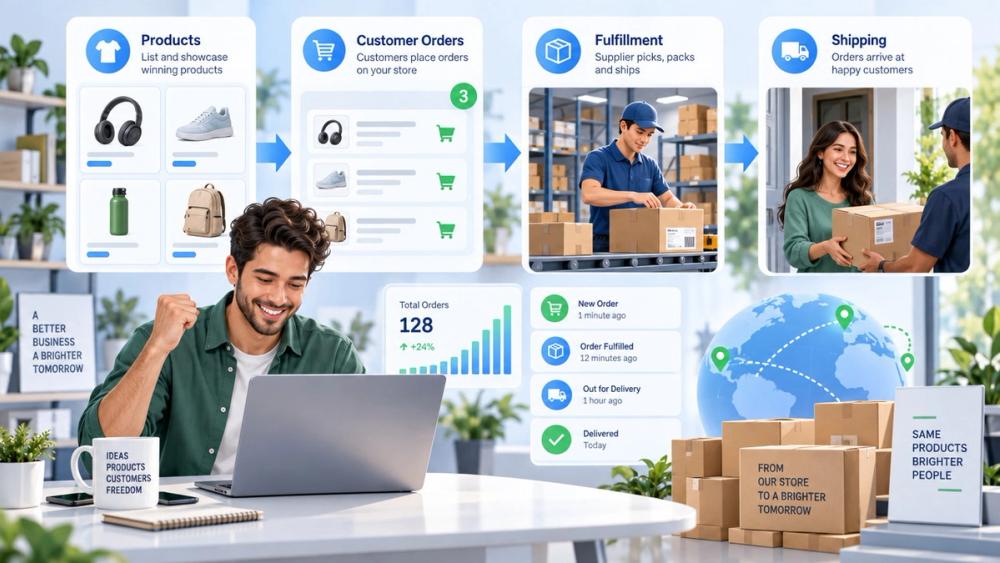
Dropshipping lets you sell products online without holding inventory. A customer places an order on your store, you pass it to a supplier, and the supplier ships directly to them. Your profit is the gap between what the customer paid and what the supplier charged you, minus fees and ads.
That model still works in 2026. It just works differently than the YouTube videos promise. Pure product-arbitrage stores struggle. The ones that last treat dropshipping more like running a small brand than hunting for the next viral gadget.
Here’s a practical sequence that gets you from idea to first sales without the usual hype.
Why Most New Dropshipping Stores Struggle
Margins look good on paper until you factor in ads, platform fees, payment processing, and returns. Net profit for stores that survive past the early months usually lands between 10 and 30 percent. Many never get there.
Supplier problems cause a big share of the failures. Late shipments, poor packaging, and weak communication destroy customer trust fast. Once reviews turn negative, paid traffic becomes expensive and organic growth stalls.
The old playbook of finding a “winning product,” throwing it on Shopify, and running Facebook ads no longer produces reliable results. Competition is higher and customer expectations around shipping speed and product quality have risen. Stores that treat the business like a real retail operation do better than those that treat it like a lottery ticket.
Choose a Niche Before You Choose Products
Start with a focused slice of a market, not a single product. “Home decor” is too broad. “Compact storage solutions for small apartments” is a niche. Narrow focus makes it easier to write copy that feels relevant and to build a coherent brand.
Look for steady search demand rather than short spikes. Check Google Trends for sustained interest. Scan Amazon best-seller lists and basic keyword tools for volume. Avoid categories where three dominant sellers already own the first page of results—acquisition costs will eat your margin.
Good niches still tend to solve a clear problem. Pet accessories, home-office gear, and specific fitness items continue to perform for many operators. The exact category matters less than whether you can explain the product’s benefit in one clear sentence.
Find and Vet Suppliers First
Most beginners pick products first and suppliers second. Reverse that order. Locate suppliers who already serve your niche reliably, then build your catalog from their range.
Order samples. This step costs money and time, but it reveals quality, packaging, and shipping speed before customers ever see the product. Test communication too. Slow replies during the sample stage usually mean slow replies when a customer has a problem.
Popular starting points include CJ Dropshipping, Spocket, and established agents who specialize in your category. Check tracking reliability, return handling, and whether the supplier can support your promised delivery windows. An 84 percent of retailers still rank finding a reliable supplier as their top challenge. Treat that step with the seriousness it deserves.
Build a Focused Store That Converts
Shopify remains the lowest-friction platform for most beginners. The Basic plan covers the essentials. Free themes exist, and you can launch a clean store without custom development.
Keep the initial catalog tight—five to ten products. Broad selections dilute testing and make advertising more expensive. Every product page needs original photos or high-quality supplier images, a clear benefit-focused description, honest shipping times, and a straightforward return policy.
Price for reality. A common floor is three times the supplier’s cost of goods. That leaves room for ads (often 30–40 percent of revenue), platform fees, and a target net margin. Underpricing to chase volume usually leads to losses once traffic costs appear.
Add basic trust elements early: contact information, a real about page, and clear policies. Customers notice when a store looks temporary.
Drive Traffic Without Burning the Budget
Organic short-form video still works. TikTok and Instagram Reels can generate sales with zero ad spend if the content shows the product solving a real problem. Create a handful of simple demo videos before you spend money on ads.
When you do test paid traffic, start small. One product. One channel. Clear rules for killing underperforming ads. Track click-through rate, add-to-cart rate, and cost per acquisition against your target margin. Scale only what already converts.
Many new stores fail by pouring budget into ads before the store itself is ready. Fix conversion first. Then buy traffic.
Treat It Like a Business
Register the business properly and set up clean bookkeeping from day one. Sales tax rules vary by location, so handle them early rather than scrambling later.
Customer service matters more than most beginners expect. Shipping delays and quality issues will happen. How you respond determines whether the customer leaves a public complaint or becomes a repeat buyer.
Review performance regularly. Kill weak products quickly. Double down on what shows profit. Refine branding and packaging over time if you want to move beyond pure dropshipping into private-label territory later.
Realistic timeline: most profitable stores take several months of consistent work before they stabilize. Treat the first 90 days as a testing period, not a judgment on whether the model works.
The sequence is straightforward. Pick a niche with real demand. Vet suppliers and order samples. Build a lean store with honest policies and proper pricing. Test traffic carefully. Manage the operation like a real retail business.
Dropshipping is not passive income. It rewards people who treat it as work. Get the fundamentals right and the model can still produce solid results.