
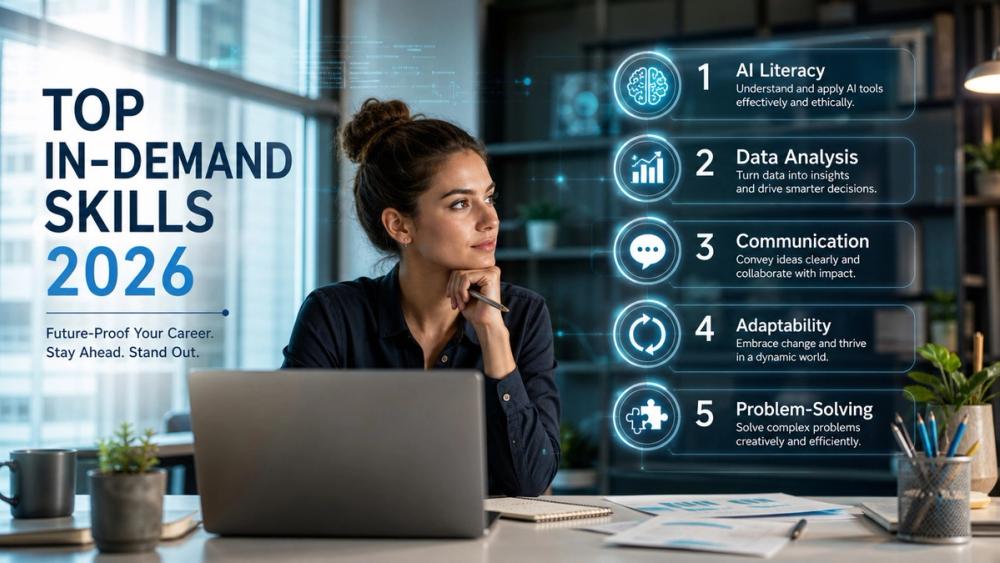
Employers in 2026 care less about degrees and more about what you can actually do. Job postings now list specific skills far more often than traditional credentials. Communication still leads the pack, showing up in roughly 23 percent of openings. AI skills sit close behind at nearly 20 percent. The gap between those two numbers tells the real story: technical tools matter, but only when paired with judgment that machines lack.
High-demand careers this year reward people who combine both. Here’s what the data and hiring patterns show.
AI Literacy Is Now Expected Across Most Roles
AI appears in almost one in five job postings analyzed through mid-2026. It ranks higher than Python, SQL, or cloud platforms. The request is rarely for pure researchers. Most employers want people who can pick the right tool, feed it useful context, check the output, and apply the result without handing over final decisions.
This demand reaches beyond engineering. Marketing teams, finance analysts, operations managers, and HR roles all list AI comfort. The edge goes to candidates who can point to concrete use: “Cut reporting time by 25 percent with X tool” or “Improved data cleaning accuracy by validating AI suggestions.” Short certifications help, but measurable results beat certificates alone.
Communication Remains the Single Most Requested Skill
Clear writing and speaking still top every major ranking. Employers need people who can turn complex results into language that non-specialists understand. AI generates more text and data than teams can process, so the ability to filter, summarize, and explain has grown more valuable, not less.
Strong communication shows up in project updates, client notes, cross-team handoffs, and even Slack threads. Portfolio samples, quantified stakeholder outcomes, or before-and-after process descriptions prove it better than generic claims on a resume.
Analytical Thinking and Critical Judgment
The World Economic Forum’s latest employer survey still ranks analytical thinking as the top core skill. Seven out of ten companies call it essential. In practice this means framing the right problem, spotting weak data, and knowing when an AI answer is incomplete or wrong.
Data-quality skills and “human-in-the-loop” validation are rising fast for the same reason. Anyone can generate a chart. Fewer people can explain why the numbers are reliable or what decision they support. Case studies, decision logs, or short analyses that changed a team’s direction give clear evidence of this ability.
Adaptability and the Habit of Learning
Resilience, flexibility, and curiosity rank among the fastest-growing skills expected through 2030. Many employers now say they will hire candidates who lack every technical requirement if those people show they can learn quickly. In a market where tools change every few months, that attitude carries real weight.
Recent courses completed, new tools adopted on the job, or role shifts with measurable results all signal adaptability. The people landing high-demand roles treat learning as ongoing work rather than a one-time event.
Collaboration, Leadership, and Getting Work Finished
Leadership and collaboration appear consistently in both technical and general postings. The version that matters most is often informal: coordinating hybrid teams, guiding work without formal authority, and keeping projects moving when priorities shift. Basic project-management habits still carry salary premiums across industries.
Evidence comes from timelines met, cross-functional outcomes delivered, or team results you can name. Titles matter less than the work that got done.
Technical Skills That Keep Appearing
A short list of durable hard skills continues to surface: Python, SQL, cloud platforms such as AWS or Azure, cybersecurity awareness, and practical automation. Not every role needs deep coding experience. Familiarity with data handling and secure practices is now common even in non-technical positions.
These skills create mobility and higher pay when combined with the human capabilities above. They function as anchors rather than the entire package.
Building and Proving These Skills
Focus on visible evidence. One solid project, a short public sample, or a clear metric beats a long list of tools. Pick one or two high-return skills and create proof points rather than trying to master everything at once. Free AI practice, basic data courses, and deliberate writing practice remain the lowest-cost starting points.
On resumes and in interviews, lead with results. Replace “proficient in AI tools” with the specific outcome those tools helped produce.
The careers growing fastest in 2026 reward people who treat AI and data as useful instruments while keeping human judgment, clear communication, and the ability to keep learning at the center. Choose one skill from this list, create one concrete proof point, and update how you present your work. That single step moves you further than most candidates will go.