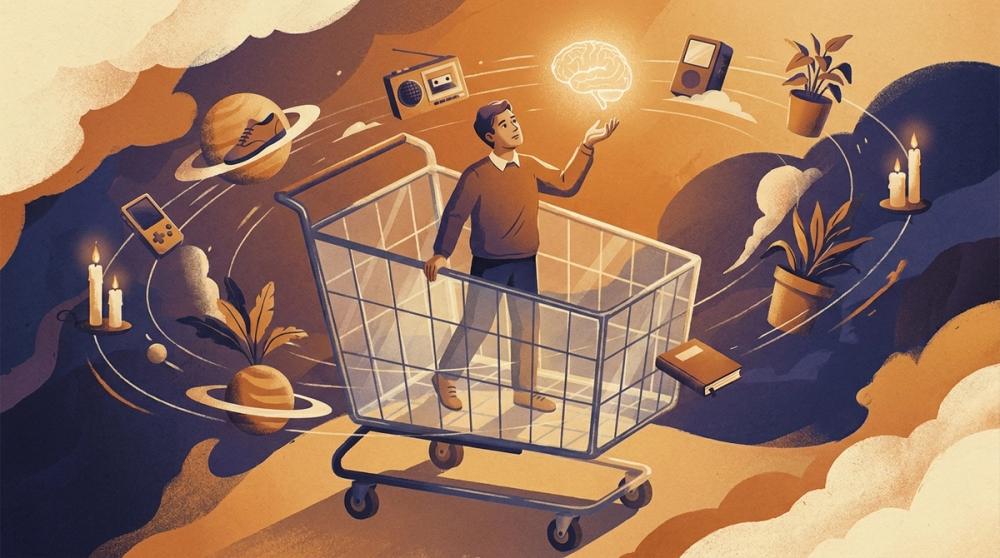
You know that moment when you're unpacking an online order and you think — why did I buy this?
Maybe it was late. Maybe you'd had a rough day. Maybe the checkout button was just... right there. Whatever the reason, the item is now in your hands and the mild regret is already setting in.
Here's the thing: that moment isn't a character flaw. It's neuroscience.
Your Brain Wasn't Built for a World of Infinite Choices
Our brains evolved in environments of scarcity. For most of human history, wanting more — food, resources, warmth — was survival. That wiring doesn't disappear just because we now live inside an economy designed to sell us things at every waking hour.
And then there's dopamine. We tend to think of it as the "pleasure chemical," but it's really more of an anticipation chemical. Your brain releases dopamine when you expect a reward, not necessarily when you receive it. That buzz you feel browsing a sale? That's dopamine. The slightly flat feeling when the package arrives? That's reality catching up.
Retail therapy is real in this sense — shopping genuinely does shift your mood. It's just that the shift is temporary and the credit card bill is not.
The Hidden Triggers Behind Every Impulse Purchase
So if it's not weakness driving your cart, what is it?
You're Not Buying the Product — You're Buying a Feeling
Emotional spending is probably the most common and least acknowledged driver of unnecessary purchases. Stress, boredom, loneliness, the vague restlessness of a Sunday afternoon — all of these create a low-level discomfort that the brain wants to resolve. Shopping feels like doing something. It feels like agency.
Think about the 11pm scroll-and-buy. You're not really shopping. You're self-soothing. The item you buy is almost irrelevant — it's the act of choosing, clicking, and imagining a slightly better version of your life that provides relief. At least until morning.
Social Proof and the FOMO Factor
"Trending now." "Bestseller." "Only 2 left in stock."
These aren't just marketing phrases. They're carefully engineered interruptions to your rational thinking. The fear of missing out is deeply social — we're wired to pay attention to what others are doing because, historically, that information kept us alive. Marketers didn't invent FOMO. They just learned to weaponize it.
And it's not just keeping up with neighbors anymore. It's keeping up with an algorithmically curated feed of people who all seem to have nicer kitchens, better skin, and a wardrobe that actually works together.
The Anchoring Effect (Or: Why "50% Off" Is a Trap)
Here's a simple question: Is a $200 jacket a good deal?
Depends entirely on what you put next to it. Next to a $500 jacket? Absolutely. In isolation? Maybe not. This is anchoring — our tendency to rely heavily on the first number we see when making decisions. The original price becomes the reference point and the "discounted" price feels like a win, even if you never needed the jacket at all.
There's also what psychologists call the licensing effect — the feeling that you've "earned" a treat after a stressful period. You had a brutal week. You deserve this. It's a perfectly human thought. It's also how a lot of unnecessary purchases get justified.
Marketers Know Your Brain Better Than You Do
The modern shopping experience isn't accidental. One-click purchasing, saved payment details, countdown timers, personalized recommendations — every friction point that might cause you to pause and reconsider has been deliberately engineered away. The easier it is to buy, the less time your rational brain has to weigh in.
Recommendation engines are particularly clever. They use your own preferences and history to present you with things you're statistically likely to want. It feels like the internet just gets you. Really, it's just very good math in the service of someone else's revenue.
How to Spend More Intentionally (Without Feeling Deprived)
Awareness helps — but it doesn't automatically change behavior. Here are a few things that actually do.
Wait 24 hours on non-essential purchases. The dopamine spike from wanting something fades fast. If you still want it tomorrow, that's a more reliable signal.
Ask: am I buying the thing or the feeling? If it's the feeling — can you get it another way? A walk, a call with a friend, an hour of actual rest?
Reduce environmental triggers. Unsubscribe from sale emails. Unfollow accounts that make you feel perpetually behind. The best purchase is the one you never got tempted to make.
Budgeting, when it works, isn't really about restriction. It's about deciding in advance what matters — so that in the moment, with the dopamine and the countdown timer and the "only 3 left," you already have an answer.
It's Not About Willpower. It's About Understanding the Game.
Our spending habits tell a story about us — our anxieties, our aspirations, the feelings we're trying to reach and the ones we're trying to escape. There's no shame in any of it. It makes us human.
The goal isn't to stop wanting things. It's to want the right things, on purpose — instead of just responding to whatever the algorithm decides to put in front of you next.
Next time you're standing at the checkout, real or virtual, and something's in your cart that wasn't there an hour ago — just pause for a second.
You know what's happening now. And that pause? That's the whole game.