
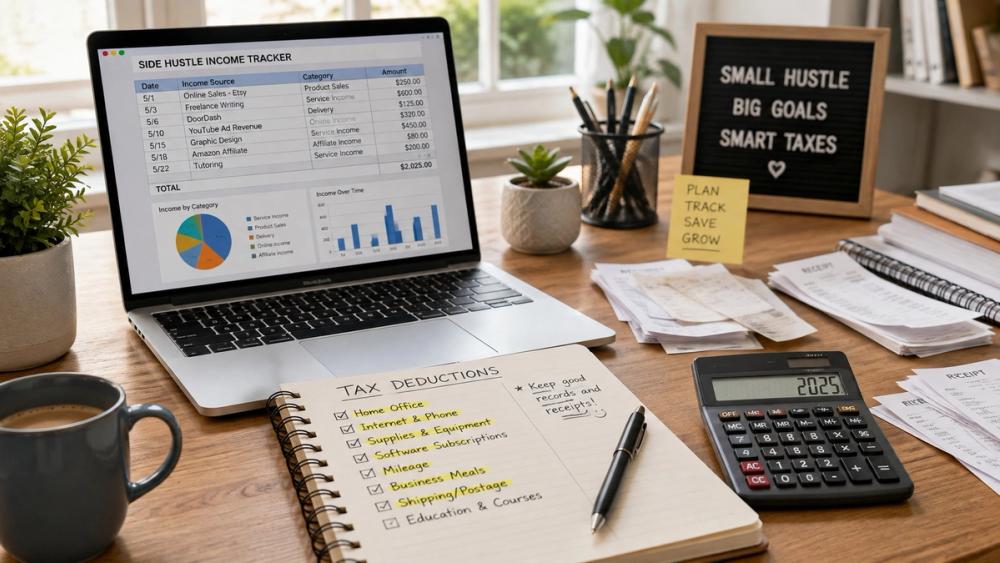
That first side-hustle payment feels great. Then tax season rolls around, and suddenly every deposit looks a little less exciting.
The good news is that legitimate business expenses can reduce your taxable side-hustle profit. The catch is that deductions aren’t secret loopholes or random purchases with “business” scribbled on top. They need a clear connection to the work you do, reasonable records, and a practical purpose.
For most independent workers, the missed deductions are not dramatic. They’re the recurring charges, short business trips, small processing fees, and home-office costs that never made it into a spreadsheet.
How Side Hustle Tax Deductions Reduce Your Taxable Income
A deduction lowers your net business profit. It does not return every dollar you spent.
Say your freelance design work brought in $10,000 during the year. You paid $1,800 for eligible software, web hosting, payment-processing fees, equipment supplies, and business mileage. Your profit before other tax calculations would be $8,200, not $10,000.
That distinction matters. Spending $1,000 simply to “write it off” is still spending $1,000. A tax deduction softens a real business cost. It does not make the cost disappear.
The IRS generally allows expenses that are both ordinary and necessary for your business. “Ordinary” means the expense is common or accepted in your line of work. “Necessary” means it is helpful and appropriate for running the business. It does not have to be indispensable, but it must be genuinely connected to earning income or operating the business.
You can review the IRS’s business expense guidance for the official framework.
Side Hustle Software and Subscription Deductions
Small monthly charges are easy to ignore. Over 12 months, though, they can add up fast.
A freelance writer may pay for grammar software, cloud storage, invoicing tools, a domain name, and a portfolio website. An online seller may use inventory software, listing tools, email marketing services, shipping platforms, and product-research subscriptions. A creator might pay for video-editing software, stock assets, a newsletter platform, or business-focused AI tools.
If these tools directly support your side hustle, they may qualify as business expenses.
Common Digital Expenses to Review
Look back through your card statements for charges related to:
- Website hosting and domain renewals
- Bookkeeping and invoicing software
- Scheduling and project-management apps
- Cloud storage and file-transfer services
- Graphic design and video-editing subscriptions
- Email marketing platforms
- E-commerce and marketplace tools
- Business research databases
- Paid templates, plugins, and digital assets
Mixed-use subscriptions need more care. If you use a service for both personal and business reasons, you generally should deduct only the business portion. A music streaming plan you play while working is not a business expense. A design platform used to make client graphics may be.
Save invoices and renewal notices as you go. Rebuilding a year of subscriptions from memory is exactly as fun as it sounds.
Payment Processing Fees and Marketplace Costs
Many side hustlers report the money they received but forget the money taken out before they received it.
Payment processors, online marketplaces, freelance platforms, and seller platforms often charge a fee on each sale. Those charges can include:
- Credit-card processing fees
- Platform commissions
- Marketplace seller fees
- Listing fees
- Transaction fees
- Currency-conversion charges tied to business sales
- Payout and transfer fees
For example, a seller may make a $100 sale through a marketplace and receive $87 after fees. If the seller reports the full $100 as income, the $13 in fees may be a deductible business cost.
But do not deduct the same fee twice. Some platforms report gross sales, while others present net payouts. Check the annual statement and make sure your bookkeeping method matches what you report.
The Home Office Deduction: Useful, but Not Automatic
The home office deduction gets plenty of attention because so many side hustles start from a spare room, a converted garage, or a small desk near the window.
But working from home does not automatically mean you qualify.
To claim a home office deduction, the space generally must be used regularly and exclusively for your business. “Regularly” means it is part of your normal work routine. “Exclusively” means the specific area is dedicated to business use.
What Usually Qualifies and What Usually Does Not
A spare bedroom used only for consulting calls, client work, bookkeeping, and product photography may qualify.
A dining table used for client invoices on Tuesday nights and family meals every other day generally does not meet the exclusive-use test.
That line can feel frustrating. Still, it is an important one. The IRS looks at how the space is actually used, not how much you wish it counted.
The IRS offers two main methods for calculating a qualifying home-office deduction:
- Simplified method: Uses a prescribed rate based on the square footage of the qualifying office space, subject to limits.
- Actual-expense method: Allows a business percentage of eligible home costs such as rent, utilities, insurance, mortgage interest, repairs, and depreciationThe decline in an asset's value over time from age and use — and, for businesses, the tax deduction that tracks it. where applicable.
Neither method wins in every situation. The simplified method may be easier. The actual-expense method may produce a larger deduction when home costs are significant and records are strong. Review IRS Publication 587 before choosing.
Internet and Phone Expenses for Side Hustlers
Your phone and internet connection may be essential to your business. That does not mean the whole bill belongs on your tax return.
If you use home internet for client calls, order management, research, content production, or remote work, you may be able to deduct the business-use portion. The same principle applies to a mobile phone used for customer communication, delivery navigation, work messages, or sales coordination.
The key word is portion.
Suppose you use your phone for client calls and order updates during the day, but you also use it personally for photos, messages, maps, and entertainment. Claiming 100% would be hard to support. A reasonable business-use percentage is more defensible.
Write down how you reached the percentage. Consistency beats perfection here. If you use a 40% business-use estimate, keep a note explaining why it reflects your real usage.
Business Mileage and Vehicle Costs Beginners Miss
For delivery drivers, mobile service providers, resellers, photographers, consultants, and freelancers who visit clients, mileage can become one of the more meaningful side hustle tax deductions.
Business driving may include trips to:
- Meet a client
- Pick up business supplies
- Deliver products
- Ship orders
- Attend a qualifying business event
- Travel between work locations
- Source inventory for resale
The IRS generally allows eligible taxpayers to use either the standard mileage method or actual vehicle expenses, depending on the situation and applicable rules. Mileage rates change, so avoid relying on an old social-media post. Check the current IRS standard mileage rates before filing.
Keep a Mileage Log While It Still Makes Sense
A useful mileage record includes:
- The date
- Where you drove
- The business purpose
- The number of miles
- Supporting receipts for related costs when relevant
A calendar entry saying “client meeting” can help support a trip. An app can also work. What matters is that the record is credible and created close to the time of travel.
And be careful with commuting. Driving from home to a regular work location is not automatically deductible. The details matter. The IRS explains the rules in Topic No. 510: Business Use of Car.
Business Travel and Meals: Where the Line Gets Blurry
Business travel can create legitimate deductions for transportation, lodging, baggage fees, and other necessary costs. Yet this category is also full of bad advice.
A personal trip does not become deductible because you answer emails from a hotel room. The business purpose must be real, documented, and central to the expense.
For qualifying travel, you may need to keep receipts, event confirmations, meeting schedules, client correspondence, and notes about the purpose of the trip.
Business meals can also qualify in certain situations. They are commonly subject to a 50% limitation, and they need a clear business connection. A meal with a client or prospective customer may qualify when you discuss business. Lunch with a friend does not become deductible because you briefly complain about your side hustle.
For the details, see IRS Publication 463, which covers travel, gifts, and car expenses.
Education, Courses, and Training Expenses
Many beginners hesitate to deduct training because they worry every course looks personal. The truth is more nuanced.
Education may qualify when it maintains or improves skills used in your existing side hustle. A freelance photographer taking an advanced editing course may have a stronger case than someone buying a course to enter a completely unrelated profession.
Potentially relevant expenses include:
- Continuing education
- Industry certifications
- Skill-specific workshops
- Business training connected to current work
- Trade publications and professional resources
The course must connect to the business you already operate. Buying a class because it is interesting is not enough. Neither is training that qualifies you for a new trade or business.
Equipment, Supplies, and Bigger Purchases
Side hustles often require physical tools: laptops, cameras, microphones, lighting, printers, packaging materials, tools, or production equipment.
Small supplies used up during the year are often straightforward. Larger items that last several years can require more analysis. Depending on the item, its cost, and its business use, you may need to depreciate it or use another permitted method to expense it.
The point is not to memorize every depreciation rule. The point is to avoid assuming that every large purchase works like a simple office-supply receipt.
Before claiming equipment, ask:
- Is it used in the business?
- Is it partly personal?
- Can I document the business-use percentage?
- Will it last longer than a year?
- Do I have the receipt and purchase date?
A laptop used 80% for client work and 20% for personal use needs a more careful approach than a label printer used only for customer shipments.
Inventory and Cost of Goods Sold for Online Sellers
If you sell physical products, inventory deserves special attention.
Buying products for resale is not always the same as claiming an immediate operating expense. Inventory may be accounted for through cost of goods sold, which considers beginning inventory, purchases, materials, and ending inventory.
Here’s why that matters: if you spend $2,000 on merchandise in December but still hold most of it at year-end, you may not deduct the full $2,000 in the same way you would deduct a monthly software subscription.
Track what you buy, what you sell, what remains, and what each item cost. This becomes especially important for resellers, handmade-product businesses, print-on-demand operators, and e-commerce sellers.
Self-Employed Health Insurance and Retirement Planning
Some side hustlers qualify for a self-employed health insurance deduction. Eligibility depends on the business structure, insurance coverage, profit, and access to employer-sponsored plans. This is not a deduction to claim casually.
The same goes for retirement contributions. A profitable side hustle may make options such as a SEP IRA or solo 401(k)An employer-sponsored retirement account that lets you invest part of your paycheck before taxes, often with a matching contribution. worth exploring. The right choice depends on income, contribution deadlines, other employment, and existing retirement coverage.
These are planning decisions, not just tax-form boxes. Review the IRS Self-Employed Individuals Tax Center and consider professional advice before making major moves.
Tax Deductions to Avoid Claiming
The internet loves the phrase “write it off.” It often skips the part where a deduction must survive basic scrutiny.
Be cautious with:
- Everyday clothing that can also be worn normally
- Personal groceries and household purchases
- Vacations with a few work emails mixed in
- Traffic tickets and fines
- Personal entertainment
- Entire phone or internet bills without a business-use calculation
- Personal expenses that only loosely relate to your work
A deduction should make sense before you put it in your accounting software. If you would struggle to explain why the cost helped run your business, pause.
Build a Recordkeeping System Before Filing Season
The easiest way to find overlooked side hustle tax deductions is to stop relying on memory.
Set up a simple monthly routine:
- Use a separate business card or bank account when practical.
- Categorize transactions once a week or once a month.
- Save receipts digitally.
- Log mileage immediately.
- Reconcile platform sales and fees.
- Review profit every quarter.
- Keep notes for mixed-use expenses.
Bank statements are useful, but they rarely explain the business purpose of a charge. A receipt, invoice, calendar event, mileage log, or short note can make the difference between a clear deduction and a questionable one.
The IRS provides more detail in its recordkeeping guidance.