
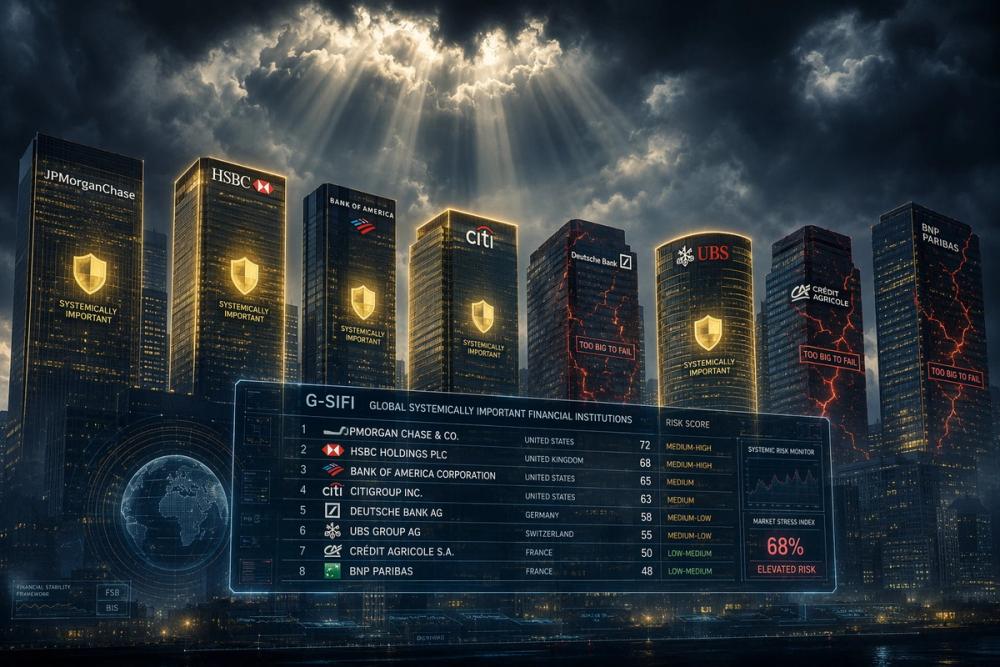
Every year, a small group of banks receives a label that sounds like both a warning and a badge: too big to fail. In 2026, that group holds steady at 29 banks. These are the institutions regulators consider so large and so tangled into the global economy that their collapse could drag everyone down with them.
This guide walks through the complete G-SIFI list for 2026, explains who draws it up, and shows what the label actually means for these banks — and for you.
What "Too Big to Fail" Really Means in 2026
The phrase took hold during the 2008 financial crisis. When giant banks teetered, governments faced an ugly choice: spend public money to rescue them or watch the wider economy implode. That trap has a name — moral hazard. If a bank knows it will be saved, it has less reason to behave carefully.
Regulators responded by turning a vague fear into a formal system. Instead of guessing which banks were dangerous, they built a scoring method to identify them and attached strict rules to the result. Being "too big to fail" in 2026 is no longer an insult. It is an official designation with real obligations.
G-SIFI vs. G-SIB: The Difference That Trips People Up
You will see both terms online. G-SIFI stands for Global Systemically Important Financial Institution, the broad umbrella covering any institution big enough to threaten the system. The list published every year, though, is technically the G-SIB list — Global Systemically Important Banks. For everyday purposes the two point at the same group of megabanks. Still, knowing the distinction helps you read the official sources correctly.
Who Decides the Too Big to Fail List?
Two organizations run the process. The Financial Stability Board (FSB) publishes the updated list each November, while the Basel Committee on Banking Supervision designs the method behind it. The current list came out on 27 November 2025 using end-2024 data and sets the rules that apply through 2026.
The scoring examines five things: a bank's size, how connected it is to other institutions, how hard it would be to replace, how complex its operations are, and how much business it does across borders. Banks that score high land on the list.
How the Bucket System Works
The list does not treat every bank equally. Each one is sorted into a "bucket," numbered 1 through 5. The higher the bucket, the more systemically important the bank — and the larger the cushion of extra capital it must hold. Think of it as a risk ladder, where the banks at the top carry the heaviest requirements.
The Complete 2026 G-SIFI List: All 29 Banks
The roster is unchanged from the previous year. No banks were added and none dropped off. JPMorgan Chase again sits at the very top as the single most systemically important bank in the world.
Here are the 29 systemically important banks, grouped by home country:
- United States (8): JPMorgan Chase, Bank of America, Citigroup, Wells Fargo, Goldman Sachs, Morgan Stanley, Bank of New York Mellon, State Street
- China (4): ICBC, Bank of China, China Construction Bank, Agricultural Bank of China
- France (4): BNP Paribas, Groupe Crédit Agricole, Groupe BPCE, Société Générale
- United Kingdom (3): HSBC, Barclays, Standard Chartered
- Japan (3): MUFG, Mizuho, Sumitomo Mitsui
- Canada (2): Royal Bank of Canada, Toronto-Dominion
- Others (5): UBS (Switzerland), Deutsche Bank (Germany), Santander (Spain), UniCredit (Italy), ING (Netherlands)
What Changed for 2026
Three banks shifted position. Bank of America and Industrial and Commercial Bank of China (ICBC) both moved up to a higher bucket, which means regulators now see them as slightly more critical and expect them to hold more capital. Deutsche Bank moved down to a lower bucket. These changes mostly reflect shifts in how complex each bank's business has become rather than any sudden crisis.
What the "Too Big to Fail" Label Requires
The designation is a burden, not a perk. Banks on the G-SIFI list face four main obligations:
- Higher capital buffers. They must hold extra reserves as a shock absorber. The requirements set by the 2025 list take full effect on 1 January 2027.
- Loss-absorbing capacity (TLAC). They keep additional funds that can absorb losses without a taxpayer bailout.
- Resolvability. Each bank prepares a "living will" — a plan for winding itself down cleanly if it fails.
- Tighter supervision. Regulators watch their risk management and internal controls far more closely than they watch smaller banks.
What the G-SIFI List Means for You
Here is the part that matters most. Landing on this list does not mean a bank cannot fail. It means the bank is watched more closely than almost any other business on earth. The label describes scrutiny, not a guarantee.
The point deserves emphasis. In 2023, Credit Suisse — a bank on this very list — collapsed and had to be rescued through an emergency takeover by UBS. Being systemically important did not make it invincible.
For ordinary savers, the real protection is deposit insuranceFederal backing that protects deposits up to $250,000 per depositor, per institution, per ownership category., such as FDIC coverage in the United States, which is separate from this list entirely. The G-SIFI framework protects the system as a whole. Deposit insurance protects your individual account.
The Bottom Line on Too Big to Fail Banks in 2026
The list of too big to fail banks in 2026 holds 29 names, each carrying tougher rules designed to make a giant's failure survivable. The goal is not to promise these banks will never stumble. It is to make sure that if one does, the damage stays contained. The next update arrives in November 2026.
Frequently Asked Questions
How many too big to fail banks are there in 2026?
There are 29 banks on the 2026 G-SIFI (G-SIB) list, unchanged from the previous year.
Is my bank too big to fail?
Only the 29 global banks named above hold the designation. Most regional and local banks are not on the list, though many are still covered by national deposit insurance.
What's the difference between a G-SIB and a G-SIFI?
G-SIB refers specifically to systemically important banks. G-SIFI is the wider term covering all systemically important financial institutions. The annual list is the G-SIB list.
Can a too big to fail bank still collapse?
Yes. The 2023 failure of Credit Suisse showed that even a listed bank can fail. The rules aim to make such a failure manageable, not impossible.