
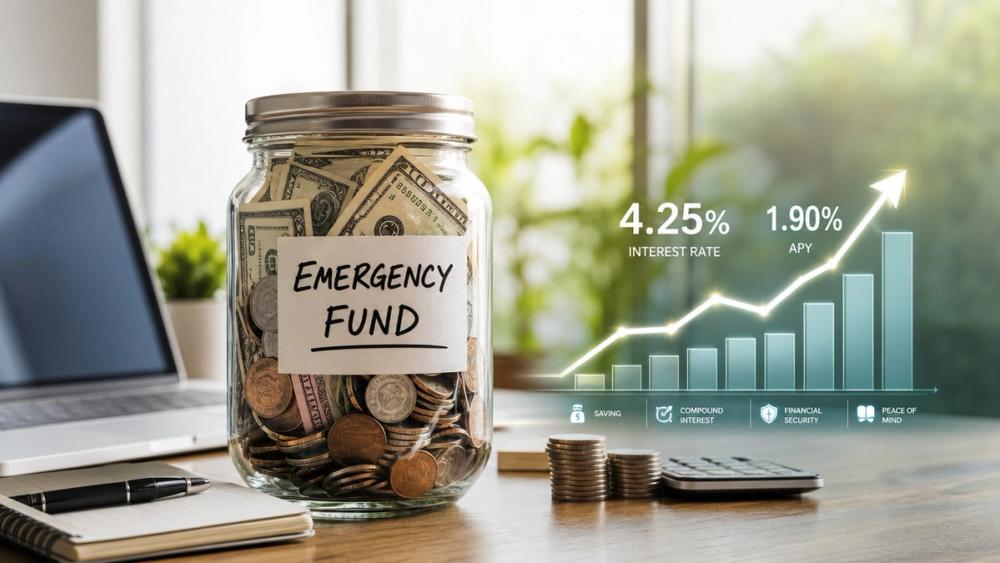
An emergency fundCash set aside in an accessible account to cover unexpected expenses or a loss of income without taking on debt. only works if the money is there when you need it. That means it has to stay safe and reachable on short notice. At the same time, parking it in a near-zero interest account lets inflationThe general rise in prices over time, which steadily reduces what each dollar of savings can buy. quietly eat the balance. The goal is straightforward: earn a competitive return without giving up access or principal protection.
Most people still keep their emergency cash in traditional savings or checking accounts that pay almost nothing. Online high-yield savings accountsA federally insured savings account paying a much higher rate than a typical bank account, with full access to your money. change that equation. They currently offer rates several times higher than the national average while keeping the same federal insurance and easy transfers. For the average household, that combination delivers the best realistic growth available.
What Actually Matters in an Emergency Fund Account
Three requirements sit above pure yield. First, the account must carry FDICFederal backing that protects deposits up to $250,000 per depositor, per institution, per ownership category. or NCUA insurance so the money cannot disappear if the bank fails. Second, you need to move funds to checking within a day or two without penalties. Third, the rate should at least keep pace with inflation and preferably exceed it.
Fail any of those tests and the account is the wrong home for emergency cash, no matter how attractive the advertised return looks.
High-Yield Savings Accounts Remain the Strongest Default
Online high-yield savings accounts currently sit at the top of the list for most people. Top rates in mid-2026 fall in the 3.75% to 4.00% APYThe yearly return on savings including the effect of compounding, which makes it the honest number for comparing deposit accounts. range. Some accounts push a bit higher if you meet conditions such as direct deposit. Compare that with the FDIC national average for traditional savings accounts, which still hovers near 0.40%.
These accounts carry the standard $250,000 FDIC insurance per depositor, per bank. Most charge no monthly fees and require little or no minimum balance. Transfers to a linked checking account usually clear the next business day. You can withdraw as needed without early-withdrawal penalties.
When you shop, focus on consistent rates rather than short promotional offers. Look for zero fees, straightforward online transfers, and clear FDIC coverage. Accounts from institutions such as Bread Savings, LendingClub, Synchrony, Marcus by Goldman Sachs, and SoFi frequently rank near the top. Rates shift, so check the current APY before you open anything.
A $15,000 emergency fund earning 4% produces roughly $600 a year. The same balance in a traditional savings account might earn $60. Over time the difference compounds and helps the fund hold its purchasing power.
Money Market Accounts as a Close Alternative
Money market accountsA federally insured bank account that pays savings-level interest while offering check-writing or debit access. work like high-yield savings but often add limited check-writing or debit-card access. Yields track closely with the best savings accounts, typically landing between 3.50% and 3.90% right now. They carry the same FDIC or NCUA protection.
Some banks set higher minimum balances to waive monthly fees. If you already maintain a larger emergency fund and like the option to write a check or use a debit card directly from the reserve, a money market account can make sense. For pure simplicity and rate, a high-yield savings account still edges ahead for most people.
Two Secondary Options for Larger Balances
Brokerage money market funds offer another solid route. Government or Treasury money market funds at firms such as Fidelity or Vanguard often yield close to or slightly above top high-yield savings rates. They settle quickly and sit under SIPC protection rather than FDIC. If you already keep investments at the same brokerage, consolidating the emergency cash there can simplify tracking.
Short-term Treasury billsShort-term US government debt sold at a discount to face value, maturing in a year or less and backed by the Treasury. provide a modest edge for larger funds or residents of high-tax states. Interest on T-bills is exempt from state and local income tax. Four-week to 26-week bills currently yield in the mid-to-high 3% range. A simple ladder of staggered maturities keeps a portion of the cash coming due every few weeks. This approach works best for the portion of the fund beyond the first one or two months of expenses, because selling early or waiting for maturity adds a small layer of friction.
Places That Fail the Test
Stocks and stock funds can drop sharply at the exact moment an emergency hits. Regular certificates of depositA deposit account that locks your money in for a fixed term at a fixed rate, with a penalty for taking it out early. often carry early-withdrawal penalties that wipe out months of interest. Traditional savings and checking accounts at large banks pay rates so low the fund loses ground to inflation. Cash kept at home earns nothing and carries theft or loss risk. Long-term bonds or I-bonds with lock-up periods reduce the accessibility that defines an emergency fund.
How to Put the Money to Work
Start by calculating three to six months of essential living expenses. That figure becomes your target balance. Open a high-yield savings account that meets the criteria above and link it to your everyday checking account. Test a small transfer in both directions so you know the process works.
Automate a monthly transfer until the fund reaches the target. Once funded, leave the money alone except for genuine emergencies. Redirect any additional savings into longer-term investments. Review the rate once or twice a year. If your bank falls behind the leaders, moving the balance is usually simple.
The Practical Ceiling on Growth
True maximum growth would mean stocks or higher-risk assets. That approach undercuts the entire purpose of an emergency fund. The accounts outlined here deliver the highest return still compatible with safety and rapid access. For most households a top high-yield savings account currently provides the cleanest mix of those three goals. Larger balances or high-tax-state residents can layer in money market funds or short-term Treasuries for a bit more yield without sacrificing the core requirements.
Your emergency fund should grow quietly in the background. Choose an account that lets it do exactly that.