
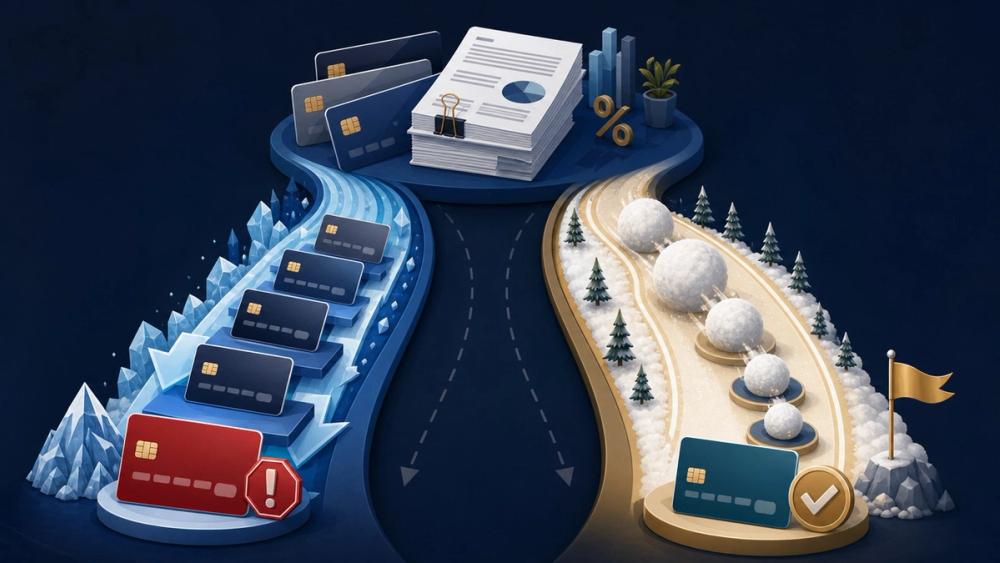
Debt can feel like a row of leaking buckets. You keep pouring money in each month, yet the total barely seems to move. The debt avalancheA payoff strategy that attacks your highest-interest debt first, which costs the least in total interest. and debt snowball methods give that money a clear job: make every minimum payment, then concentrate every remaining dollar on one balance.
Both approaches can get you out of debt. But if you can follow either plan consistently, the debt avalanche usually clears debt faster and costs less because it attacks the highest-interest debt first.
Debt Avalanche vs. Debt Snowball: The Essential Difference
The two methods differ only in how they choose the first target debt. Everything else stays the same. You continue making at least the required minimum payment on every account, avoid adding new debt when possible, and roll each paid-off payment into the next balance.
With a debt avalanche, you rank debts by annual percentage rateThe yearly cost of borrowing, expressed as a percentage that includes the interest rate plus most lender fees., or APR. The highest APR goes first. With a debt snowballA payoff strategy that clears your smallest balance first, using early wins to build momentum regardless of interest rate., you rank debts by balance. The smallest amount owed goes first.
That distinction looks minor on paper. In practice, it changes how much interest you pay and how quickly you see a zero balance.
How the Debt Avalanche Method Works
The debt avalanche method puts interest ratesThe percentage charged for borrowing money or paid for depositing it, quoted as an annual figure. in charge. List every debt from the highest APR to the lowest. Pay the minimum due on all accounts, then send every extra dollar to the debt at the top of the list.
Suppose you have a credit card charging 29.99% APR, another at 18.99%, and a personal loan at 10.99%. The 29.99% card becomes your first target even if it does not have the smallest balance.
Once it is paid off, take the payment you were making on that card and add it to the minimum payment on the next-highest-rate debt. This is the “avalanche” effect. Your payment power grows as each account disappears.
The method works because high-interest balances are expensive to carry. Interest keeps accumulating while a balance remains unpaid. Reducing the costliest debt first means more of your future payments can go toward the money you actually borrowed.
How the Debt Snowball Method Works
The debt snowball method puts quick wins in charge. List debts from the smallest balance to the largest, regardless of interest rate. Continue making minimum payments on all accounts and direct extra money to the smallest balance.
For example, you might have:
- A $900 credit card balance at 18.99% APR
- A $2,000 credit card balance at 29.99% APR
- A $4,000 personal loan balance at 10.99% APR
The $900 card gets paid first under the snowball method. When it is gone, you add that old payment to the next-smallest balance.
It is not the cheapest route in every case. But it offers something that spreadsheets cannot measure perfectly: momentum. Closing an account quickly can make a long debt payoff plan feel real. For someone who has started and stopped several budgets, that early progress may matter more than a mathematically optimal order.
Which Clears Debt Faster: Debt Avalanche or Debt Snowball?
The answer is straightforward: the debt avalanche typically clears debt faster when you pay the same total amount each month.
Here is why. Interest is the price you pay for carrying debt. A balance at 29.99% APR grows more aggressively than one at 10.99% APR. When you direct extra money to the highest APR, you cut off the most expensive source of future interest first.
Less interest means more of your payment reaches principal. As principal falls, interest charges shrink. And then the payoff pace improves further.
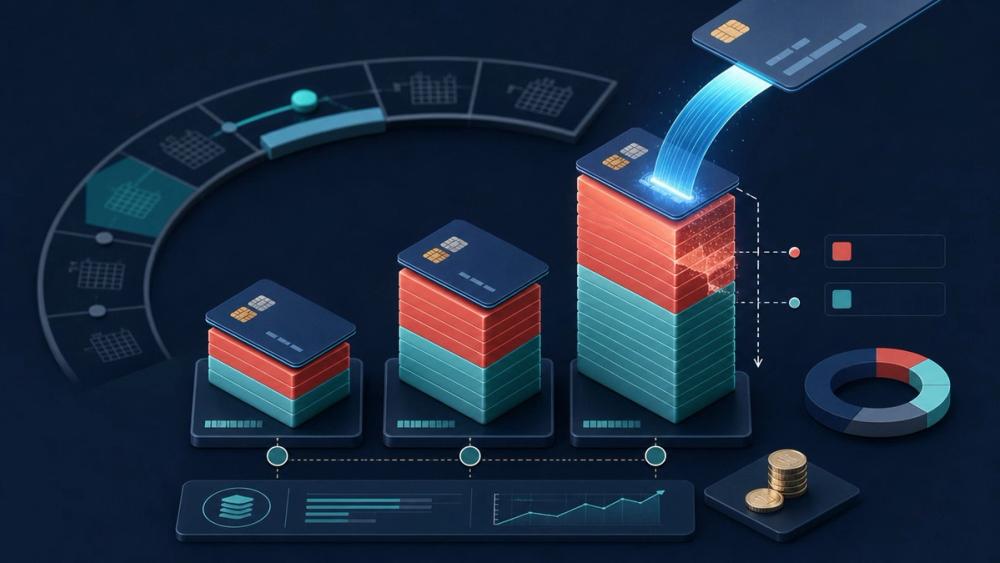
The debt snowball can take longer because it may leave a large, high-rate balance untouched while you pay smaller debts with lower rates. That delay can create additional interest charges, especially with credit card debt.
Still, “faster” depends on more than a calculator. A debt avalanche plan that you abandon after two months is not faster than a snowball plan you follow until every balance reaches zero.
A Simple Debt Avalanche vs. Debt Snowball Example
Imagine you have the three debts listed above and can contribute an extra $300 per month beyond your required minimum payments.
Under the debt avalanche, the $2,000 card at 29.99% receives the extra $300 first. Under the debt snowball, the $900 card at 18.99% gets that money first.
The snowball may eliminate the $900 balance quickly. That is satisfying, and it reduces the number of bills you must manage. But the 29.99% balance continues generating higher interest in the background.
The avalanche delays that first payoff milestone, yet it sends your extra cash where it has the greatest financial impact. If your payment amount, income, and spending stay the same, this approach generally produces lower interest costs and an earlier final payoff date.
The difference becomes more pronounced when one debt carries a very high APR. If all your interest rates are close together, the savings from the avalanche may be modest. In that situation, motivation may reasonably become the deciding factor.
When the Debt Avalanche Method Makes the Most Sense
Choose the debt avalanche if your main goal is to reduce interest costs and become debt-free as soon as possible. It is especially useful when you carry high-interest credit cards, retail cards, or other revolving balances.
The method suits people who can stay focused on a larger target without immediate account closures. You may not get a quick win in the first month. But you can track another form of progress: falling interest charges and a larger share of every payment reducing principal.
Debt avalanche works well when you have:
- A large gap between your highest and lowest interest rates
- Steady income and a predictable amount for extra payments
- A clear monthly budget
- Enough motivation to stick with a long-term financial plan
- High-interest credit card debt that needs urgent attention
Before ranking debts, bring any past-due account current if possible. Late payments can trigger fees, harm your credit, and sometimes cause a penalty interest rate. A debt strategy should never come at the cost of missed minimum payments.
When the Debt Snowball Method May Be Better
Choose the debt snowball if debt has become emotionally exhausting or administratively messy. It is often easier to stay engaged when you can cross a balance off your list in a few weeks or months.
Maybe you have four store cards with small balances, a medical payment plan, and one larger credit card. Keeping track of all those due dates can feel like spinning plates. Clearing the smallest debt first can simplify your month and free one minimum payment for the next target.
The snowball method can be a strong fit when you:
- Have several small balances
- Need quick evidence that your plan is working
- Have struggled to maintain a previous repayment strategy
- Feel overwhelmed by the number of accounts
- Face relatively similar APRs across your debts
The trade-off is real. You may pay more interest than with the avalanche method. But a plan you complete is worth far more than a perfect plan that stays in a spreadsheet.
Can You Combine Debt Avalanche and Debt Snowball?
Yes, though you should give the hybrid method firm rules. Otherwise, it becomes a monthly excuse to chase whichever payment feels easiest.
One practical hybrid approach is to eliminate a tiny balance that you can clear almost immediately. Then switch to the highest APR and follow the debt avalanche until the rest of your debt is gone.
This can work if clearing the small balance removes a required monthly payment or gives you enough momentum to commit fully. It makes less sense if you repeatedly delay a credit card with a punishing interest rate.
Think of it as a short warm-up, not a permanent detour.
Build a Debt Payoff Plan That Holds Up
Your chosen method matters, but your system matters more. Start by listing each debt’s balance, APR, minimum payment, due date, and any promotional interest-rate deadline. A 0% APR offer may affect your repayment order, particularly if the promotional period ends soon. Read the terms closely, though. Some offers use deferred interest, which can add retroactive interest if you do not pay the balance in full by the deadline.
Next, decide how much extra money you can send to debt every month. Be realistic. A plan that requires you to skip groceries, medicine, or every unexpected expense will probably collapse.
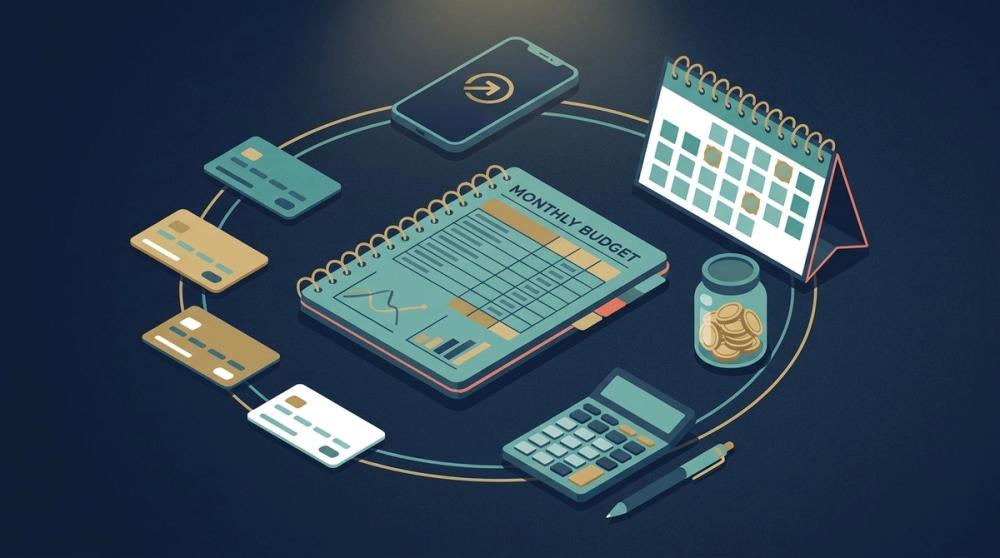
Set up automatic minimum payments where possible. Then schedule your extra payment for the chosen target debt. Review the plan monthly, especially after a change in income, expenses, or interest rates.
And keep a small emergency buffer if you can. Without one, a car repair or medical bill can send you back to the credit card you were trying to pay off.
The Better Choice
If you want the fastest and least expensive route, choose the debt avalanche. It targets the highest interest rate first, which usually reduces total interest and shortens the payoff timeline.
If you need visible momentum to stay committed, the debt snowball may be the better practical choice. It trades some mathematical efficiency for fast early wins.
Pick one method, automate the essentials, and keep the extra payment moving forward. That is how debt stops feeling like a permanent weight and starts becoming a number with an end date.