
Housing is the expense that quietly bullies most budgets.
You can meal prep, cancel subscriptions, and stop buying $7 lattes. Fine. That helps a little. But if rent or a mortgage eats 30% to 40% of your income every month, the real leverage sits in one place: where you live.
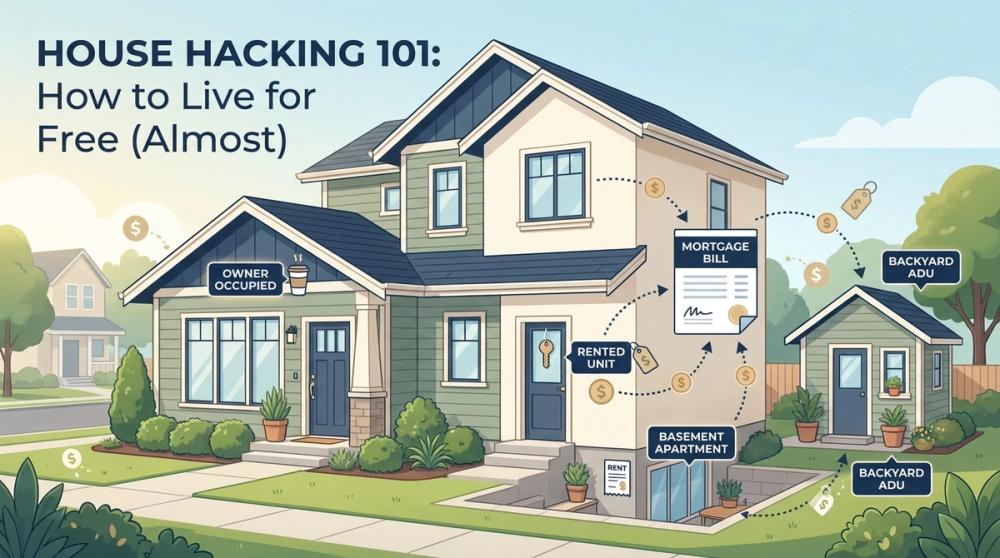
That’s where house hacking comes in. At its simplest, house hacking means you live in a property while someone else helps pay for it. Maybe you buy a duplex and rent the other unit. Maybe you rent out two spare bedrooms. Maybe you build an accessory dwelling unit behind the house. The goal is not to become rich overnight. The goal is better: reduce your housing cost so dramatically that your monthly budget finally has room to breathe.
And yes, the “almost” matters. Roofs leak. Tenants move out. Insurance premiums rise. Still, when done carefully, house hacking can turn your home from a pure expense into a wealth-building machine.
What Is House Hacking?
House hacking 101 starts with a simple idea: use your primary residence to generate income.
Instead of buying a home only for yourself, you buy or use a property in a way that creates rental income. You might live in one unit of a small multifamily property. You might rent spare rooms in a single-family home. You might convert a basement into a legal apartment.
The strategy works because you need housing anyway. If a tenant, roommate, or guest can cover part of your mortgage, taxes, insurance, utilities, or maintenance, your real cost of living drops.
For example, imagine your total monthly housing cost is $2,800. If a tenant pays $1,900 in rent, your effective housing cost falls to $900. That may not sound like “free living” in a flashy social media way. But compared with paying $2,000 for an apartment across town, it’s a serious financial win.
Why House Hacking Works
House hacking works because it attacks the biggest line item in most household budgets.
Cutting small expenses can help, but there’s only so much juice in that lemon. Reducing housing costs by $800, $1,500, or even $2,500 per month changes your financial trajectory. That money can go toward debt payoff, emergency savingsCash set aside in an accessible account to cover unexpected expenses or a loss of income without taking on debt., retirement accounts, or a future investment property.
There’s another layer too. When you own the property, you may also build equity as the loan gets paid down. Over time, you can benefit from appreciation if the property rises in value. Nothing is guaranteed, of course. Real estate markets move in cycles. But house hacking gives you three potential benefits at once: shelter, income, and long-term ownership.
That’s why many first-time real estate investors start here. It feels less abstract than buying a rental property across town. You live inside the asset. You see how it works, sometimes very literally when the upstairs sink starts dripping at 9 p.m.
The Best House Hacking Strategies
Multifamily House Hacking
The classic version of house hacking involves buying a duplex, triplex, or fourplex. You live in one unit and rent out the others.
This model gives you more privacy than renting bedrooms inside your home. Your tenant has a separate entrance, kitchen, bathroom, and living space. That separation can make the landlord-tenant relationship feel cleaner.
The tradeoff? Small multifamily properties often cost more than single-family homes. You also need to understand rents, vacancies, insurance, repairs, and local landlord rules. Still, for many buyers, this is the cleanest version of living for free almost.
Room Rental House Hacking
The simplest house hack is renting out extra bedrooms.
You buy a three-bedroom house, live in one room, and rent the other two. This can work especially well in college towns, expensive cities, and areas with strong job markets. It usually requires less money upfront than buying a multifamily property.
But privacy takes a hit. Shared kitchens, bathrooms, laundry, and parking can create tension. Clear written rules matter. So does screening. A bad roommate is not just a tenant problem. It’s a Tuesday morning problem while you’re trying to make coffee.
ADU and Basement Apartment House Hacking
An accessory dwelling unit, or ADU, can be a backyard cottage, garage apartment, basement suite, or separate living area attached to the home.
ADUs can create strong rental income while preserving personal space. They’re especially powerful in high-cost housing markets. But they come with serious due diligence. You need to check zoning, permits, construction costs, utility access, parking rules, and rental regulations.
For further reading, the U.S. Department of Housing and Urban Development offers helpful housing resources, and many local planning departments publish ADU-specific rules online.
How to Run the Numbers
House hacking fails when people fall in love with the idea before doing the math.
Start with your full monthly cost:
- Mortgage principal and interest
- Property taxes
- Homeowners insurance
- Mortgage insurance if applicable
- Utilities
- Maintenance reserves
- Vacancy reserves
- Repairs and capital expenses
Then subtract realistic rental income.
Not hopeful rent. Not “my cousin said this neighborhood is hot” rent. Real rent based on current listings, local property managers, and comparable units.
A conservative example might look like this: your monthly property cost is $3,000. You rent two rooms for $900 each. That gives you $1,800 in income. Your net housing cost becomes $1,200 before unexpected repairs.
That’s not free. But it may beat your current rent by a mile.
Financing a House Hack
One major advantage of house hacking is owner-occupied financing.
Because you plan to live in the property, you may qualify for loan programs with lower down payments than traditional investment loans. Options can include conventional owner-occupied mortgages, FHA loans, VA loans for eligible borrowers, and renovation loans. FHA information is available through HUD’s FHA loan resources.
Some lenders may count a portion of projected rental income when evaluating a small multifamily property. Rules vary, so speak with a mortgage professional who understands house hacking.
And remember this: loan approval does not mean the deal is good. A lender asks whether you can repay the loan. You still need to ask whether the property actually makes sense.
Risks You Should Take Seriously
House hacking is powerful, but it’s not cute little passive income wrapped in a bow.
You may deal with late rent, broken appliances, personality clashes, vacancies, and local regulations. If you use short-term rentals, you also step into hospitality work: cleaning, guest messages, reviews, pricing, and city rules.
Tenant screening matters. Use written leases. Verify income. Check references. Understand fair housing laws. Learn your state’s landlord-tenant requirements before anyone moves in.
Also be honest about your personality. If sharing walls makes you miserable, don’t rent bedrooms to three strangers because a spreadsheet looked exciting. Choose the version of house hacking that fits your life.
How to Start House Hacking
Start small and practical.
First, define your comfort zone. Could you share a kitchen? Would you prefer a duplex? Are you willing to manage short-term guests? Then study your local rental market. Look at real listings and ask what people actually pay.
Next, get preapprovedA lender's conditional commitment to a loan amount after reviewing your finances — stronger than a prequalification, short of an approval. with a lender who understands owner-occupied rental strategies. Build a basic team: investor-friendly agent, lender, insurance agent, inspector, contractor, and tax professional.
Finally, run conservative numbers. Add reserves. Assume vacancy. Plan for repairs. If the deal only works when everything goes perfectly, it doesn’t work.
House Hacking Is Better Math
House hacking is really about one thing: changing the housing equation.
Instead of paying your largest expense alone, you use the property to help carry the load. It takes planning, patience, and a little tolerance for inconvenience. But if the numbers work and the lifestyle tradeoff feels manageable, house hacking can become one of the most accessible paths into real estate investing.
Not magic. Not effortless.
But smart? Very.