
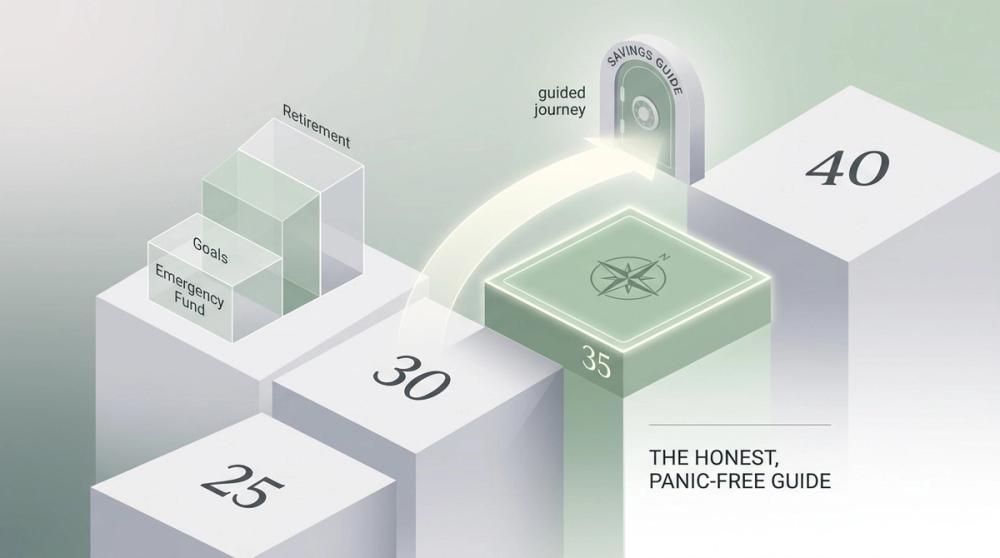
You know that exact moment. You are scrolling on your phone and you see a headline about financial milestones. It tells you exactly where you are supposed to be at your age and you instantly feel like you are ten years behind. Hitting your mid-thirties brings up a lot of complicated feelings about money.
Honestly, figuring out how much you should have saved by age 35 can feel like looking at a scoreboard where everyone else knows the rules. We are going to look at the real numbers today without the judgment. We will break down the industry benchmarks and then we will look at how to actually apply them to a normal human life.
The Standard Rule of Thumb for Savings at 35
Let’s get the big, scary number out of the way first. When you ask financial experts how much you should have saved by age 35, they usually point to a specific formula. The standard industry guideline—often credited to institutions like Fidelity—suggests you should have one to one-and-a-half times your annual salary saved by the time you blow out 35 candles.
Here is what that actually looks like in plain numbers. If you currently make $70,000 a year, the goal is to have between $70,000 and $105,000 tucked away across all your accounts.
That number might make you nod your head or it might make your stomach drop. If you feel a sudden wave of panic, take a deep breath. Think of this benchmark as a compass rather than a report card. It is simply a helpful target to aim for but missing it does not mean you have failed at adulthood.
Why the "Rules" Might Not Fit Your Reality
The truth is that those neat little formulas rarely survive contact with reality. A lot of those rules were written decades ago for a completely different economy. They do not account for the massive variables that impact thirty-somethings today.
Maybe you spent your twenties paying down crushing student loan debt. Perhaps you are dealing with skyrocketing housing costs or you completely pivoted your career at 32 and took a temporary pay cut. Those are real factors that deeply impact your bottom line. Your current savings rate actually matters just as much as your current account balance. Moving in the right direction is a massive win all on its own.
Breaking Down Your Savings by Age 35
Looking at one giant lump sum is overwhelming. It is much easier to figure out how much you should have saved by age 35 when you break that money down into specific buckets. Here is where that money should ideally live so it can actually work for you.
1. Your Emergency Buffer
This is your absolute baseline safety net. You want to aim for three to six months of basic living expenses sitting safely in a High-Yield Savings AccountA federally insured savings account paying a much higher rate than a typical bank account, with full access to your money.. Notice the word "basic" there. We are not talking about your current lifestyle budget. We are talking about "bare bones" expenses like rent, groceries, and keeping the lights on if you suddenly lose your job.
If you only have $1,000 to your name right now, then that is your starting line. Celebrate that thousand bucks and build from there.
2. Retirement Savings
The bulk of that salary multiplier benchmark we talked about earlier belongs right here. This includes your 401(k)An employer-sponsored retirement account that lets you invest part of your paycheck before taxes, often with a matching contribution., any employer matches, and individual retirement accounts like a Roth IRAA retirement account funded with after-tax dollars where qualified withdrawals, including all growth, come out tax-free..
It is incredibly easy to put this off because retirement feels like a lifetime away. But remember that at 35 you still have three full decades for compound interestInterest earned on both your original money and the interest already added to it, which makes balances grow faster over time. to do the heavy lifting for you. Time is still very much on your side and every dollar you put away now does exponential work later.
3. Short-Term Goals and Investments
You are also allowed to save for the life you want to live right now. This bucket holds the money for a house down payment, a wedding, or the capital to start a small business. You do not need to be a day trader to grow this money. Putting funds into a basic, low-cost index fundA fund that mechanically tracks a market index rather than picking stocks, giving broad exposure at very low cost. is a completely valid and smart way to build wealth over a five to ten-year timeline.
What to Do If You Are Falling Behind on Your Age 35 Savings Goals
If you are reading this and realizing your numbers do not line up with the targets, I need you to do one thing right now. Drop the guilt. Guilt is a terrible financial planner and it will only keep you stuck.
The first step is simply logging into your accounts and looking at the real numbers because knowing is always better than guessing. Once you know your baseline, you can make a clear plan.
Here are two small moves you can make this week to get back on track:
- Check your employer match: Log into your benefits portal and verify that you are contributing enough to get the full 401(k) match from your employer. Never leave free money on the table.
- Automate a tiny transfer: Set up a $50 automatic monthly transfer from your checking account into a savings account that you never look at. It feels small but it builds the habit of paying yourself first.
Your Next Best Step
Figuring out exactly how much you should have saved by age 35 is just about finding your bearings. Wealth building is a marathon. Age 35 is merely a checkpoint on a very long road and you have plenty of time to change the trajectory of your finances.
You do not need to fix everything today. Just open up your main banking app, figure out your current baseline, and take one small step forward.