
Picture a self-made millionaire and your brain probably fills in the blanks with luck, a rich uncle, or some clever angle the rest of us never spotted. Here's the uncomfortable part: most of the time, none of that is the story. The gap between people who build real wealth and people who don't has surprisingly little to do with income — and almost everything to do with a handful of plain, repeatable habits. Not secrets. Habits. The kind you could start this week. Let's walk through the ones that actually move the needle.
They Spend Less Than They Earn (and Actually Mean It)
This is the least exciting habit on the list and the one almost everyone skips. The wealth building habits of self-made millionaires usually start right here, with a gap — the space between what they earn and what they spend. That gap is where wealth lives. In their landmark study The Millionaire Next Door, Thomas Stanley and William Danko found that a huge share of American millionaires looked nothing like the part: modest homes, used cars, no flash. They got rich precisely because they didn't try to look rich.
The villain in this story is lifestyle creepThe tendency for spending to rise alongside income, so a raise improves how you live without improving your finances. — the raise that quietly disappears into a nicer apartment and a pricier phone. Self-made millionaires tend to let their income climb while keeping their spending roughly flat. Do that for a decade and the difference compounds into something serious.
They Pay Themselves First
Most people save whatever's left at the end of the month. The problem is that nothing is ever left. Wealthy people flip the order. They treat saving as the first bill they pay, not the last.
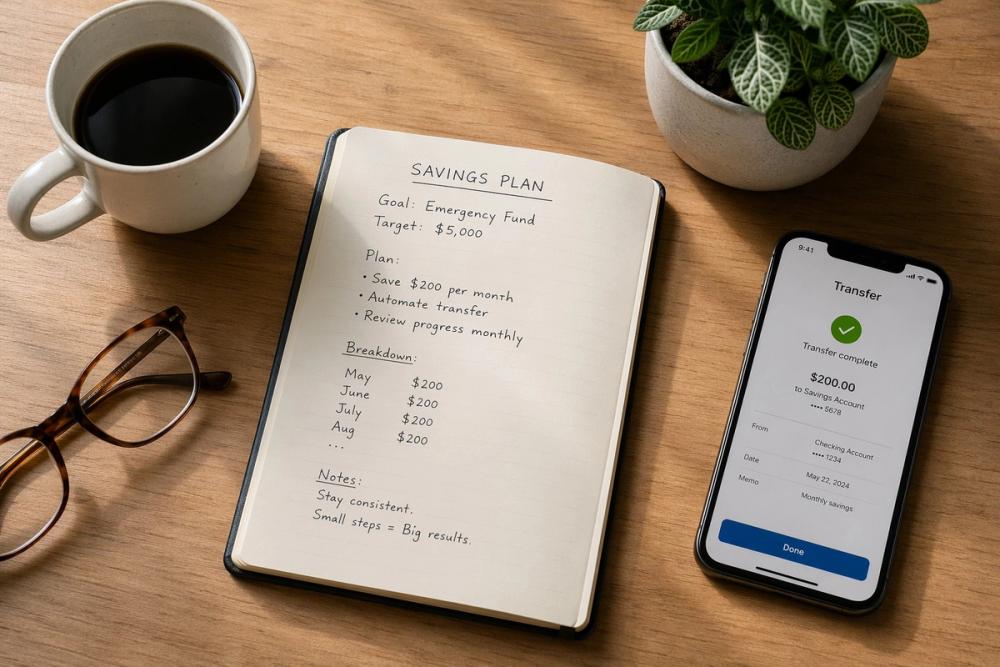
Even better, they take willpower out of it entirely by automating the transfer. Money moves into savings or investments the moment a paycheck lands, before it can be spent or even missed. Picture a transfer that fires every payday on its own — you never see the money, so you never build your life around it. That single shift, from "save what's left" to "spend what's left," is one of the most reliable wealth building habits going.
They Let Compounding Do the Heavy Lifting
If there's one force behind self-made wealth, it's compoundingInterest earned on both your original money and the interest already added to it, which makes balances grow faster over time. — and the people who win at it understand that time matters more than timing. Compounding is a snowball. For the first stretch it looks pathetic, barely growing. Then it becomes unstoppable.
Here's the math that should change how you think about it. Assume a 7% average annual return. One person invests $300 a month from age 25 to 35, then stops — ten years, about $36,000 in total. Another invests the same $300 a month from 35 to 65 — thirty years, roughly $108,000. By age 65, the early starter sits around $420,000. The one who put in three times as much money? About $370,000. Read that again. The earlier you start, the less you actually need to invest.
They Build More Than One Stream of Income
A single paycheck is a single point of failure. It's one of the quieter wealth building habits of self-made millionaires: they rarely lean on just one source of money. Side businesses, dividendsA share of a company's profits paid out to shareholders, usually in cash and usually every quarter. from investments, rental income, equity in a company — the specific mix matters less than the principle. More than one rope holding the weight.
This doesn't mean juggling five jobs or chasing some get-rich-quick scheme at midnight. Most of these streams start tiny and grow slowly, often as a side effect of the saving and investing habits above. Dividends, for instance, are just income that your earlier discipline quietly built for you.
They Keep Learning and Decide on Purpose
The last habit ties the rest together. Self-made millionaires tend to be relentless learners. They read, they ask questions, they stay curious about money long after they technically need to. And more importantly, they decide on purpose. Instead of drifting into spending or letting a salesperson set the agenda, they treat money as a tool with a job to do — not a scoreboard for impressing strangers.
Honestly, that's the thread running through every habit here. Spending less, paying yourself first, investing early, building income — none of it is complicated. It's the same unremarkable decision, made on purpose, over and over.
The Boring Truth
Here's the part nobody likes: none of this is secret, and that's exactly why it works. The barrier was never knowledge. It's doing the unglamorous thing long enough that it stops feeling like progress and starts feeling like just your life.
So don't build a grand plan tonight. Pick one habit. Automate a single transfer this week — even $50 — and let it run. That's how almost every self-made fortune actually starts: small, repeatable, and far more boring than the movies make it look.