The car makes a noise it didn't make last week. Or a tooth starts aching on a Sunday. And before you've consciously decided anything, your brain is already running the math — what's in checking, what clears Friday, which card still has room.
If that's familiar, you're not an outlier. In the Federal Reserve's most recent household survey, 63 percent of adults said they could cover a surprise $400 expense with cash or its equivalent. The other 37 percent would have to borrow money or sell something. Nearly six in ten had at least one major unexpected expense in the previous year, and the most common one was a car repair.
Here's the problem with most advice on this subject. It opens with "save three to six months of expenses," which for a lot of households is a five-figure number. When the entry fee looks like that, not starting is the rational choice.
So let's move the entry fee.
Why the Usual Emergency Fund Advice Fails on a Tight Budget
Three to six months is a destination. It is not a starting line. Treating the two as the same thing is why so many people never put in a first dollar.
Consider what actually happens without a buffer. A $400 repair goes onto a credit card at north of 20 percent APRThe yearly cost of borrowing, expressed as a percentage that includes the interest rate plus most lender fees.. That raises your minimum payment, which raises your monthly floor, which makes saving harder the following month. The hole digs itself.
A starter fund isn't really about security. It's about interrupting that specific loop.
Start With a Number That Sounds Almost Insulting
Five hundred dollars.
It sounds too small to matter and that's precisely the point. Five hundred covers a large share of the expenses that push people onto credit — a brake job, an urgent filling, an insurance deductible, a thin week of hours.
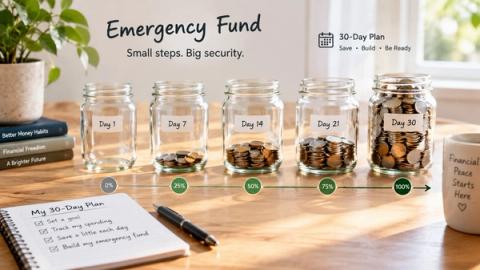
Build the ladder one rung at a time:
- $100. Proof that the system works at all.
- $500. Your first genuine buffer.
- One month of bare expenses. Rent, food, utilities, minimum payments — the stripped version, not your real budget.
- Then the conventional three-to-six-month target.
You have permission to ignore the top rungs for now. They'll still be there later.
Where the Money Comes From When There Isn't Any
This is the section where most articles tell you to skip the coffee. Skip that advice instead.
Catch the irregular money first. Tax refunds, rebates, reimbursements, a bonus, birthday cash. Route a fixed share into savings before it lands in checking. Most starter funds get built here rather than out of monthly income.
Audit the recurring charges once. Pull up last month's statement and read every line. Households routinely underestimate what's auto-billing them. You're hunting for the subscriptions you forgot about, not launching a lifestyle overhaul.
Make two phone calls. Re-shop your insurance at renewal, and ask your phone carrier what plan you'd be offered as a new customer. For medical bills, request an itemized statement and ask about a payment plan. Scripts beat willpower.
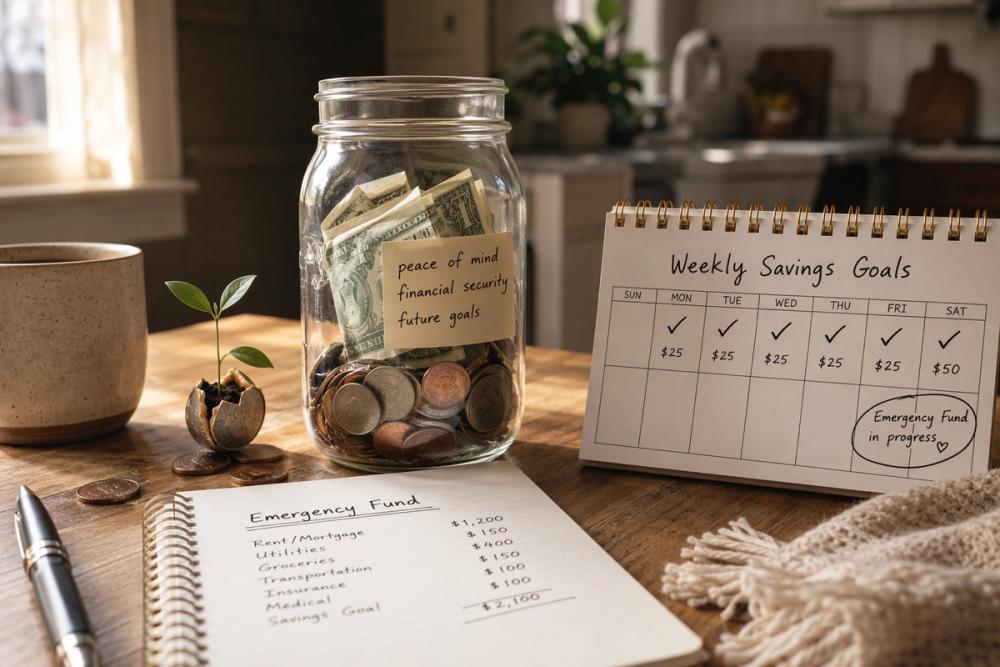
Automate an amount small enough to ignore. Round-up transfers, or ten dollars every Friday. Small and invisible outperforms ambitious and abandoned.
Emergency Fund or Debt Payoff First?
Both, in a particular order.
Build the small buffer first. Then attack the high-interest balance hard. Without that buffer, the next surprise lands straight back on the card and your payoff progress resets. People abandon debt plans because of that reset far more often than because of the interest itself.
Above roughly 20 percent APR, a large pile of idle cash genuinely does cost you money. So keep the buffer deliberately small, kill the balance, then come back and build the rest.
Keep It Somewhere Slightly Annoying to Reach
Open the account at a different institution than your checking account. Don't attach a debit card to it. That one-to-two-day transfer delay isn't an inconvenience — it's the entire feature. It puts a night's sleep between an impulse and a withdrawal.
A high-yield savings accountA federally insured savings account paying a much higher rate than a typical bank account, with full access to your money. is the right home for this money. Rates move constantly so compare current offers rather than trusting a figure you read last year. And don't invest an emergency fundCash set aside in an accessible account to cover unexpected expenses or a loss of income without taking on debt.. It needs to be boring and available.
What Actually Counts as an Emergency
Three tests: unexpected, necessary, urgent. It has to pass all three.
A furnace dying in January passes. A flight to a wedding you've known about since spring does not, however much it feels like one in the moment. Neither does a sale, ever.
One more thing worth saying plainly. If you spend the fund on a real emergency, the fund worked. That isn't a failure — it's the whole purpose. Refilling it is simply the next task.
The First Move
Open the separate account this week. Move twenty dollars into it. Set a recurring transfer for an amount you won't feel.
The point of the first $500 was never really the $500. It's finding out that you can do this at all.