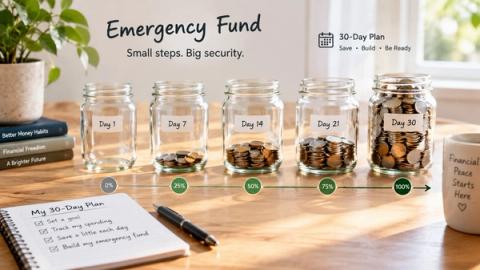

Your emergency fundCash set aside in an accessible account to cover unexpected expenses or a loss of income without taking on debt. should sit somewhere safe. It should also stay easy to reach. A high-yield savings accountA federally insured savings account paying a much higher rate than a typical bank account, with full access to your money. meets both needs and it pays far more than a typical branch savings account.
The FDIC national average for savings recently sat near 0.38% APYThe yearly return on savings including the effect of compounding, which makes it the honest number for comparing deposit accounts.. Several online banks pay about 3.00% to 3.80% on cash you can withdraw without a penalty. That gap adds up. On a $10,000 reserve the difference can exceed $300 a year.
The seven accounts below fit an emergency fund. Each one is federally insuredFederal backing that protects deposits up to $250,000 per depositor, per institution, per ownership category.. Each one keeps cash liquid. Rates are variable so confirm the current APY on the bank’s site before you apply.
Why High-Yield Savings Accounts Work Best for Emergency Funds
An emergency fund exists for job loss, medical bills and sudden repairs. You need the money within a day or two. You cannot afford market swings. Certificates of depositA deposit account that locks your money in for a fixed term at a fixed rate, with a penalty for taking it out early. lock funds for a set term. Investment accounts can lose value. A high-yield savings account avoids both problems.
Online banks pay more because they skip costly branch networks. You still get FDIC insurance up to $250,000 per depositor per ownership category. Transfers to linked checking usually take one to three business days. That window covers most real emergencies.
What Makes the Best Savings Accounts for Your Emergency Fund
Look past the headline rate. A slightly lower APY with faster transfers can serve you better when a bill is due tomorrow.
Focus on these traits:
- No monthly maintenance fee
- No high minimum that could slash your rate
- Reliable ACH transfers
- A clear mobile app
- Full FDIC coverage
Skip teaser yields that drop after a few months unless you plan to move the money later. For emergency cash, a steady rate and clean fee schedule beat a short-lived promo.
7 Best Savings Accounts for Your Emergency Fund in 2026
1. Synchrony Bank High Yield Savings
Synchrony remains a strong pick for emergency cash. Recent listings put the APY near 3.30% with no monthly fee and no minimum balance. Interest compounds daily and it credits monthly.
Synchrony also offers an ATM card. Few pure savings products do. The bank refunds up to $5 per cycle for domestic ATM fees. That helps if you ever need cash in a pinch. Electronic transfers carry no Synchrony fee. Outgoing wires cost $25.
Some customers report slower transfers during busy periods. Plan for a short delay rather than same-day access. For a set-and-hold emergency fund that trade-off is usually acceptable.
2. Marcus by Goldman Sachs High-Yield Savings
Marcus keeps the product simple. Market roundups recently placed the APY near 3.40%. There is no monthly fee and no minimum deposit. Incoming funds start earning interest on the day Marcus receives the transfer request.
Same-day transfers up to $100,000 are available when you submit by noon Eastern on a business day. That speed is rare among online banks. Support runs 24/7. The app stays uncluttered.
Marcus does not issue an ATM card or checks. You must move money to another bank first. That extra step can protect the fund from impulse withdrawals.
3. Ally Bank Online Savings Account
Ally listed a 3.00% APY as of early September 2026. The account has no fees and no minimum. Buckets let you split one balance into labeled goals so the emergency reserve stays separate from a vacation fund.
Ally staffs phones, chat and email around the clock. Surprise Saver can move leftover cash from linked checking when spending looks lighter than usual. Transfers are reliable for most users.
The rate sits a bit below the top of this list. The tools and support often make up for it if you want help building the habit.
4. Capital One 360 Performance Savings
Capital One 360 Performance Savings recently paid about 3.00% APY on every balance. There is no monthly fee and no minimum. You can open the account online or at a Capital One Café.
This option fits people who already bank with Capital One. Internal transfers can move faster than ACH to an outside bank. Mobile check deposit is available. Café and branch access helps if you prefer a person for a rare in-person task.
The APY is solid rather than leading. Convenience is the main reason to choose it.
5. CIT Bank Platinum Savings
CIT Bank Platinum Savings paid 3.75% APY on balances of $5,000 or more as of July 2026. Balances under that threshold earned only 0.25% APY. You need $100 to open the account. There is no monthly maintenance fee.
Bankrate has listed a promotional yield as high as 4.10% for this product. Promotions expire so read the current terms. This account works best once your emergency fund already exceeds $5,000. Below that line the rate is not competitive.
6. Discover Online Savings Account
Discover’s online savings account charges no monthly fee and requires no minimum. Recent comparisons placed the APY near 3.00%. U.S.-based support is available 24/7. The app and website feel familiar if you already hold a Discover card.
You will not find a large branch network. Transfers go through standard ACH. The account suits savers who want a known brand and a clean fee schedule more than the single highest rate on the market.
7. Western Alliance Bank High-Yield Savings Premier
Western Alliance advertised 3.80% APY on the full balance. That is among the stronger ongoing rates in this group. You need $500 to open the account. After that a balance of one cent still earns the advertised yield. There are no monthly fees and no rate tiers.
The bank is a large FDIC member with a simpler product than household names. Transfers happen online. This account fits savers who care most about yield and insurance rather than ATMs or in-person help.
How to Choose Among the Best Savings Accounts for Your Emergency Fund
Match the account to how you will use the money. Pick Marcus or Synchrony if you want a high rate and a simple app. Pick Ally if buckets and 24/7 help matter. Pick Capital One if you already keep checking there. Pick CIT or Western Alliance if your balance can clear their opening or tier rules.
Confirm three items before you apply:
- Current APY on the bank’s own site
- Transfer limits and typical clearing time
- Any early-close or paper-statement fees
Keep the emergency fund at a different bank from daily spending when you can. The small delay reduces the urge to dip into it.
Open Your Emergency Fund and Put It to Work
Choose one account from this list and open it this week. Link your checking account and set an automatic transfer on payday. A common target is three to six months of essential bills.
Revisit the rate twice a year. If another insured account pays meaningfully more and transfers are easy you can move the balance. The best savings accounts for your emergency fund earn a real return and they stay ready when life is not.
APYs are variable and change with the market. Figures above reflect publicly listed rates as of September 2026. Verify terms directly with each bank before you open an account.