
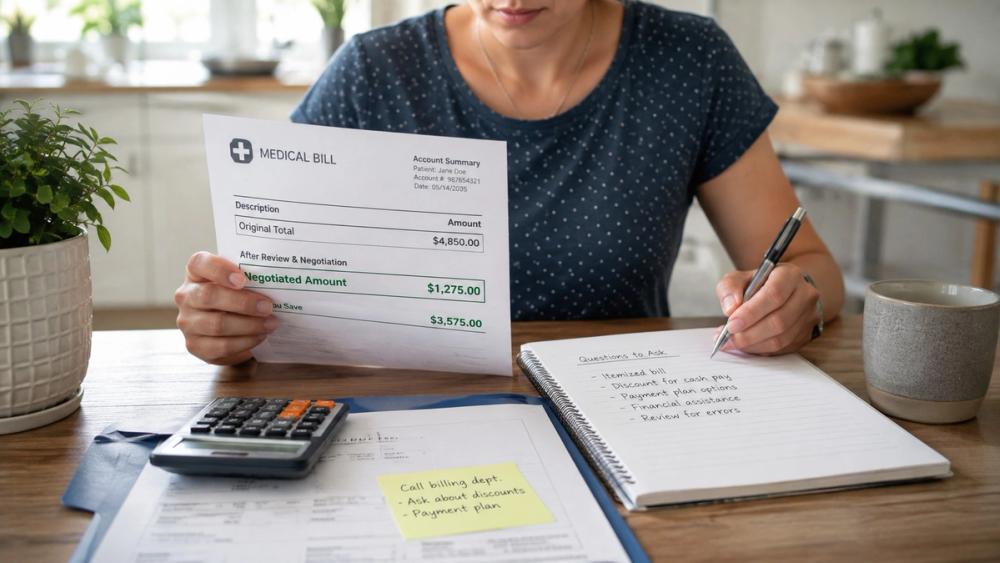
You get the bill in the mail and the number stops you cold. Hospitals and clinics routinely charge uninsured patients the full chargemaster rate—the highest price on the books. That figure is almost never the amount you actually have to pay. Patients who negotiate often walk away paying 30 to 70 percent less, sometimes far more.
The process is straightforward if you follow a clear order. Start by cleaning up the bill itself, then claim the discounts that already exist, and finish by offering a number the provider will accept.
Begin With the Itemized Bill
The first statement you receive is usually a summary. It shows a big total and little else. Call the billing office and ask for a complete itemized bill. You want every CPT code, the date of service, the quantity, and the individual charge.
Errors show up often—duplicate charges, services you never received, or coding mistakes. Studies and patient advocates put the error rate around one in four bills. Once you have the line-by-line version, check it against what actually happened during your visit. Mark anything that looks wrong and call back with the specific lines. Providers correct many of these mistakes without argument.
If you received a good-faith estimate before care, compare the final bill to that number. Under the No Surprises Act, uninsured patients can dispute a bill that comes in more than $400 higher than the estimate. You have 120 days from the first bill to start that process.
Ask for the Self-Pay Discount
Most hospitals maintain a self-pay or uninsured rate that sits 30 to 60 percent below the listed price. They do not always volunteer it. You have to ask.
A simple line works: “I’m paying this myself. What is your self-pay or uninsured rate for these services?”
Many places will also offer a prompt-pay discount on top of that rate if you settle within 30 days—another 10 to 25 percent is common. Get the new total in writing before you send any money. A verbal promise is not enough.
Check What the Care Should Cost
Arm yourself with numbers. Free tools such as FAIR Health Consumer, Healthcare Bluebook, and Medicare fee schedules show typical prices for the same CPT codes in your area. Hospitals must also post their cash prices under federal price-transparency rules. Pull those figures and use them in the conversation.
If a nearby facility charges significantly less for the same procedure, say so. Providers prefer to adjust a bill rather than watch a patient walk away or complain publicly.
Apply for Financial Assistance
Nonprofit hospitals are required to have a written financial-assistance policy. Many for-profit facilities offer similar programs even if they keep them quiet. Eligibility usually depends on household income compared with the federal poverty level—often up to 200 or 400 percent.
Ask for the application the same day you request the self-pay rate. You generally have 240 days from the first post-discharge bill to apply. Submit the paperwork even if you are unsure you qualify. Hospitals sometimes grant hardship reductions outside the strict guidelines when a patient shows genuine difficulty.
Offer a Lump-Sum Settlement
After the self-pay discount and any charity-care reduction, the remaining balance is still negotiable. Offer a single payment that is lower than what is left. Starting around 30 to 50 percent of the reduced total is a common opening point.
Say something like: “I can pay $X today as payment in full. Will you accept that amount to close the account?”
Hospitals would rather take guaranteed cash now than spend months chasing a larger sum through collections. Once you agree on a number, get written confirmation that the payment settles the debt completely and will be reported as paid in full.
Set Up a Payment Plan When Needed
If a lump sum is impossible, request an interest-free payment plan. Propose a monthly amount you can actually keep up with. Confirm in writing that the plan pauses collection activity while you stay current. Keep every receipt.
Keep Records and Stay Persistent
Log every call—date, time, name of the person you spoke with, and what they promised. Follow up important conversations with a short email that restates the agreement. If the first representative cannot help, ask for a patient financial counselor or supervisor. Polite persistence usually gets further than anger.
The sequence works because providers already expect to collect less than the sticker price. They negotiate with insurance companies every day. Treating your bill the same way is simply good business on both sides. Start early, stay organized, and keep everything in writing. The difference between the first number and the final one can be thousands of dollars.