
You're standing in the checkout line. Your kid spots something — a toy, a candy bar, a completely unnecessary slime kit — and asks for it. You say no. They ask why. You say "we don't have the money for that right now." And then comes the one that stops you cold:
"Why don't you just use the card?"
Most of us laugh it off. But honestly? That question is a gift. It means they're paying attention. And it means you have an opening.
The truth is, most of us grew up in homes where money was either a source of stress nobody talked about or a topic reserved for hushed adult conversations. We figured it out eventually — sometimes the hard way. But you don't have to repeat that pattern. Teaching kids about money doesn't require a finance degree or a formal sit-down. It just requires starting. Here's how to do it at each stage, without overcomplicating things.
Ages 3–5: Keep It Concrete
Little kids can't grasp concepts like interest ratesThe percentage charged for borrowing money or paid for depositing it, quoted as an annual figure. or budgets. But they absolutely understand this toy costs money and money is something we trade for things we want. Start there.
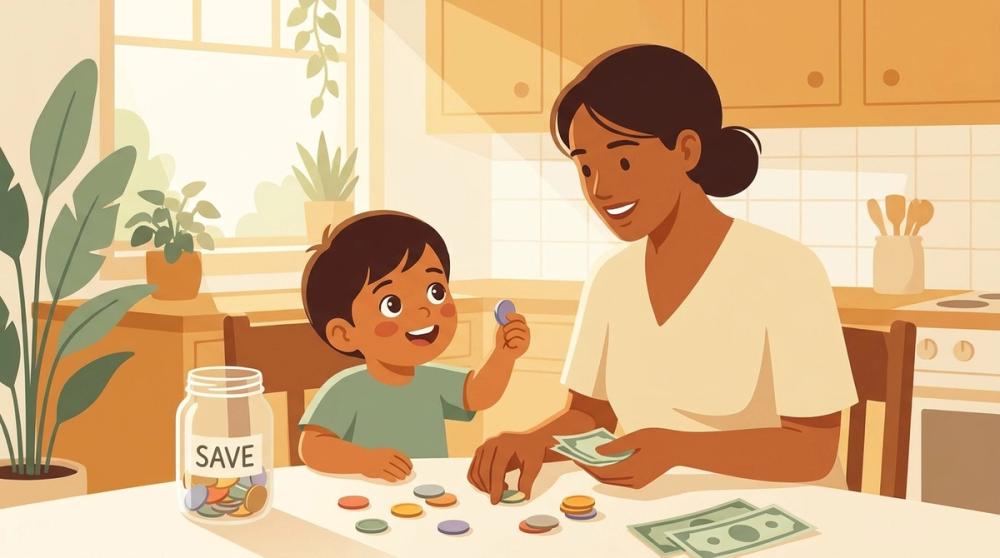
Let them hold coins. Play store at home. Give them a few dollars to "spend" at a dollar store and watch their faces as they realize they have to choose. That moment of choice — do I want this or that? — is the entire foundation of financial thinking. You're not raising a mini-CFO. You're just planting the seed that money is real, it's finite and it matters.
Ages 6–10: Give Them Some Skin in the Game
Here's where it gets interesting. Kids this age are ready for a small allowance — not as payment for breathing, but as a tool for learning. The exact amount matters less than what they do with it.
Try the three-jar method: one jar for spending, one for saving, one for giving. It sounds almost too simple. But it works because it makes abstract concepts physical. They can see their money growing. They can feel the weight of choosing.
Set a savings goal together. Maybe it's a video game. Maybe it's a stuffed animal they saw at the store. Help them count toward it, week by week. When they finally buy it with their own money? That's a feeling they won't forget.
And let them make bad calls. Let them blow their spending jar on something silly. Don't rescue them from the regret. That regret — that mild, completely safe disappointment — is one of the most valuable lessons money can teach. Way more effective than any lecture you could give.
Ages 11–13: The Real World, Gently
Pre-teens can handle more than we give them credit for. This is a great age to open a basic savings account together and show them how a bank actually works. Even tiny interest adds up and watching numbers grow (even slowly) makes the concept click in a way no explanation can.
Start talking about budgets in real terms. Give them a set amount for school lunches or weekend spending and let them manage it. If they run out on Wednesday, that's the lesson. You don't need to add commentary.
This is also a good time to pull back the curtain, just a little, on what things actually cost. Not to stress them out — but because kids who grow up with zero financial context often become adults who are genuinely shocked by how the world works.
Ages 14–18: Treat Them Like Almost-Adults
Because they almost are.
When they get their first job, sit down with them and look at their pay stub together. Explain taxes before they're blindsided by them. Talk about credit — what it is, how it builds, how fast it can go sideways with one bad habit. These aren't scary conversations. They're just honest ones.
Let them manage their own debit card. Compare phone plans together. Talk about what college actually costs. Involve them in real decisions. Teens who feel trusted with real information make better decisions than teens who are kept in the dark and handed a credit card at 18 with zero context.
The Thing That Actually Matters Most
You don't need to be a financial expert to raise money-smart kids. You just need to talk about it — regularly, casually, without shame.
Let them see you budget. Let them see you save for something. Let them see you choose not to buy something, and explain why. That modeling does more than any lesson plan ever could.
So next time your kid asks why you can't just use the card? Take a breath. Smile. And tell them — actually, let me show you how that works.
That's where it starts.