
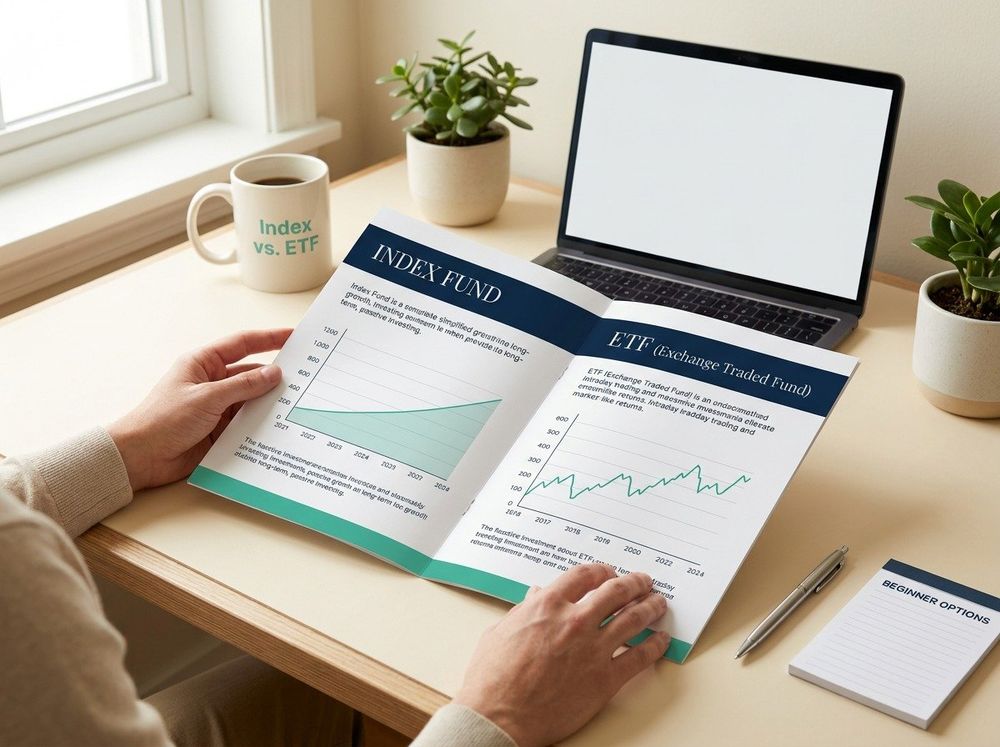
For many beginners, the choice is not really index fundsA fund that mechanically tracks a market index rather than picking stocks, giving broad exposure at very low cost. or ETFsA fund holding a basket of investments that trades on an exchange like a single stock, usually tracking an index at low cost.. An index fund is an investment strategy: it aims to track a market index. An ETF is a type of fund that trades on an exchange. An ETF can be an index fund, and an index fund can also be a mutual fundA pooled investment holding a portfolio of securities on behalf of many investors, priced once a day after the market closes..
So the practical comparison is usually between an index mutual fund and an index ETF. Both can offer a straightforward way to invest in a group of stocks or bonds. The better fit depends on how you want to buy shares, how much you plan to invest, the account you use, and the fund’s costs. Index Funds | Investor.gov
The short answer
An index mutual fund may suit you if you prefer investing a set dollar amount on a regular schedule and want purchases handled at the end of the trading day. An index ETF may suit you if you want to trade during market hours or your brokerage offers a low-cost way to buy fractional shares.
Neither format is automatically cheaper or better. Compare the specific funds’ expense ratiosThe annual percentage of your investment that a fund charges to operate, deducted automatically from returns., account rules, transaction costs, investment minimums, and the indexes they track. Both can lose value, and a fund that tracks a broad index still carries the risks of the investments in that index. Characteristics of Mutual Funds and Exchange-Traded Funds (ETFs) – Investor Bulletin | Investor.gov
What is the difference between an index fund and an ETF?
An index fund aims to follow a particular index, which is a measurement of a group of investments. For example, a fund might track an index of large U.S. companies or a broad bond market. The fund may hold every investment in the index or a representative sample. Its results can differ from the index because of fees, trading costs, and how closely it tracks the index. Index Funds | Investor.gov
An ETF, or exchange-traded fund, is bought and sold on a stock exchange. ETFs can follow an index, but they can also use other strategies. Mutual funds can be index funds, too, so be sure to check a fund’s investment goal rather than assuming that its structure tells you what it owns or how it invests. Characteristics of Mutual Funds and Exchange-Traded Funds (ETFs) – Investor Bulletin | Investor.gov
Index mutual funds vs. index ETFs
| Feature | Index mutual fund | Index ETF |
| How you buy and sell | You buy or redeem shares through the fund or a brokerage. The price is based on the next calculated net asset value, or NAV. | You buy and sell shares on an exchange at market prices while the market is open. |
| When the price is set | Typically once each business day after the market closes. | Changes during the trading day. The market price may be above or below the fund’s NAV. |
| Investing a set dollar amount | Often supports purchases in dollar amounts, subject to the fund and account rules. | You may need to buy whole shares unless your brokerage offers fractional shares. |
| Potential costs | May have an expense ratio, investment minimum, or other fund fees. | May have an expense ratio and trading costs, such as a bid-ask spread or brokerage commission. |
| Taxes in a taxable account | May distribute taxable capital gainsThe profit from selling an asset for more than you paid, taxed at a lower rate if you held it longer than a year., even if you did not sell your shares. | Often has fewer capital gains distributions than a similar mutual fund, but distributions can still be taxable. |
The details vary by fund and brokerage. For example, some mutual funds have low or no investment minimums, and some brokerages let customers buy fractional ETF shares. Check the fund prospectus and your account’s fee schedule before investing. Characteristics of Mutual Funds and Exchange-Traded Funds (ETFs) – Investor Bulletin | Investor.gov
When an index mutual fund may be a good fit
An index mutual fund may be convenient if you want to invest a specific dollar amount each month. Some funds and accounts let you set up recurring purchases, which can make it easier to follow a regular investing plan. Availability and minimums depend on the fund and brokerage.
Mutual funds are priced once per business day. If you place an order during the day, you generally will not know the exact share price until the fund calculates its NAV after the market closes. That may work well if you are investing for a long-term goal and do not need to make trades during the day. Mutual Funds | Investor.gov
When an index ETF may be a good fit
An index ETF may be a better fit if you want to buy or sell during market hours. Because it trades on an exchange, its price changes throughout the day. That flexibility does not guarantee a better price, and an ETF’s market price may be slightly higher or lower than its NAV. Characteristics of Mutual Funds and Exchange-Traded Funds (ETFs) – Investor Bulletin | Investor.gov
ETFs may also be practical when you want to invest with a smaller amount, depending on the share price and whether your brokerage offers fractional shares. Before trading, check for commissions and consider the bid-ask spread, the difference between the price buyers are offering and the price sellers are asking. These costs can affect your results, especially if you trade often. Mutual Fund and ETF Fees and Expenses – Investor Bulletin | Investor.gov
Compare costs, not just the fund label
The expense ratio is the fund’s annual operating expenses expressed as a percentage of its assets. It is deducted from the fund, so it reduces the return you receive. Also check for other charges, including sales loads, account fees, commissions, and trading costs. A low expense ratio is useful to compare, but it does not tell you everything about a fund’s cost. Mutual Fund and ETF Fees and Expenses – Investor Bulletin | Investor.gov
Compare funds that track similar indexes, then review their prospectuses and fee information. A fund tracking a broad U.S. stock index, for example, is not directly comparable to one focused on a narrow sector. Check what the index includes, how the fund tracks it, and whether the fund’s risks fit your plans.
Consider the account and tax impact
If you invest in a taxable brokerage account, you may owe taxes on dividendsA share of a company's profits paid out to shareholders, usually in cash and usually every quarter. or on capital gains distributions from the fund. ETFs often distribute capital gains less frequently than similar mutual funds because of how some ETF transactions are structured. That is a tendency, not a guarantee: an ETF can still make a taxable distribution. Characteristics of Mutual Funds and Exchange-Traded Funds (ETFs) – Investor Bulletin | Investor.gov
In a tax-advantaged account, such as an IRA or 401(k)An employer-sponsored retirement account that lets you invest part of your paycheck before taxes, often with a matching contribution., the difference in tax treatment between an ETF and a mutual fund may not matter in the same way. Account rules, available investments, and tax consequences vary, so consider the account type as well as the fund structure. Characteristics of Mutual Funds and Exchange-Traded Funds (ETFs) – Investor Bulletin | Investor.gov
How beginners can compare funds
Before choosing between an index mutual fund and an index ETF, check:
- The index and holdings. Make sure you understand what the fund invests in and whether it is broadly diversifiedSpreading money across many investments so that a loss in any one of them does limited damage to the whole portfolio. or concentrated in a particular market segment.
- The expense ratio and other costs. Review the prospectus fee table, brokerage charges, and any purchase or account minimums.
- How you plan to invest. Consider whether you want recurring dollar-based purchases, fractional shares, or the option to trade during the day.
- The account you will use. Your workplace plan or brokerage may offer only certain funds, or may charge different fees.
- The risks. A fund that tracks an index can still fall in value. Diversification may reduce the impact of a poor result from one investment, but it does not prevent losses.
The SEC recommends reviewing a fund’s available information, including its prospectus and shareholder report, before investing. Index Funds | Investor.gov
So, which is better for beginners?
For a beginner investing regularly in a long-term goal, either a low-cost index mutual fund or a low-cost index ETF may work. Choose based on the specific fund, total costs, account access, and the way you want to manage contributions. Do not select a fund solely because it is an ETF or a mutual fund.
If you want purchases based on a set dollar amount and do not need intraday trading, an index mutual fund may feel simpler. If you value exchange trading or your brokerage supports convenient fractional ETF purchases, an index ETF may suit you better. The key is understanding what the fund holds, what it costs, and how it fits your broader financial plan.
This article is for educational purposes only and is not personalized investment, tax, or financial advice.