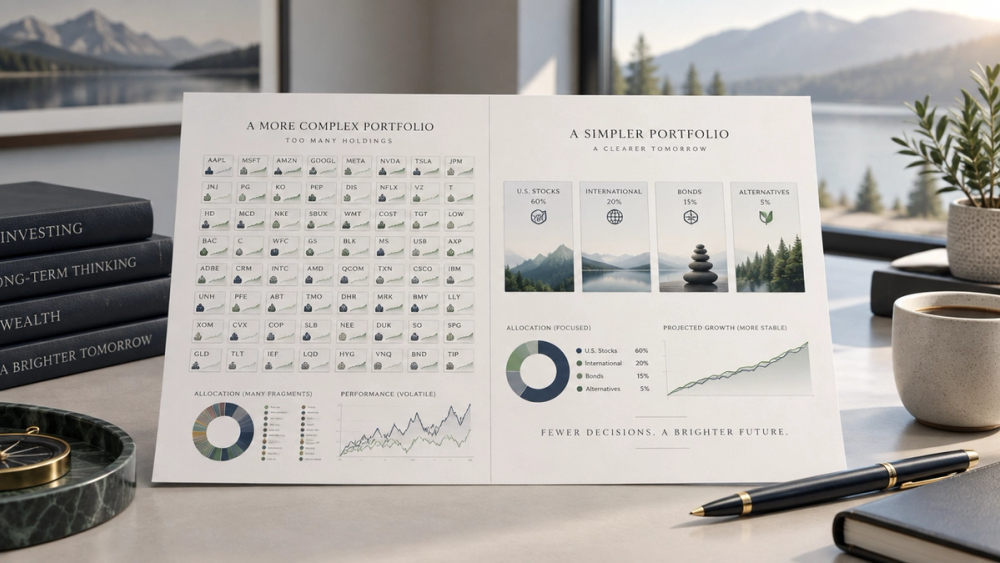
You check your portfolio and see forty different funds. You feel safer with all that variety, but your returns barely budge when markets move. That's over diversificationSpreading money across many investments so that a loss in any one of them does limited damage to the whole portfolio. at work: spreading your money so thin that you've watered down any real gains while piling on fees and making your portfolio impossible to actually manage.
Most investors assume more holdings always mean less risk. The math says otherwise. After a certain point, each new investment adds almost nothing to your protection but plenty to your costs and confusion.
You'll learn where that point sits for different types of investors, how to spot the signs you've crossed it, and what a right-sized portfolio actually looks like for someone who wants protection without the overhead.
What over-diversification looks like
Over-diversification happens when you hold so many investments that adding more increases complexity without meaningfully reducing risk. The principle at work is diminishing returns: your first stock holding carries all your risk, your second cuts that risk roughly in half, but your twentieth holding might reduce risk by only a fraction of a percent.
Research shows most diversification benefit comes from the first 15 to 30 holdings. After that point, each additional investment does less to protect you while making your portfolio harder to track and more expensive to maintain.
Common signs you've crossed into over-diversification territory include owning 100 or more individual stocks, holding a dozen mutual fundsA pooled investment holding a portfolio of securities on behalf of many investors, priced once a day after the market closes. that all invest in large US companies, or buying multiple ETFsA fund holding a basket of investments that trades on an exchange like a single stock, usually tracking an index at low cost. that track nearly identical indexes. When your portfolio becomes difficult to monitor or you can't explain what each holding does, you've likely added more than you need.
The hidden costs of owning too much
Every position you add carries a price beyond its purchase cost. Brokerage commissions have largely disappeared, but many funds still charge transaction fees when you buy or sell. RebalancingPeriodically buying and selling to return a portfolio to its target mix after market moves have shifted it. twenty positions costs more than rebalancing five, both in fees and in the bid-ask spread you pay on each trade.
Tax season gets messier as holdings multiply. Each sale generates a capital gainThe profit from selling an asset for more than you paid, taxed at a lower rate if you held it longer than a year. or loss that needs tracking. You'll need to maintain cost basisWhat you originally paid for an investment, adjusted over time — the figure your taxable gain or loss is measured against. records for every lot of every security, and wash sale rules become harder to navigate when you hold multiple overlapping funds. What takes an hour with a handful of holdings can take an afternoon with dozens.
Monitoring demands scale with your portfolio. Each position deserves attention when earnings reports arrive, when management changes, or when the fund adjusts its strategy. Few investors can meaningfully track more than ten or fifteen holdings. Beyond that, something gets ignored.
Overlapping funds create another drag. If three of your index fundsA fund that mechanically tracks a market index rather than picking stocks, giving broad exposure at very low cost. all hold Apple and Microsoft, you're paying three separate expense ratiosThe annual percentage of your investment that a fund charges to operate, deducted automatically from returns. for nearly identical exposure.
When more holdings stop helping
Adding your tenth stock reduces portfolio volatility meaningfully. Adding your fiftieth barely moves the needle. Research shows most diversification benefits arrive within the first 15 to 20 holdings, with diminishing returns after that.
More holdings also create hidden problems. Investors who own 40 mutual funds often discover their portfolios contain the same large-capA company's share price multiplied by its shares outstanding — the standard measure of how large a public company is. tech stocks in multiple funds. The false sense of diversification disappears when everything drops together during a sector downturn. Geographic overlap works the same way: owning three international funds that all hold the same emerging markets does not triple your diversification.
When you spread capital across too many positions, your portfolio tends to mirror broad market returns, minus the extra trading costs, management fees, and tax consequences from rebalancing dozens of holdings. You also lose the ability to act when opportunities appear or problems surface. Shifting 2% of your portfolio requires selling multiple positions, paying transaction fees, and tracking cost basis across accounts. The complexity erodes both returns and decision speed.
How many holdings you actually need
Passive investors who build portfolios from index funds typically need only three to seven funds. A straightforward approach might include a U.S. stock index fund, an international stock fund, a bond fund, and possibly a real estate or small-cap fund. Each additional fund should add genuine exposure you don't already have.
Active stock pickers face a different calculation. Academic research on portfolio construction shows that 15 to 30 individual stocks capture most of the diversification benefit available from stock selection. Below 15, you take on unnecessary company-specific risk. Above 30, you're adding complexity without meaningfully reducing volatility.
Target-date fundsA single fund that holds a whole diversified portfolio and shifts automatically from stocks toward bonds as its target year approaches. and balanced funds are designed as complete portfolios, so investors using them often need just one holding. Adding other funds on top usually creates overlap rather than diversification.
The right number for you depends on your investment approach, the time you can dedicate to monitoring positions, and your account size. Smaller accounts benefit from simplicity because trading costs and rebalancing eat into returns. Focus on covering the asset classes you need, then stop.