
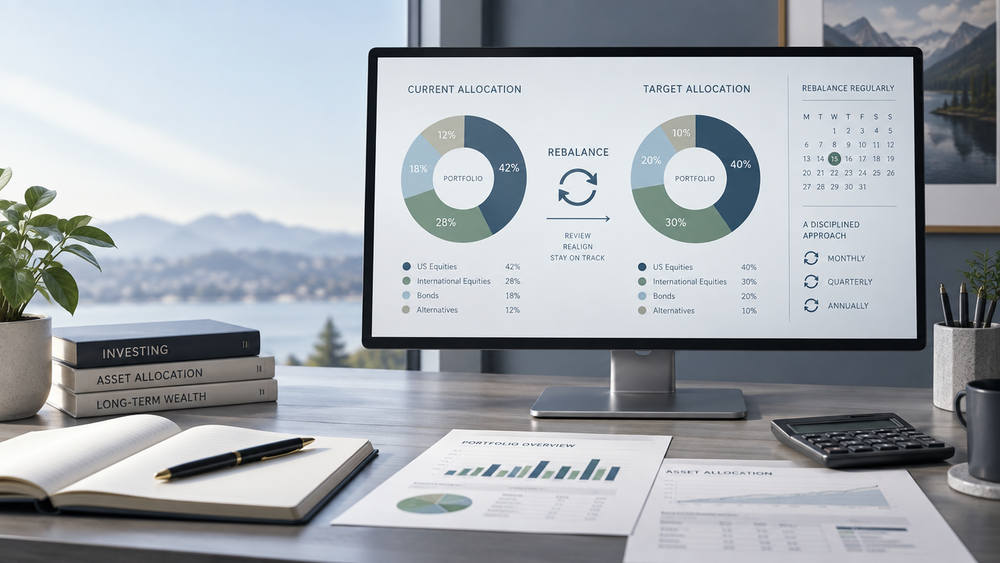
Your portfolio starts out perfectly balanced. Six months later, a tech rally has pushed your stock allocation from 60% to 68%, and you're holding more risk than you planned. Portfolio rebalancingPeriodically buying and selling to return a portfolio to its target mix after market moves have shifted it. is the fix, but doing it too often triggers unnecessary taxes and trading costs, while waiting too long lets your risk creep out of control.
The right rebalancing schedule depends on whether you prefer a predictable calendar routine or a responsive system that acts only when your allocations actually drift past a threshold. You'll also need to account for tax-advantaged accounts, transaction costs, and whether your portfolio is simple or spread across multiple accounts. By the end, you'll know which approach fits your situation and how to set up a rebalancing routine you can actually stick with.
Why portfolios drift from target allocation
Different assets grow at different rates, and that changes your portfolio's balance over time. If you start with 60% stocks and 40% bonds, and stocks gain 20% in a year while bonds return 3%, your allocation shifts. After that growth, stocks might represent 70% of your portfolio and bonds only 30%, even though you didn't buy or sell anything.
This drift is not a mistake or a sign you invested poorly. It happens naturally because markets move. A bull marketA sustained stretch of rising prices, conventionally dated from a 20% recovery off the previous market low. pushes stocks higher. A bond rally increases fixed income holdings. Real estate appreciates. Each asset class follows its own path, and the percentages shift accordingly.
The problem is risk. That 60/40 portfolio was designed with a specific risk level in mind. When drift pushes it to 70/30, you're now taking more equity risk than you originally planned. If the market drops, the losses will be larger than your original allocation would have produced.
Calendar rebalancing: the set-it-and-forget-it approach
Calendar rebalancing means you adjust your portfolio on a fixed schedule regardless of how much your allocations have shifted. You pick a date—quarterly, semiannually, or annually—and review your holdings on that day every time it arrives.
The main advantage is simplicity. You don't need to monitor your portfolio constantly or make judgment calls about when drift has become significant. The schedule creates discipline, which matters when markets are volatile and emotions run high. Most individual investors rebalance once a year, often at year-end or around tax season. Annual rebalancing keeps transaction costs and taxable events to a minimum while still preventing allocations from straying too far.
The downside is timing mismatch. If you rebalance in March and a large market swing happens in April, you'll wait until the following March to address it. Conversely, you might rebalance when your allocations have barely moved, paying trading costs for no meaningful benefit.
Threshold rebalancing: responding to actual drift
Threshold rebalancing triggers adjustments only when an asset class drifts beyond a specific percentage from your target allocation. If your stock allocation is supposed to be 60% but climbs to 66%, a 5% threshold would require you to sell stocks and buy bonds to restore balance. With a 10% threshold, you would wait until stocks reached 66% of your portfolio before acting.
This approach responds to actual market movements rather than calendar dates. During periods when markets trade sideways, you avoid unnecessary transactions and their associated costs. The downside is that it requires regular monitoring—weekly or monthly checks to spot when an asset class breaches your threshold.
Many investors combine both methods by checking their portfolio quarterly or semiannually but only rebalancing if an asset class has drifted beyond their chosen threshold. This hybrid approach reduces monitoring burden while preventing trades when portfolio balance remains close to target.
Tax considerations and practical timing
Rebalancing in taxable brokerage accounts triggers capital gainsThe profit from selling an asset for more than you paid, taxed at a lower rate if you held it longer than a year. taxes when you sell appreciated assets. If you've held the investment for less than a year, those gains are taxed as ordinary income. Hold it longer than a year, and you pay the lower long-term capital gains rate. Either way, the tax bill cuts into your returns.
Tax-advantaged accounts like IRAs and 401(k)sAn employer-sponsored retirement account that lets you invest part of your paycheck before taxes, often with a matching contribution. avoid this problem. You can sell and rebalance inside these accounts without owing taxes until you withdraw the money in retirement (or ever, in the case of Roth accounts).
To minimize taxes in taxable accounts, direct new contributions toward underweighted assets instead of selling overweighted ones. This method rebalances over time without triggering gains.
Review your allocation at least once per year, but only act when the drift is large enough to justify the tax and transaction costs. A portfolio that's slightly off target usually costs you less than the taxes you'd pay to fix it.