

An auto equity loan is a secured loanAn asset you pledge to a lender that it can seize if you stop paying — the thing that makes a loan secured. where you hand over the car title as collateral and receive a lump sum based on a percentage of the vehicle's value, usually repaid in fixed monthly installments. It can look like easy relief when cash is tight, but the U.S. auto-loan market carried more than $1.6 trillion in balances and over 100 million active accounts by Q4 2023 (CFPB report), so the stakes are bigger than the simple phrase sounds.
You might be sitting in a driveway with a truck that's paid off, or nearly paid off, and wondering whether it can cover a furnace repair, medical bill, or rent gap. That's the right question to ask, because an auto equity loan borrows against a depreciatingThe decline in an asset's value over time from age and use — and, for businesses, the tax deduction that tracks it. asset, not a stable store of value, and the quoted equity can shrink fast if the car loses value or if you roll in too much debt.
What an Auto Equity Loan Actually Is
Maria's furnace dies in January, and the repair quote lands at the same time her savings account is already thin. She owns a 2019 pickup outright, so the obvious question becomes whether the truck can do the same job her emergency fundCash set aside in an accessible account to cover unexpected expenses or a loss of income without taking on debt. was supposed to do.
An auto equity loan lets her use the truck as collateral. She signs over the title or grants a lien, keeps driving the vehicle, and repays the loan in fixed monthly installments until the principal and interest are gone. The lender cares less about whether Maria has perfect credit and more about whether the truck has enough value to back the debt.
That collateral piece is what separates this loan from unsecured debt. A credit card can't be repossessed, but a vehicle can, which is why lenders can sometimes work with borrowers who've had bruises on their credit. It also explains why this product is often priced below revolving credit, even though the car itself is doing all the heavy lifting.
The term gets mixed up with a car title loan, and that confusion matters. A true title-loan product is usually shorter, more expensive, and much closer to emergency borrowing than to a normal installment loan. An auto equity loan, by contrast, is usually structured with regular payments and a set payoff date, even if the car is still the security.
Practical rule: If you can't explain who holds the title, how long the repayment schedule lasts, and what happens after one missed payment, you're not ready to sign.
The amount you can borrow depends on the lender, but the basic idea is the same. The loan is tied to the vehicle's value, not to a vague promise about future income. If the borrower defaults, the lender can repossess the car, sell it, and try to recover what's owed.
Equity, in plain language is what's left after debt is subtracted from value, and that simple definition is where many borrowers get tripped up. The first question is whether equity is there today. The second is whether it's likely to survive long enough to matter by the time the loan is paid off.
How Lenders Calculate Your Vehicle Equity
Start with the lender's math, not the sale price on a marketplace listing. Vehicle equity is the current value of the car minus what you still owe, so a truck worth $18,000 with a $6,000 payoff leaves $12,000 in equity. That figure is only the starting point, because the car is a depreciating asset, and the cushion can shrink fast if the market turns or the condition worsens.
Lenders rarely treat that full amount as available borrowing room. They apply a loan-to-value ratio, or LTVThe size of a loan measured against the value of the property securing it — the number that drives mortgage insurance, rate, and approval., to leave space for depreciation, auction costs, and repossession expenses. In practice, that means the lender looks at the vehicle the way a buyer at auction would, not the way the owner hopes a private sale might go.
The valuation method is usually conservative. A lender may rely on trade-in or wholesale-style numbers, then trim the figure again if the mileage is high, the body has damage, or the vehicle needs repairs. That is why two people with the same model can see different offers, even before credit is considered.
If you want to spot hidden title problems before applying, check vehicle title liens first. An old lien can slow funding or lower the amount a lender is willing to advance.
A simple example makes the math easier to follow. If the truck's equity is $12,000, a lender using a tighter 60% LTV cap might offer $7,200. A more generous 90% cap could reach $10,800. The gap is not random, it is the lender protecting itself against a value drop after approval.
| Step | Figure | Calculation |
| Vehicle market value | $18,000 | Lender appraisal or trade-in estimate |
| Existing payoff | $6,000 | Amount still owed |
| True equity | $12,000 | $18,000 minus $6,000 |
| 60% LTV offer | $7,200 | $12,000 x 60% |
| 90% LTV offer | $10,800 | $12,000 x 90% |
A cleaner vehicle, stronger credit profile, and a less complicated title can all improve the offer, but the lender's number still comes first. The quoted equity today can disappear quickly if the car depreciates faster than the balance falls.
Inside the Application and Funding Process
The application usually starts online or in a branch with a short form. Lenders ask for the vehicle's year, make, model, mileage, and VIN, then they add in the borrower's income, housing status, and contact details to see whether the loan fits the file they're building.
The document list is straightforward, but missing one item can stall everything. Expect to provide a government ID, proof of income through pay stubs or bank statements, proof of insurance that names the lender, and the title or payoff details if another lender already has a claim on the car. Some lenders also ask for references, especially when the credit profile is thin.
What happens after the forms go in
The inspection step is often less dramatic than people expect. Many lenders now use photo uploads through an app instead of a full in-person appraisal, though they still need enough images to judge condition, damage, and mileage consistency. A hard credit pull is common, but some lenders will start with a soft pullA lender's review of your credit report when you apply for credit — recorded on the report and worth a few points for about a year. for pre-qualification so the borrower can see whether the file is worth moving forward.
After approval, the title handoff is the control point. The lender either holds the physical title or files a lien with the state DMV, and the borrower keeps driving the car. That arrangement is why the loan feels convenient upfront and risky later, because the car is still usable while also serving as the lender's security.
Funding can move quickly once the title is verified as clear. Pre-qualification may take minutes, conditional approval can come within hours, and funding is often the next business day if there's no existing lien to unwind. The two most common slowdowns are an old lien that has to be paid off first and a state title-processing backlog that stretches the paperwork.
Rates, Fees, and What Drives the Price
The headline APRThe yearly cost of borrowing, expressed as a percentage that includes the interest rate plus most lender fees. is only part of the cost. An auto equity loan can also carry origination fees, title fees, document fees, tracker or GPS add-ons, and sometimes prepayment penalties, so the “rate” a borrower hears on the phone isn't always the rate that shows up in the total cost.
A simple example shows how fees change the math. If a borrower takes a $5,000 loan at 25% APR and pays $500 in fees, the effective cost climbs noticeably even before considering the risk of repossession. Fees don't just add annoyance, they can make a small loan much more expensive than it first appears.
What changes the quote
Pricing depends on the borrower's risk profile and the lender's business model. A stronger credit scoreA three-digit number, typically 300 to 850, that lenders use to estimate how likely you are to repay borrowed money. can help, but the vehicle still matters a lot, especially the loan size relative to value, the term length, the car's age, the mileage, and whether the lender is a credit union, an online specialist, or a high-cost title-style shop. State rules also reshape the offer, because some markets allow much higher pricing than others.
Practical rule: The cheapest quote is usually the one with the fewest add-on fees, not just the lowest advertised APR.
Typical title-lending markets can carry around 300% APR with monthly finance charges near 25% (ProPublica coverage), while regulated credit products sit far lower. That spread is why borrowers should read the full contract, not just the teaser rate.
| Fee Type | Typical Range | Purpose |
| Origination fee | Varies by lender | Covers underwritingThe process a lender or insurer uses to verify your finances and decide whether to approve you, and on what terms. and setup |
| Title fee | Varies by state and lender | Updates lien or title records |
| Document fee | Varies by lender | Admin and processing |
| GPS or tracker add-on | Varies by product | Collateral monitoring |
| Prepayment penalty | Sometimes charged | Offsets early payoff |
If a quote jumps once paperwork is drafted, ask which charge changed and why. The answer usually tells you whether you're dealing with a plain secured loan or a much pricier title-lending structure dressed up in softer language.
Why Equity Can Disappear Faster Than You Think
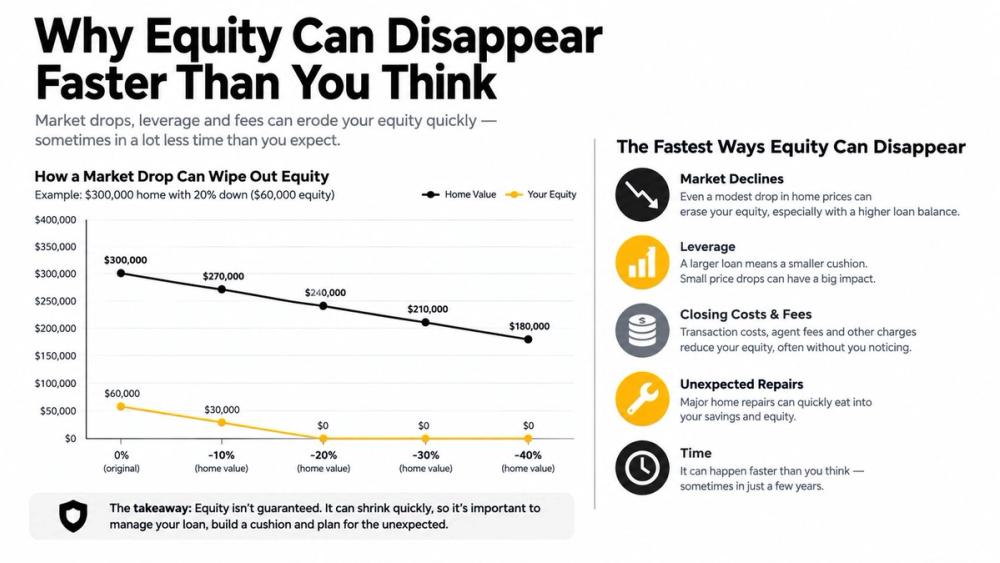
The dangerous part of borrowing against a car is that the collateral wears out while the debt sits still. A vehicle loses value with age, mileage, wear, and market swings, so the equity a lender quotes on day one may not be there by the time you're halfway through repayment.
That's not theoretical. The CFPB found negative equity in 11.6% of vehicle financing transactions from 2018 to 2022, and when negative equity was rolled into financing, the average amount was $5,073 for new-vehicle loans and $3,284 for used-vehicle loans (CFPB report). In other words, underwater loans are common enough to show up as a market pattern, not an edge case.
The cushion has to survive depreciation
The first year of a car's life is usually the hardest on value, and the decline doesn't stop there. If a borrower starts with thin equity, the loan can drift toward underwater status even when every payment is on time. That's why an auto equity loan is really a bet that today's cushion will outlast future depreciation, fees, and interest.
A borrower who needs cash today should ask a harder question than “How much equity do I have?” The better question is, “How much equity will still be there after a year of wear and payments?”
The internal term depreciation is the right lens here because the car is not a house. Home equityThe share of an asset you genuinely own — for a home, its market value minus everything still owed against it. can be more stable, but vehicle value can move quickly enough that a lender's comfort margin disappears before the loan does. That's the trap many borrowers miss when they treat the truck like a savings account on wheels.
The safest borrowers stress-test the loan against a value drop, not just the current appraisal. If the resale market weakens or the car needs repairs, the lender still expects payment, but the cushion behind the debt may already be gone. Once that happens, the borrower has less room to refinanceReplacing an existing loan with a new one, usually to lower the rate, change the term, or convert equity into cash., sell, or trade the car without adding more debt.
Auto Equity Loans Compared With Other Options
A car loan built on equity sits between convenience and risk. The borrower gets cash by using a vehicle as collateral, but the car itself is still a depreciating asset. That matters because a balance that looks safe at signing can become uncomfortable fast if the car loses value faster than the loan balance falls.
A personal loan is the cleaner comparison. It is unsecured, so the lender cannot take the car if payments go late, but approval usually depends on stronger credit and steadier income. A title loan sits at the other end of the range. It can be fast and easy to obtain, but the price is often much higher, and the lender usually wants stronger control over the collateral.
The simplest comparison comes down to four questions: how much it costs, whether the car is at risk, how fast the money arrives, and how hard the lender looks at credit.
| Feature | Auto Equity Loan | Personal Loan | Title Loan |
| Cost | Mid-range secured pricing | Usually lower for strong credit | Usually the highest |
| Vehicle risk | Yes, the car secures the debt | No direct vehicle collateral | Yes, high repossession risk |
| Funding speed | Often 1 to 3 business days | Can be same-day in some cases | Often very fast |
| Credit impact | Usually checked | Usually checked | Often minimal or no check |
That table helps, but the decision involves tradeoffs. A borrower with strong credit may prefer an unsecured loan from a bank or credit union because the car stays protected. A borrower who needs cash quickly and does not have great credit may be drawn to the car-based option, yet speed comes with collateral risk. The question is not only whether the money is available. It is what the borrower is putting at risk to get it.
For a broader paper trail view, a Capital One statement for accountants can help document cash flow. Even then, the better choice comes from matching the loan type to the repayment burden. If the car is needed for work or family logistics, losing it can cost far more than the loan balance.
A Pre-Sign Checklist for Borrowers
The best time to negotiate an auto equity loan is before you sign, not after the first payment is due. Ask the lender direct questions about the APR, any prepayment penalty, the repossession timeline after a missed payment, and whether hardship options exist if your income drops.
Check the numbers on paper, not just in conversation. The offered amount should make sense against the appraised value, the total repayment should fit your budget with room to spare, and the monthly payment should still work if another bill shows up the same week. If the quote looks fine only because it assumes perfect conditions, the loan is too tight.
Read the contract like a skeptic
Go line by line through the loan agreement, lien placement, and insurance requirements. If the phone quote said one rate and the contract adds more than you expected, stop and ask why. A quote that jumps sharply between the first conversation and the final document is a warning sign, not a paperwork quirk.
- Ask about repossession timing: If the lender won't say how long after a missed payment they act, that's a problem.
- Check the total cost: If the monthly payment looks low only because the term is long, the loan may be more expensive than it appears.
- Watch for verbal promises: If a salesperson says one thing and the contract says another, the contract wins.
- Look for blank spaces: Empty fields invite disputes later, especially around fees and add-ons.
Walk away if you feel rushed, if the lender pressures you to sign the same day without time to read, or if the paperwork contains blank spaces that “will be filled in later.” Those are classic signs that the deal is better for the lender than for you.
Stress-test the loan against another 10 to 15 percent drop in car value before you commit. If the deal only works when the vehicle holds its current price perfectly, the cushion is too thin for a depreciating asset.
If you're comparing an auto equity loan with other ways to cover a cash shortfall, use Informer Money to slow the decision down and check the trade-offs in plain language. Visit Informer Money for more step-by-step guides that help you compare costs, collateral risk, and repayment terms before you sign.