
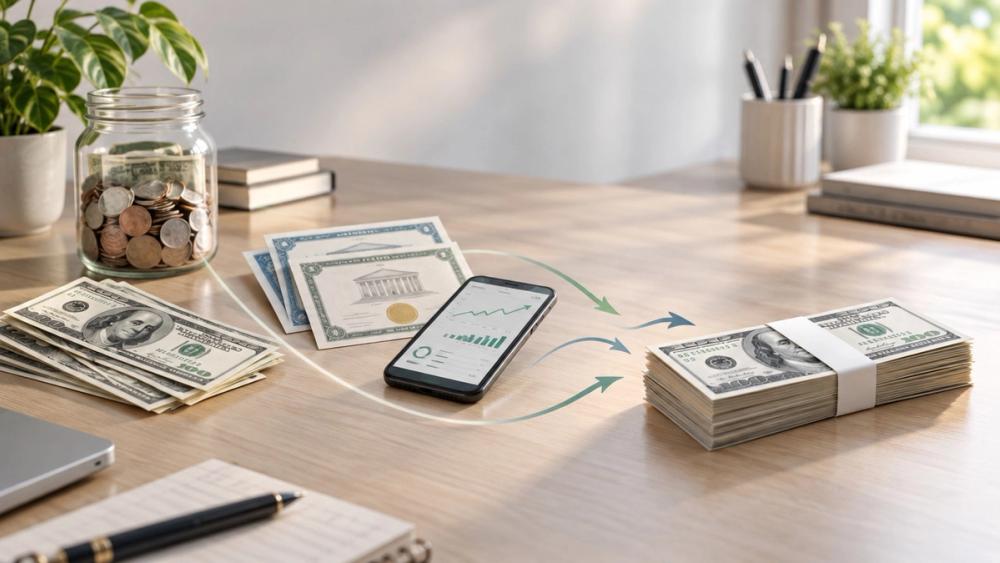
When an emergency hits or an opportunity appears, you need money now, not next month. The difference between covering that expense and going into debt often comes down to which assets you own and how fast you can turn them into cash.
Most liquid assets convert to money in days or even minutes, with little to no loss in value. Others take weeks to sell or come with penalties that eat into what you actually receive. Knowing which assets give you immediate access, and which only look liquid until you try to sell them, helps you build a financial cushion that works when you need it. Below are seven assets ranked by how quickly they convert to cash, what conversion costs to expect, and how each one fits into a financial plan built for flexibility.
1. Cash
Cash is liquid by definition. Physical currency in your wallet, at home, or stored in a safety deposit box requires no conversion to spend. You already hold the medium of exchange.
This immediacy makes cash useful for emergencies and daily transactions. If you need to pay for something right now, cash delivers without processing delays, account transfers, or sale transactions. No brokerage needs to execute a trade. No bank needs to release funds from a certificate of depositA deposit account that locks your money in for a fixed term at a fixed rate, with a penalty for taking it out early..
The tradeoff is opportunity costThe value of the best alternative you gave up by choosing something else — the part of a decision's cost the price tag never shows.. Cash earns no interest sitting in a drawer or wallet. While your checking and savings accounts typically pay some yield, physical currency generates nothing. Over time, inflationThe general rise in prices over time, which steadily reduces what each dollar of savings can buy. erodes its purchasing power. A dollar today buys less than it did five years ago, and that gap widens the longer you hold physical bills without putting them to work in interest-bearing accounts or investments.
2. Checking Accounts
Checking accounts deliver the fastest access to your cash. Funds are available immediately through debit cards, ATM withdrawals, checks, or electronic transfers like Zelle or Venmo. Unlike investments that require selling or CDs that impose waiting periods, checking account money moves the moment you need it.
Most banks charge no fees for standard withdrawals, though you may pay for out-of-network ATM use or overdraftsA bank service that covers transactions exceeding your balance, either by linking another account or by charging a fee to advance the money.. These accounts typically earn little to no interest because they prioritize accessibility over returns. The tradeoff is deliberate: banks keep these funds ready for instant withdrawal rather than investing them for yield.
For emergency purchases, bill payments, or unexpected expenses, checking accounts function as pure liquidity. The money sits ready without conversion steps, making them the default choice when speed matters more than growth.
3. Savings Accounts
Savings accounts offer quick access to cash while earning interest on your balance. Most banks let you transfer funds to a linked checking account instantly or withdraw cash at an ATM the same day. High-yield savings accountsA federally insured savings account paying a much higher rate than a typical bank account, with full access to your money., often offered by online banks, may take one to three business days to complete external transfers to accounts at other institutions.
You typically won't pay fees for standard withdrawals, though your bank may charge for excessive transactions. Federal Regulation D historically capped certain types of withdrawals and transfers to six per month, but the Federal Reserve suspended enforcement in 2020. Some banks still maintain similar limits in their account terms.
The tradeoff for liquidity is modest interest ratesThe percentage charged for borrowing money or paid for depositing it, quoted as an annual figure. compared to longer-term investments. Still, savings accounts remain more accessible than certificates of deposit while providing FDIC insuranceFederal backing that protects deposits up to $250,000 per depositor, per institution, per ownership category. up to $250,000 per depositor.
4. Money Market Accounts
Money market accountsA federally insured bank account that pays savings-level interest while offering check-writing or debit access. bridge savings and checking features, offering both liquidity and competitive interest rates. You can access your funds through checks, debit cards, or ATM withdrawals, making them more flexible than standard savings accounts.
Most transactions settle the same day if initiated during business hours. External transfers to other banks typically take one to three business days, similar to checking accounts.
These accounts usually pay higher interest rates than regular savings accounts because they invest in short-term, low-risk securities. However, banks often require minimum balances ranging from $1,000 to $25,000 to open an account or avoid monthly fees.
Federal regulations previously limited certain withdrawals to six per month, though many banks have relaxed this restriction. Check your bank's current policy before relying on frequent access.
5. Treasury Bills
Treasury billsShort-term US government debt sold at a discount to face value, maturing in a year or less and backed by the Treasury. are short-term government securities that mature in 4, 8, 13, 26, or 52 weeks. You buy them at a discount and receive the full face value at maturity, with the difference serving as your return.
You can sell Treasury bills before maturity on the secondary market, where transactions typically settle in one to two business days. This makes them nearly as liquid as money market accounts, though timing depends on when you initiate the sale.
The U.S. government backs these securities, so the credit risk is virtually zero. Transaction costs through TreasuryDirect are minimal, and brokerage fees for buying or selling are low compared to other investments.
The main consideration is interest rate risk. If rates rise after you purchase, selling before maturity may result in a small loss since newer bills offer better returns. For holdings close to maturity, this impact shrinks considerably.
6. Stocks in Major Exchanges
Publicly traded stocks on the New York Stock Exchange or NASDAQ can be sold any time the market is open. Once you place a sell order and it executes, the transaction settles in two business days (T+2), meaning the cash appears in your brokerage account within that window.
Large-capA company's share price multiplied by its shares outstanding — the standard measure of how large a public company is. stocks from established companies like Apple or Microsoft trade with high volume, so you can usually sell quickly at market price. Small-cap stocks or those with lower trading volume may take longer to sell, and you might need to accept a lower price to find a buyer.
Most major brokers now charge zero commissions on stock trades, though you still pay the bid-ask spread—the difference between what buyers will pay and what sellers are asking. That spread is typically small for heavily traded stocks but can be wider for less popular ones.
Market volatility is the bigger concern. Stock prices fluctuate, so you might sell for less than you paid. For a deeper look at how stocks function as liquid assets, see [link to "Are Stocks Liquid Assets? What Investors Need to Know"].
7. Bonds
Corporate and municipal bonds can be sold on secondary markets before they mature, making them reasonably liquid if you need cash. Investment-grade bonds issued by established corporations and stable municipalities move faster than high-yield or obscure bonds, which may have fewer interested buyers.
Settlement takes two to three business days once you agree to sell. Your broker executes the trade quickly, but the cash doesn't reach your account until settlement completes.
The bid-ask spread on bonds is typically wider than stocks, meaning you'll see a bigger gap between what buyers offer and what sellers ask. That spread cuts into your proceeds. If interest rates have risen since you purchased the bond, its market value has likely dropped, and selling before maturity could mean taking a capital lossThe loss from selling an investment for less than you paid, which offsets capital gains and up to $3,000 of ordinary income a year.. Rates and bond prices move in opposite directions, so timing matters when you need to convert bonds to cash.
Building your liquidity cushion with the right mix
The most liquid assets share one trait: you can convert them to cash in three days or less. Cash, checking accounts, and savings accounts give you immediate access with no conversion costs. Money market accounts and Treasury bills add a day or two but still settle quickly. Stocks and bonds take the longest at two to three business days and may involve spreads or losses depending on market conditions.
Start by checking how much you hold in same-day assets like cash and checking accounts. If that total covers three to six months of expenses, you have a solid liquidity cushion. If it doesn't, consider shifting some money from investments into high-yield savings or money market accounts where it stays accessible but still earns interest.