
A hardware wallet is supposed to put distance between your Bitcoin and everyone trying to take it. No exchange login to steal. No browser extension to compromise. No private key sitting on an internet-connected computer.
That’s why the Coldcard security incident landed so hard.
In late July 2026, large amounts of Bitcoin began moving out of wallets in coordinated sweeps. The reported losses grew quickly into the tens of millions of dollars. The suspected cause was not a new break-in or a stolen batch of devices. It was a flaw in how some Coldcard wallets had generated recovery seeds years earlier.
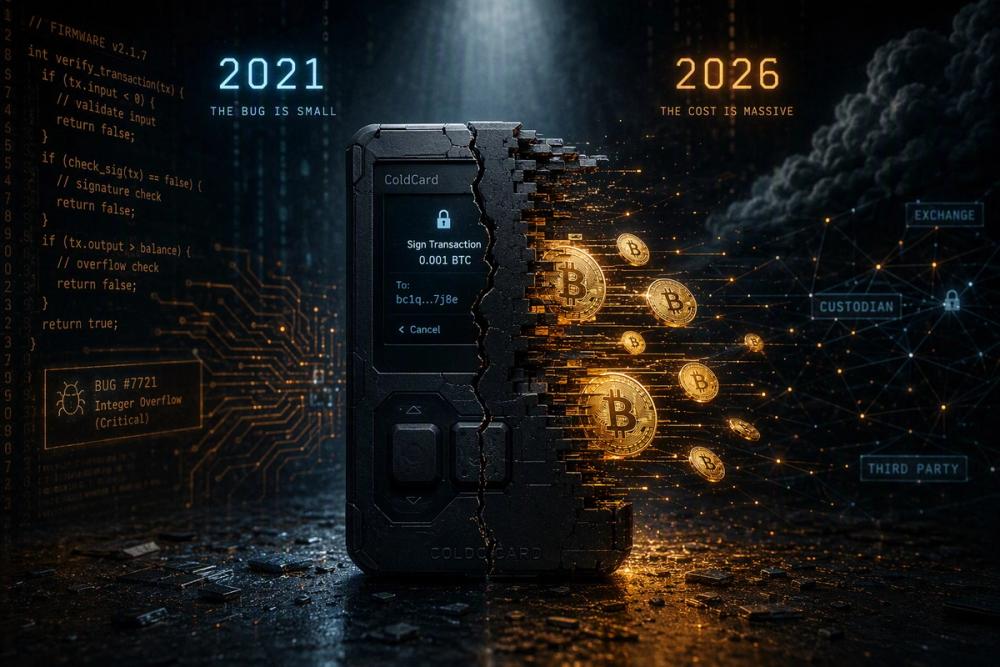
The problem began with a firmware change in 2021. And it carries a difficult lesson for anyone holding Bitcoin: keeping keys offline is only as safe as the process that created those keys in the first place.
The Coldcard hack timeline: A bug introduced in 2021
Bitcoin wallets depend on randomness.
When you set up a hardware wallet, it creates a recovery phrase—usually 12 or 24 words. Those words represent the secret that ultimately controls your Bitcoin. A properly generated seed has so many possible combinations that guessing it should be practically impossible.
That was the expectation. But Coldcard’s firmware changed in March 2021.
Before that change, the wallet’s seed-generation process used the STM32 chip’s hardware random-number generator. On March 1, 2021, Coldcard changed the code path used to generate wallet entropy. The new path was included in firmware version 4.0.0, released on March 17, 2021.
According to Block’s published engineering analysis, the new code did not use the intended hardware randomness source. Instead, due to a software integration mistake, it used a deterministic fallback generator in MicroPython known as Yasmarang.
That distinction matters. A deterministic generator can produce output that looks random. But if an attacker can reconstruct the information that started it—such as device-specific details, timing values, and the sequence of earlier operations—they may be able to reproduce candidate seeds offline.
In other words, the seed words could be less unpredictable than owners believed.
Why the 2021 Coldcard firmware bug was serious
This wasn’t a typical Bitcoin theft where someone clicks a phishing link, gives away a seed phrase, or installs malicious software.
The reported Coldcard theft risk began much earlier: at the moment the wallet created the recovery seed.
Think of it like a house key cut from a machine that uses a limited set of patterns. The key may look unique. But if someone understands the machine well enough, they may be able to narrow down the possible copies without ever entering your home.
A Bitcoin address is public, which makes this especially dangerous. An attacker can generate a possible seed, derive its addresses, and compare them with addresses already visible on the blockchain. If there’s a match, they have found the key material needed to control the funds.
The wallet does not need to be online. The owner does not need to make a mistake that day. And updating the device after the fact does not make an old seed unpredictable again.
That last point is the one many people could easily miss.
From firmware flaw to 2026 Bitcoin theft
In 2022, later Coldcard models introduced a secure-element reseed process intended to strengthen the random-number generation process. But Block’s researchers concluded that the implementation retained only 32 bits of the secure input, which still left a much smaller security margin than a properly generated Bitcoin seed should have.
The severity differed across Coldcard generations. The older Mk2 and Mk3 devices running affected 4.x firmware were considered the most exposed because their seed-generation path did not add cryptographic entropy. Later models had a different risk profile, but the issue still required urgent action.
Then, on July 30, 2026, public reports began to show unusual, rapid sweeps from many Bitcoin addresses. Blockchain investigators linked the affected addresses to wallets created during the vulnerable period. Multiple waves of theft followed.
Important nuance: a blockchain transaction pattern can show that funds moved in a similar way, but it cannot automatically identify the person behind the theft or prove that every related transaction was unauthorized. The attacker has not been publicly identified.
Still, the timing, affected wallets, and underlying vulnerability made the threat hard to dismiss.
Which Coldcard wallets may be affected?
According to Coinkite’s security advisory, exposure depends on the firmware that was installed when the seed was created—not the firmware currently installed and not necessarily the date the device was purchased.
The advisory identifies these affected ranges:
- Mk2 and Mk3: Seeds generated on firmware versions 4.0.1 through 4.1.9.
- Mk4 and Mk5: Seeds generated before standard version 5.6.0 or Edge version 6.6.0X.
- Coldcard Q: Seeds generated before standard version 1.5.0Q or Edge version 6.6.0QX.
Coinkite says the risk is reduced where the owner added at least 50 fair, independent, private dice rolls during seed creation. Those dice rolls supply independent entropy rather than relying entirely on the device-generated value.
A strong, unique BIP-39 passphrase can also provide meaningful extra protection. But it is not the same thing as a Coldcard PIN. The PIN protects physical access to the device; a BIP-39 passphrase creates a separate wallet behind the recovery words.
Even then, Coinkite recommends moving funds to a newly generated seed as soon as practical.
What Coldcard owners should do now
The first rule is simple: do not assume a firmware update repairs your existing recovery phrase.
Updating is still necessary, but it only protects new seeds generated after the fix. If your old seed came from affected firmware, importing those same words into a new wallet carries the original weakness with it.
A careful migration looks like this:
- Update the Coldcard to the fixed firmware for your model.
- Create a completely new seed on the updated device.
- Back up the new seed offline and verify the wallet fingerprint and a receive address on the device screen.
- Send a small test amount first.
- Confirm the transaction arrived before moving the rest of the Bitcoin.
- Never enter your old seed words or passphrase into a website, email form, or unsolicited “support” tool.
This is also a moment when scams multiply. Use official sources directly, not links sent through social media, email, or direct messages.
The bigger lesson from the Coldcard hack timeline
The Coldcard incident does not mean hardware wallets are useless. It does mean that “offline” is not a complete security strategy.
Bitcoin self-custody puts more control in your hands. But it also means trusting the device, the firmware, the seed-generation process, your backups, and your own habits. One weak link can matter for years before anyone notices.
For Coldcard owners, the practical takeaway is clear: if your seed may have been created on affected firmware and you cannot confidently verify that you used sufficient private dice entropy, treat it as at risk. Update the device, generate a new seed, and move the Bitcoin carefully.