The chart climbed all week. You decided to take profits, tapped sell, and got an error. You refreshed. Same error. Twenty minutes later the price sat near zero and the project's Discord had disappeared.
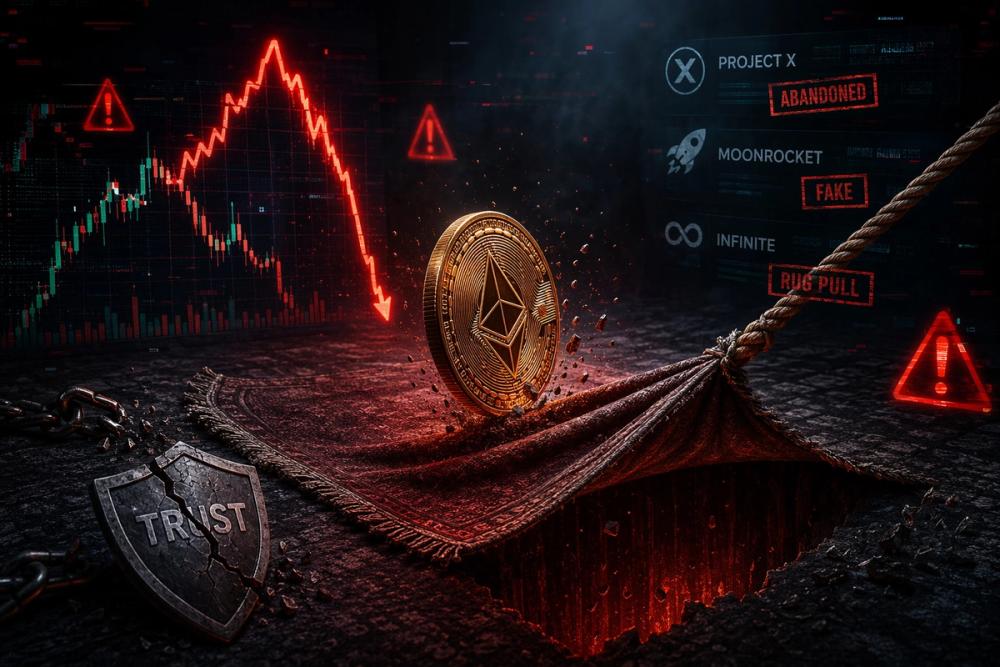
That error message is a crypto rug pull in progress — developers build hype around a token or NFT project, then take the funds and leave holders with something worthless. Blockchain analytics firm Chainalysis attributes roughly $2.8 billion in losses to rug pulls in 2025, close to 35% of everything lost to crypto scams that year.
Nearly every case runs on one of five mechanics. Learn their shapes and you will spot the setup before your money moves.
1. The Liquidity Pull: When the Exit Door Disappears
Every tradable token needs a liquidity pool — a pot of money that lets buyers and sellers transact. Developers usually create that pool themselves, which means they hold the keys. In a liquidity pull they withdraw everything and the market ceases to exist.
AnubisDAO is the textbook case. In October 2021 it raised around $60 million in Ethereum in roughly twenty hours, promising a decentralized reserve currency. No whitepaper. No website. A pseudonymous team. The pool emptied before most investors had finished reading the announcement thread.
The check that catches it: confirm the liquidity is locked or burned before buying. Unlocked liquidity means the developer can walk out whenever the pot is full enough.2. The Honeypot: You Can Buy But You Cannot Sell
This rug pull scam lives in the contract code rather than the founders' behavior. Buying functions perfectly. Selling is quietly disabled for everyone outside the insider wallets.
The chart looks extraordinary right up to the collapse, for a mechanical reason: no sell pressure exists when nobody is permitted to sell. Squid Game Token demonstrated this in November 2021, riding the Netflix series to a peak near $2,861 before holders discovered the contract blocked their exits. The developers extracted about $3.38 million and closed every channel.
The check that catches it: run the contract address through a free honeypot scanner, or buy $5 worth and immediately try to sell it before committing anything real.3. The Insider Dump: A Pump and Dump Wearing a Roadmap
No code exploit appears here at all. The team holds most of the supply, manufactures attention, then sells into the demand it created. The pool stays open the entire time and the price still reaches zero.
Distribution is the whole story. When ten wallets control 70% of a token, ten people decide your outcome. Influencer memecoins repeat this pattern mechanically: viral launch, insider wallets exiting within hours, community holding the remainder.
The check that catches it: review holder concentration on a block explorer before you buy.4. The Mint and Vanish: NFT Rug Pulls
Same fraud in a different wrapper. Here the roadmap itself is the product — staking rewards, merchandise, exclusive access, a game arriving next quarter.
Frosties launched in January 2022 with 8,888 pieces of ice-cream-themed art. It sold out fast, raised between $1.1 and $1.3 million, and the treasury drained within hours. It also produced rare consequences: prosecutors charged both founders with wire fraud and money laundering.
The check that catches it: treat unfunded roadmap promises as advertising rather than obligations. Founders with verifiable identities and prior work change the risk calculation considerably.5. The Soft Rug: Death by Slow Abandonment
The hardest version to see and the hardest to prosecute. Nobody drains anything in one dramatic transaction. Insiders sell gradually, development slows, moderators go quiet, and roadmap dates slip until they stop being mentioned. It resembles ordinary business failure, which is precisely the point.
Soft rug pulls have grown faster than the hard variety, partly because intent is so difficult to prove. Without documented deception, quietly abandoning a project may be unethical yet fall short of criminal.
The check that catches it: watch team wallet movement and commit activity instead of announcements. Quiet selling shows up on-chain long before it reaches the community.The Red Flags Shared Across All Five
Before any purchase, work through this list:
- Anonymous team with no verifiable track record
- Unlocked or very shallow liquidity
- A handful of wallets holding most of the supply
- Unverified or unaudited contract code
- Guaranteed returns, countdown timers, or a coordinated wave of influencer posts
- Pressure to buy right now, before the "next leg up"
If You Have Already Been Rugged
Blockchain transactions are irreversible and recovery is rare. That is the honest position.
Report it anyway. Complaints filed with the FBI's IC3 and the CFTC build the cases that occasionally produce arrests. Save wallet addresses, transaction hashes, and screenshots for tax purposes.
One more warning: anyone promising to retrieve your funds for a fee is running the second scam. Victim lists circulate and get worked twice.
The Practical Takeaway
Every one of these five rug pulls was visible before the money moved. Locked liquidity, holder distribution, verified code, a test sale — the checks take minutes and they remove most of the risk you can actually control. Size positions for total loss, because here total loss is a routine outcome rather than an unlucky edge case.