
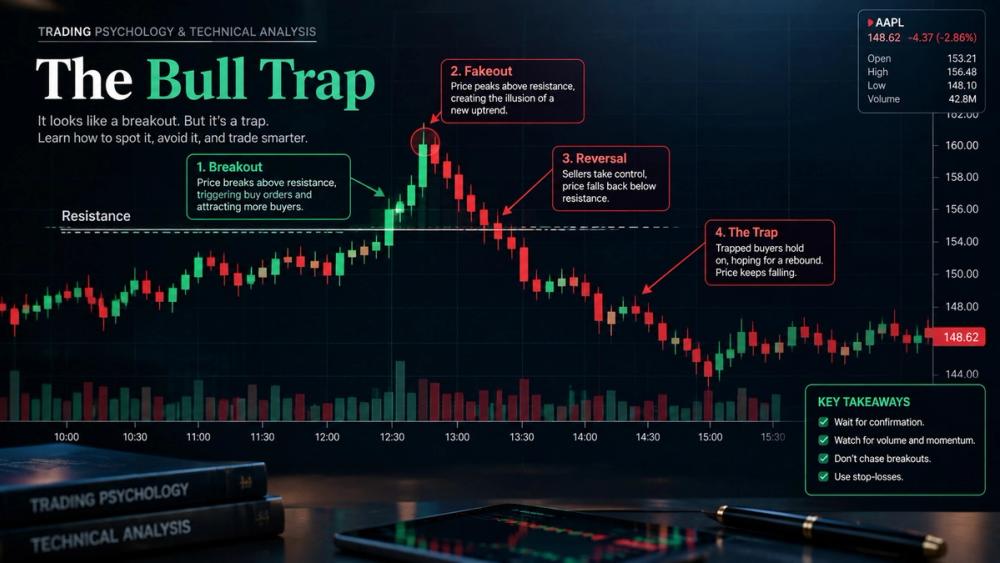
A sudden price surge looks like the start of a rally, so you buy in. Days later, the stock reverses and your position is underwater. That's a bull trap: a false breakout that tricks investors into buying right before prices fall.
Bull traps happen during downtrends and sideways markets when short-term price moves look like the beginning of something bigger. Professional traders know the setup and avoid it. Retail investors often don't spot the warning signs until it's too late.
This guide explains how bull traps form, why they catch so many traders off guard, and what patterns signal trouble before you commit capital. You'll learn to recognize the conditions that create false breakouts and separate real momentum from temporary noise.
Bull trap definition and mechanics
A bull trap is a false breakout where a stock's price rises above a key resistance level, attracting buyers who expect the uptrend to continue, then quickly reverses and falls. The pattern deceives traders into entering long positions at precisely the wrong moment.
The mechanism unfolds in stages. Initial buying pressure pushes the price through resistance, often triggering automated buy orders and drawing attention from momentum traders. This creates the illusion of a legitimate breakout. Within hours or days, selling pressure overwhelms the move. Buyers who chased the breakout find themselves holding positions as prices drop back below the resistance level they thought was conquered.
Bull traps catch momentum traders and breakout buyers who interpret the initial move as confirmation of continued strength. These patterns appear in individual stocks and market indexes alike.
Why bull traps happen
Market psychology plays a central role. When prices break through resistance levels, traders who missed earlier gains rush in, driven by the fear of missing out. This late buying often happens at precisely the wrong moment.
Technical factors amplify the problem. A breakout on low trading volume signals weak conviction. Without substantial participation, the move lacks the strength to sustain itself. Prices may rise briefly, but the absence of follow-through buying leaves the rally vulnerable.
Institutional players sometimes contribute deliberately. Large investors holding significant positions can push prices higher to create exit liquidity. As retail traders buy the breakout, institutions sell into the demand, distributing their shares at favorable prices.
Bull traps frequently appear near the end of extended bull marketsA sustained stretch of rising prices, conventionally dated from a 20% recovery off the previous market low., when buying power becomes exhausted and fewer participants remain willing to chase prices higher.
Warning signs of a bull trap
Several technical signals can help you spot a potential bull trap before you get caught. Watch for volume divergence: when a stock breaks above resistance on declining or unusually light volume, it suggests institutional investors aren't participating in the move. Price momentum indicators like RSI or MACD sometimes show bearish divergence, pointing downward even as the stock makes new highs—a warning that upward momentum is fading. Breakouts that occur on sudden gaps or sharp vertical moves tend to be less reliable than gradual, sustained advances built over multiple sessions. If price fails to hold above the breakout level within a few days and quickly reverses back below the old resistance zone, that's a classic trap pattern. Also consider the broader market: if major indexes show weakness or mixed signals while your stock is breaking out, the individual move may lack the support needed to sustain gains.
Historical examples of bull traps
The dot-com bubble's final months in early 2000 produced several devastating bull traps. The NASDAQ Composite briefly rallied in late March after an initial sell-off, convincing many investors the correction had ended. Thousands bought back in, only to watch the index lose 78% of its value over the next two years. Similarly, during the 2008 financial crisis, bear marketA decline of 20% or more from a recent market high, and the stretch of falling prices that follows it. rallies in May and August lured investors who believed the worst had passed. The S&P 500 dropped another 40% by March 2009. Individual stocks show the pattern too: Lehman Brothers rallied 20% in early September 2008 as buyers saw a bargain, then collapsed into bankruptcy within days. These episodes share a common thread—initial optimism, a sharp reversal, and substantial losses for those who bought the false signal.
How to avoid bull traps
Wait for confirmation before committing capital. Let the breakout establish itself over at least two or three sessions with consistent closing prices above resistance. A single strong day means little if the next two sessions give back the gains.
Set stop-loss orders just below the breakout level to cap your downside if the move reverses. This protects you from holding through a full collapse back to the previous range.
Volume separates real breakouts from false ones. Trust moves accompanied by above-average buying volume, which signals genuine institutional participation rather than retail speculation.
If you miss the initial breakout, wait for a pullback to support rather than buying at resistance. Chasing momentum into an extended move increases your odds of entering just as the trap springs.
Finally, check the broader market before acting on individual stock signals. Bull traps multiply during late-stage rallies when indexes are overextended.
Protecting yourself from bull traps
Bull traps punish investors who chase breakouts without confirmation. Before buying on an apparent breakout, wait at least two to three days to see if the price holds above resistance on strong volume. If you do enter, place a stop-loss order just below the breakout level so a reversal doesn't turn into a major loss. Most importantly, resist the urge to chase a stock that has already moved sharply higher. Missing one trade is better than entering at the peak of a false move. When broader market conditions look weak or volume is declining, skepticism serves you better than momentum.
Frequently asked questions
How long does a bull trap typically last?
A bull trap can last anywhere from a few hours to several weeks, depending on market conditions and the asset involved. Short-term traps in volatile stocks might resolve within days, while broader market bull traps can persist for weeks before the reversal becomes clear. The duration often correlates with how widely the false breakout was believed.
Can bull traps happen in bear markets?
Yes, bull traps frequently occur during bear markets as temporary rallies that deceive investors into thinking the downturn has ended. These are sometimes called bear market rallies or relief rallies. They're particularly common during extended downturns when investors are eager for signs of recovery and may interpret any upward movement as a trend reversal.
What's the difference between a bull trap and a bear trap?
A bull trap is a false signal that a declining price trend has reversed upward, trapping bullish investors who buy in. A bear trap is the opposite: a false signal that an upward trend has reversed downward, trapping bearish investors who short-sell or sell their positions. Both are false breakouts, just in opposite directions.
Do professional traders fall for bull traps?
Yes, even experienced traders can be caught in bull traps, though they typically use risk management tools like stop-loss orders to limit losses. The difference is that professionals usually have predetermined exit strategies and position sizing rules, while retail investors may hold losing positions longer hoping for recovery. No trader is immune to false signals.
Are bull traps illegal or a form of market manipulation?
Bull traps themselves are not illegal. They're a natural result of market psychology, technical patterns, and collective investor behavior. However, deliberately creating a bull trap through coordinated buying followed by selling, or spreading false information to trigger one, would constitute market manipulation and is illegal. Most bull traps form organically.