There is a line on your bank statement labeled "monthly maintenance." It is small enough to scroll past and large enough to matter. The 2026 MoneyRates Checking Account Fee Survey puts that charge at an average of $13.95 a month — nearly $170 a year for the privilege of storing your own money.
Here is the complication. "No fee" has become a marketing phrase rather than a guarantee. Plenty of banks advertise free checking then quietly attach conditions: keep $500 on deposit, receive a qualifying direct deposit, make ten debit purchases. Miss the condition and the fee returns.
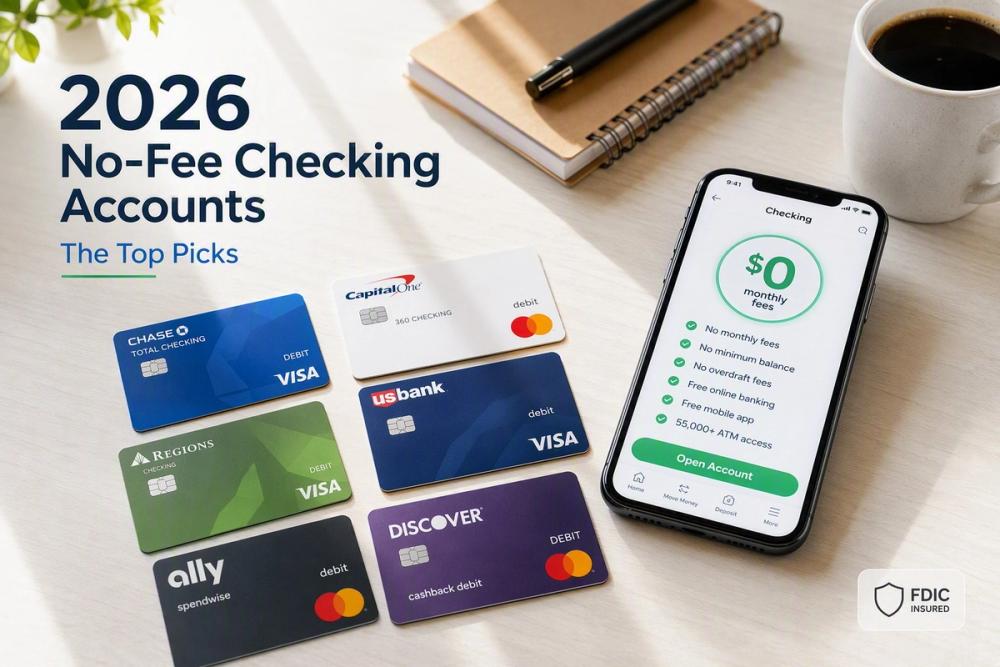
The seven accounts below charge nothing unconditionally. No balance floor. No activity quota. They are sorted by who each one actually fits, because the right free checking account depends far more on how you bank than on where it lands in a ranking.
What Makes a Checking Account Genuinely No Fee in 2026
A waived fee and an absent fee produce identical statements — right up until the month you stop qualifying. That distinction is the whole game.
Four non-negotiables separate the real thing from the marketing:
- $0 monthly maintenance fee with no strings. No minimum balance, no direct deposit requirement, no debit transaction count.
- No minimum opening deposit. You should be able to open the account with $0 and keep it open at $0.
- Free cash access. Either a large in-network ATM footprint or reimbursement of out-of-network surcharges.
- No overdraftA bank service that covers transactions exceeding your balance, either by linking another account or by charging a fee to advance the money. or NSF fee. These now average north of $30 per occurrence, and they cascade — several transactions while negative means several separate charges.
One safety note before the picks. Every account here is federally insuredFederal backing that protects deposits up to $250,000 per depositor, per institution, per ownership category. — FDIC coverage to $250,000 per depositor per ownership category at banks, NCUA coverage at credit unions. You can verify any institution directly at FDIC.gov.
The 7 Best No Fee Checking Accounts in 2026
1. Ally Spending Account — Best No Fee Checking Account Overall
Ally is the low-drama default, and that is a compliment. The Ally Spending Account carries no monthly fee, no overdraft fee and no minimum deposit. It earns 0.10% APYThe yearly return on savings including the effect of compounding, which makes it the honest number for comparing deposit accounts. on balances under $15,000 and 0.25% above that line. You get access to more than 75,000 fee-free ATMs plus up to $10 per statement cycle in reimbursements for third-party ATM surcharges.
The feature worth noticing is CoverDraft. Eligible customers get up to $250 in overdraft coverage at zero fee — the transaction simply goes through and you repay it when funds land. No interest, no penalty.
The catch: no branches, and no debit card cash back. If you deposit physical cash more than occasionally, look at the next entry instead.2. Capital One 360 Checking — Best Free Checking With Branch Access
Most banks force a choice between fee-free terms and a physical location. Capital One 360 Checking refuses that tradeoff. No monthly fee, no minimum balance, no overdraft fee — paired with real branches and Capital One Cafés where you can deposit cash and talk to a person.
The account earns up to 0.10% APY as of May 2026. That is modest. It is also more than the 0% most large traditional banks pay on checking.
The catch: the yield trails SoFi and Axos by a wide margin. You are paying for branch access in foregone interest, which is a reasonable trade if you use the branches.3. Charles Schwab Bank Investor Checking — Best for Travelers
Schwab Bank Investor Checking has one feature almost nobody matches: unlimited ATM fee rebates on cash withdrawals worldwide, with no cap. Add no foreign transaction fees, no monthly service fee, no minimum balance and no overdraft fee, and you have the standard-issue account for frequent international travelers.Two structural details matter. The account requires a linked Schwab One brokerage account — free to open, no trading required. And rebates credit at the end of the statement period rather than instantly.
The catch: Schwab lists no cash-deposit method. This account cannot be your primary if you handle physical currency.4. SoFi Checking and Savings — Best for Early Direct Deposit
SoFi pays 0.50% APY on checking — roughly seven times the national average for interest-bearing checking — with no monthly fees and no minimum balance. Direct deposit arrives up to two days before payday. You get more than 55,000 Allpoint ATMs and up to $50 in overdraft coverage if you maintain direct deposit and a $1,000 balance.The Vaults feature lets you partition money into labeled buckets inside the same account, which is genuinely useful for anyone who budgets by category.
The catch: no branches, and the best perks are gated behind qualifying direct deposit. The account itself stays free either way.5. Axos Rewards Checking — Best No Fee Checking for Yield
Axos Rewards Checking advertises up to 3.30% APY with unlimited domestic ATM fee reimbursement and no monthly fee. Read the mechanics carefully, because the headline rate is tiered rather than automatic.The advertised APY splits into thirds. You earn one third for each monthly condition met: $1,500 in direct deposits, ten debit card purchases of at least $3 each, and a qualifying Axos Invest balance. Meet all three and you out-earn most high-yield savings accountsA federally insured savings account paying a much higher rate than a typical bank account, with full access to your money. on your checking balance.
The catch: reimbursement covers domestic surcharges only — no international coverage. Domestic wires cost $35. The account is unconditionally free. The rate is not.6. Fidelity Cash Management Account — Best for Large Cash Balances
The Fidelity Cash Management Account delivers checking mechanics — debit card, check writing, bill pay, Zelle — with $0 fees and unlimited worldwide ATM reimbursement. Its differentiator is insurance depth. Uninvested cash sweeps overnight into a network of program banks, extending FDIC coverage to roughly $5 million. That sweep earns about 2.72% APY. Hold cash in a money market fund like SPAXX instead and the yield climbs closer to 4.97%.
The catch: this is a brokerage account with banking features attached, not a bank account. The distinction matters for how deposits are held and how quickly funds settle.7. Alliant High-Rate Checking — Best Credit Union Option
Alliant Credit Union High-Rate Checking charges no monthly maintenance fee and reimburses up to $20 per month in ATM fees — the most generous capped reimbursement on this list. To earn interest, you enroll in e-statements and maintain at least one recurring monthly deposit. The catch: membership requires an eligibility step, though Alliant's qualification paths are broad. Deposits carry NCUA insurance rather than FDIC.Also Worth a Look
Chime suits people rebuilding banking history who want early pay without a ChexSystems hurdle. Varo offers debit cash back that most free accounts dropped.The Big 2026 Change: Discover Cashback Debit Is Gone
The best debit rewards account in America stopped taking applications, and most published rankings have not caught up.
Discover merged with Capital One in May 2025 and closed to new banking applications as of January 2026. Existing accounts are migrating to Capital One. What disappeared: 1% cash back on up to $3,000 in monthly debit purchases, worth up to $360 a year, on an account with no monthly fee and no overdraft fee.
Capital One does not currently offer an equivalent cash back debit product. If you hold a Discover checking account today, wait for official migration instructions rather than closing it yourself. If a "best of 2026" list still ranks it, treat that list as stale.
How to Choose the Right No Fee Checking Account
The ranking matters less than the match. Choose by behavior:
- You handle cash regularly → Capital One 360 or Alliant. Rule out Schwab entirely.
- You travel internationally → Schwab or Fidelity. Both reimburse worldwide with no cap.
- You want maximum yield and will meet monthly conditions → Axos.
- You want one login, no hoops → Ally or SoFi.
- You hold six figures in cash → Fidelity, for the program bank insurance depth.
How to Switch Without Breaking Your Autopay
Switching accounts is easy. Switching cleanly takes about sixty days.
- Open the new account and fund it with a small starter amount — $100 to $500.
- Update direct deposit through your employer's payroll portal.
- Move autopay billers one at a time, confirming each payment posts before moving the next. This is the slow part. Do not batch it.
- Keep the old account open with a cushion for at least one full billing cycle.
- Once nothing has hit the old account for 30 days, close it in writing and keep the confirmation.
Frequently Asked Questions
Are no fee checking accounts really free? The seven above are. The broader category is not. Test any account against the four non-negotiables — unconditional monthly fee, no minimum, free cash access, no overdraft charge. Do no fee checking accounts earn interest? Some do, modestly. The FDIC national average for checking sits at 0.07% APY as of July 2026. Even the strongest checking yields belong in a savings account instead. Is my money safe at an online-only bank? Yes, provided the institution carries FDIC or NCUA insurance. Coverage runs to $250,000 per depositor per ownership category — identical protection to any branch bank. Can I open one with poor banking history? Most banks screen through ChexSystems. Fintech-backed accounts like Chime are typically more forgiving than traditional institutions.The Bottom Line
Roughly $170 a year, recovered by a fifteen-minute application and held permanently. That is the entire proposition. The account that fits you is the one that matches how you actually move money — cash, travel, direct deposit, or balance size — not the one that ranks first on somebody's list.
Rates, fees and account terms change frequently. Verify current details on each institution's website before opening an account. Rates verified: August 2026.