
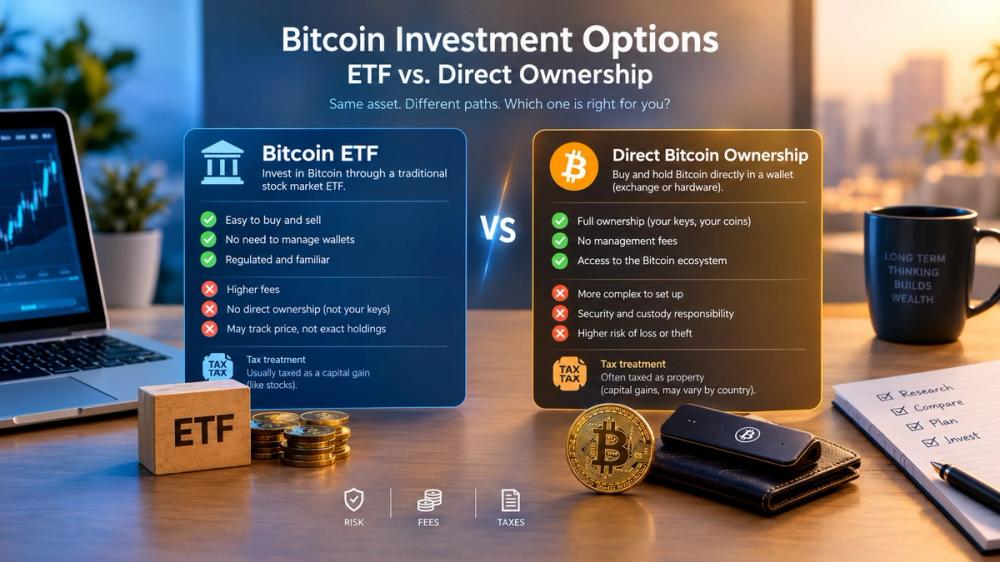
A spot Bitcoin ETFA fund holding a basket of investments that trades on an exchange like a single stock, usually tracking an index at low cost. is a share you buy in a brokerage account. Owning Bitcoin means you hold the coins, either with an exchange or in a wallet you control. Both move with Bitcoin's price. They do not give you the same control, the same paperwork, or the same places to keep the position. The better fit depends on whether you want a security in a normal account or the coins themselves.
This is general information, not tax, legal, or investment advice. Federal rules can change, and state rules differ.
What you actually hold
A spot Bitcoin ETF holds Bitcoin and issues shares that track its price. Funds such as IBIT, FBTC, and GBTC work this way. You buy and sell those shares during stock-market hours, next to the rest of a portfolio. You cannot send the shares to a wallet, spend them, or move them on the Bitcoin network. The fund's custodian holds the coins. You hold a security.
The fund charges an expense ratioThe annual percentage of your investment that a fund charges to operate, deducted automatically from returns.. The annual fee looks small, but it reduces your result every year you stay invested. Check the current figure on the issuer's site before you buy. A quoted price from last year is not a quote you can use.
Owning Bitcoin is different. You buy coins on an exchange or receive them, then leave them there or move them to a wallet. Self-custody takes the exchange out of the picture. It also means a lost seed phrase can mean lost coins. There is no fund fee. You still pay network fees, trading spreads, and the time it takes to secure the wallet.
Futures products, such as BITO, do not hold Bitcoin. Their tax treatment can differ. The comparison below is about spot funds unless a sentence says otherwise.
Pros and cons of a Bitcoin ETF
Brokerage access is the practical advantage. You already have the account, the statements, and often an IRA or 401(k)An employer-sponsored retirement account that lets you invest part of your paycheck before taxes, often with a matching contribution. lineup that will accept the shares. You do not manage seed phrases. You can rebalancePeriodically buying and selling to return a portfolio to its target mix after market moves have shifted it. the position in the same place as your other holdings.
SIPC may cover missing securities if a brokerage fails. It does not cover a drop in Bitcoin's price. FDIC insuranceFederal backing that protects deposits up to $250,000 per depositor, per institution, per ownership category. does not apply to ETF shares either.
The tradeoff is distance from the asset. You depend on the fund, its custodian, and market hours. You pay the expense ratio for as long as you hold the shares. You cannot use the position as money. A large sponsor does not remove Bitcoin's price swings.
Pros and cons of owning Bitcoin
Direct ownership gives you the coins. You can move them at any hour, hold them outside a brokerage, and keep them if you leave a particular firm. There is no fund expense ratio. Small purchases are often available, though fees and spreads still matter.
The costs show up as operational risk. An exchange account can be frozen or hacked. Self-custody fails if you lose the keys or approve a bad transaction. Coin-to-coin trades, spending, and some transfers are also easier to mishandle at tax time than a single brokerage sale. The price risk is the same risk an ETF holder takes.
Bitcoin ETF tax rules vs. taxes on the coins
The IRS treats digital assets as property, not currency. That rule goes back to Notice 2014-21. Selling a spot Bitcoin ETF share is a taxable sale. Selling, spending, or trading Bitcoin is a taxable disposition. Simply holding either one does not create a capital gainThe profit from selling an asset for more than you paid, taxed at a lower rate if you held it longer than a year..
The holding period sets the rate. If you held the asset for one year or less, the gain is short-term and taxed at ordinary income rates. If you held it for more than one year, the gain is long-term and uses the lower capital-gains brackets. A spot Bitcoin ETF is not taxed at a lower rate than Bitcoin itself. Losses can offset gains. Up to $3,000 of net capital lossThe loss from selling an investment for less than you paid, which offsets capital gains and up to $3,000 of ordinary income a year. can offset ordinary income each year, with the rest carried forward. Use the brackets in the current IRS instructions rather than a number you remember from an older return.
The forms are where the two paths split. A brokerage usually reports spot ETF sales on Form 1099-B. You still report the lots on Form 8949 and Schedule D. Direct sales through a custodial broker now face Form 1099-DA. Brokers must report gross proceeds for transactions on or after January 1, 2025. Basis reporting phases in for certain sales of assets acquired on or after January 1, 2026. The IRS describes the phase-in on its digital assets page. Moving coins to a wallet does not erase your duty to track what you paid.
Retirement accounts are the clean tax difference for most readers. Many IRAs can hold a spot Bitcoin ETF. A traditional IRAA retirement account where contributions may be tax-deductible now and withdrawals are taxed as ordinary income later. defers tax until you take money out. A Roth IRAA retirement account funded with after-tax dollars where qualified withdrawals, including all growth, come out tax-free. can make qualified withdrawals tax-free. Putting coins in a self-directed IRA is possible, but the setup is slower, and prohibited-transaction rules are easy to break.
Wash salesAn IRS rule disallowing a capital loss if you buy a substantially identical security within 30 days before or after the sale. need a careful reading. ETF shares are securities, so the wash-sale rule can disallow a loss if you buy the same or a substantially identical share within 30 days before or after the sale. Direct Bitcoin has not been treated as a security under that rule. Lawmakers have looked at closing that gap. Do not build a loss-harvesting plan on the assumption that it stays open.
Futures funds can fall under different rules, including mark-to-market treatment and a 60/40 long-term and short-term split. That treatment belongs to those products, and only when the tax form you receive shows it. Do not apply it to a spot fund.
Which one fits
Neither choice is automatically better. Choose the ETF if you want Bitcoin's price inside a brokerage account, want retirement-account treatment, and do not want to hold keys. Choose direct Bitcoin if you want the coins and you will handle custody and your own basis records.
Either position can sit as a small slice of a broader portfolio. Neither removes volatility. If you want to spend Bitcoin, trade coin for coin, or earn staking-style rewards on other assets, that is a separate decision, with its own risks and tax reporting.
You get the same price exposure either way. You do not get the same ownership or the same tax forms. Before you buy, check the fund's current expense ratio. Before you sell, check the latest IRS instructions, or ask a tax professional who can look at your return.