

Your first paycheck after a raise arrives and the federal income tax line is higher than you expected. Knowing how to check your federal withholdingThe income tax your employer deducts from each paycheck and sends to the government on your behalf during the year. after a raise starts with two numbers on your pay stub. One shows what your employer withheld for that pay period and the other shows what it has withheld so far this year. Use both to estimate whether you’re on track for tax season and decide whether to update Form W-4.
1. How to check your federal withholding after a raise using your pay stub
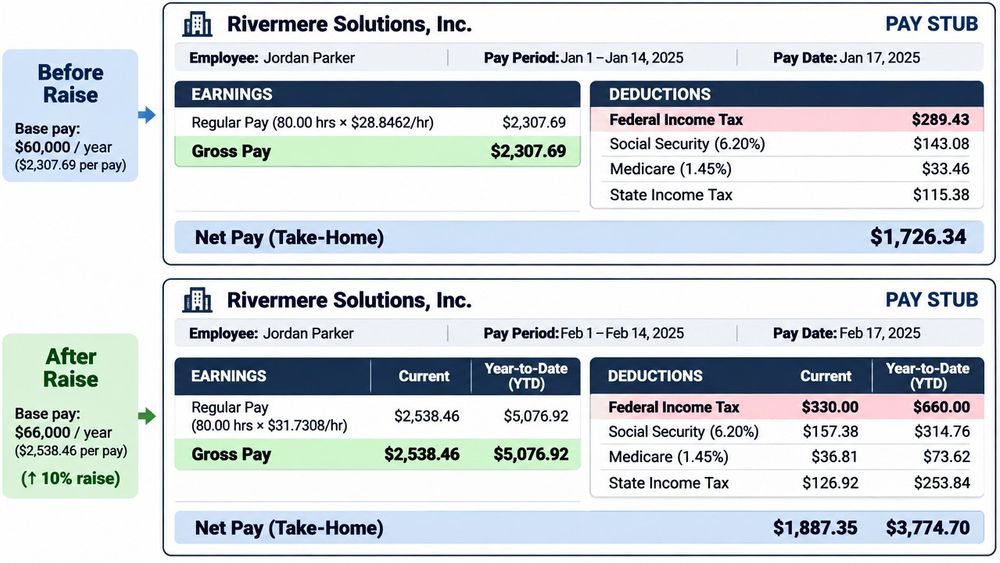
Compare your last regular paycheck before the raise with your first paycheck covering a full pay period at the new rate. Start with gross payYour total pay before any taxes, benefits, or contributions are deducted — the figure lenders and tax rules start from., the amount you earned before taxes and deductions. Then compare how much federal income tax your employer took out of each check and paid to the IRS on your behalf. If the raise started partway through a pay period, wait for a check that reflects the new rate throughout. That gives you a better baseline for what payroll will withhold from future checks.
Find the current and year-to-date withholding amounts
Look for “Federal Income Tax,” “FIT” or “FITW” on your pay stub. Read across that row to find the two amounts you’ll use.
- Current shows how much federal income tax payroll withheld from this paycheck.
- Year to date (YTD) shows the total withheld this year through this paycheck.
Leave out the separate deductions for Social Security, Medicare and state income tax when entering federal income tax withheld.
2. Use the IRS Tax Withholding Estimator after a midyear raise
A midyear raise changes what you’ll earn and what payroll will withhold for the rest of the year. Your year-to-date figures capture paychecks already issued while your latest regular check helps project the months ahead. The IRS Tax Withholding Estimator uses those figures to compare your projected federal tax payments with your estimated tax bill.
Gather pay stubs and account for household income
Have the latest pay stub from each job and your pay schedule handy. If you expect to file jointly, gather your spouse’s pay stubs as well. Include expected bonuses and other income, such as freelance earnings, when the tool asks for them. Your last federal return can help you identify deductions or credits you expect to claim again. Include any estimated federal tax payments you’ve made because they also count toward your tax bill.
Read the projected refund or balance due
Suppose your latest pay stub shows $4,000 in federal income tax withheld year to date. You expect another 10 paychecks with $220 withheld from each. Those checks add $2,200 and bring your projected withholding to $6,200. If your estimated federal tax is $6,500 and you have no other tax payments, your projected balance due is $300.
Count only future paychecks when estimating how much more your employer will withhold. Your latest check is already included in the year-to-date total. If the tool projects a refund or balance that seems off, double-check that you entered the current and YTD amounts in the right fields.
3. Decide whether to update Form W-4 after a raise
Use the estimator’s result to decide whether your current withholding still works for you. If the tool projects a balance due, increasing withholding can reduce what you owe when you file. If it projects a larger refund than you want, reducing withholding can increase take-home pay.
Submit the change and verify it on a later pay stub
If you decide to adjust your withholding, use the estimator to generate a prefilled Form W-4. If it recommends extra withholding, Step 4(c) specifies the additional amount per paycheck. Give the updated form to your employer or enter the recommended changes in its payroll portal.
Ask payroll when the update will take effect. Then check the federal income tax line on the first pay stub that reflects the change. Revisit the estimate around year-end if you made a midyear adjustment. An extra amount intended for a handful of paychecks can add up quickly when payroll applies it for a full year.
FAQ
Will a raise put all my income in a higher federal tax bracket?
Only the portion of taxable income within the higher bracket faces the higher rate. Taxable income in the lower brackets still faces those lower rates.
What if my first paycheck includes a bonus or retroactive raise pay?
Employers can use different withholding methods for bonuses and retroactive pay, which the IRS classifies as supplemental wages. Use a regular paycheck to gauge ongoing withholding and include the one-time payment when estimating your full-year income.
What if the raise came from a second job?
Include pay from every job and your spouse’s wages if you file jointly. IRS Publication 505 explains when a raise at a second or third job can require a new Form W-4 if withholding falls short.
Conclusion
If you’re wondering how to check your federal withholding after a raise, start with the first full paycheck at your new rate. Run the IRS estimate before changing your W-4 and verify any adjustment once payroll applies it.