

A good starting point is 10% to 20% of take-home pay. The exact amount depends on your income, your goals, and whether you're aiming for a fixed-dollar target or a resilience target for emergencies.
If you're staring at rent, groceries, debt payments, and one unpredictable bill after another, the question isn't whether you should save. It's how to set a monthly number that survives real life. The wrong target feels impressive on paper and impossible in your checking account.
Start With Your Real Numbers

Start with the money you can spend. Use net income, not gross payYour total pay before any taxes, benefits, or contributions are deducted — the figure lenders and tax rules start from., because taxes, benefits, and pre-tax deductions never reach your checking account. That matters when you compare your plan with the national backdrop. The BEA's personal saving rate gives a broad snapshot of household saving behavior, while your monthly target still needs to fit your bills, debt, and cash flow (BEA context on the personal saving rate).
A national average is a reference point, not a plan.
If your take-home pay is $5,000 a month, a modest saving rate can look manageable on paper and still miss the mark for your life. One household may only need a small buffer. Another may need a larger monthly transfer because rent is high, income swings, or a job change would create immediate pressure. That is why the right question is not how much the average household saves. The better question is how much your budget can support without forcing you to raid the account next month.
Use your own net income as the baseline, then compare it with a practical guide like how much to save of each paycheck if you want a paycheck-by-paycheck version of the same math. If the numbers still feel fuzzy, pair that with a simple net-worth check. Saving gets easier when you know what you already own and owe, because the target stops being abstract and starts being tied to your real balance sheet.
Practical rule: write down the amount that lands in your checking account each month, not the salary number on your offer letter.
Apply the 50/30/20 Rule as a Baseline
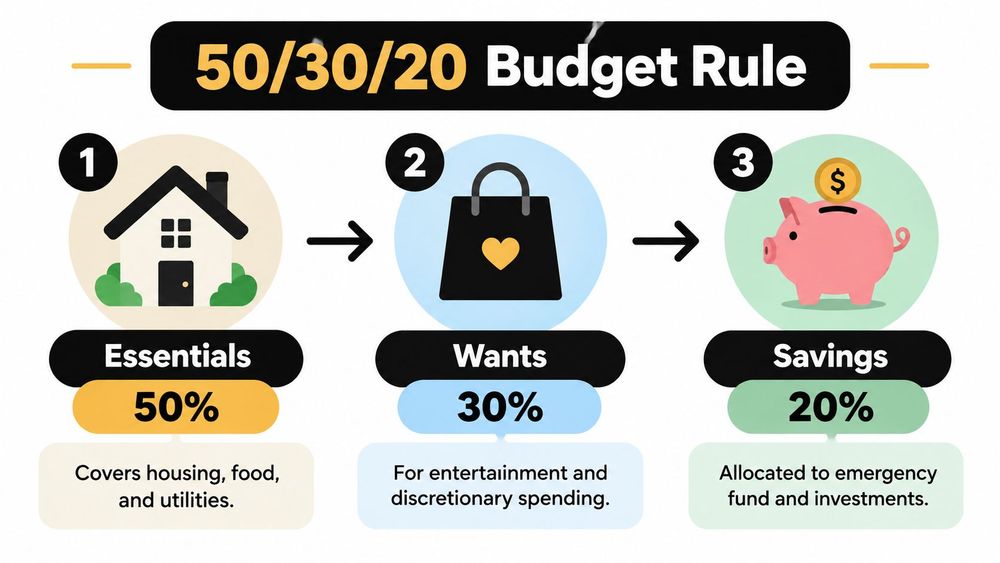
The 50/30/20 framework gives you a starting point, not a verdict. Essentials take 50%, wants take 30%, and savings plus debt repayment take 20% of net income. On a monthly after-tax income of $4,000, that leaves about $800 for savings and debt combined.
For a first pass, that split is useful because it forces a decision. Money gets assigned before lifestyle spending can absorb it, which is exactly what many households need when cash flow feels tight.
What 20% looks like in real life
That 20% does not have to land in one place. You can split it between an emergency fundCash set aside in an accessible account to cover unexpected expenses or a loss of income without taking on debt., short-term goals, and extra debt payments if high-interest balances are still in play. The point is to set a monthly transfer you can repeat.
The catch is that national saving behavior is uneven. Analysts at NerdWallet found that regular savers put away $985 per month on average, while the median was $250 (survey data on monthly saver behavior). That gap matters. It shows why a clean percentage rule can be helpful, but only if the target fits your actual income, bills, and job risk.
Informer Money's 50/30/20 budget rule guide is a useful reference if you want the logic behind the split, but the practical test is simpler. If 20% strains your budget, start lower and build it up. A steady 10% habit is more useful than a plan you abandon after one hard month.
Set an Emergency Fund Target That Fits Your Life
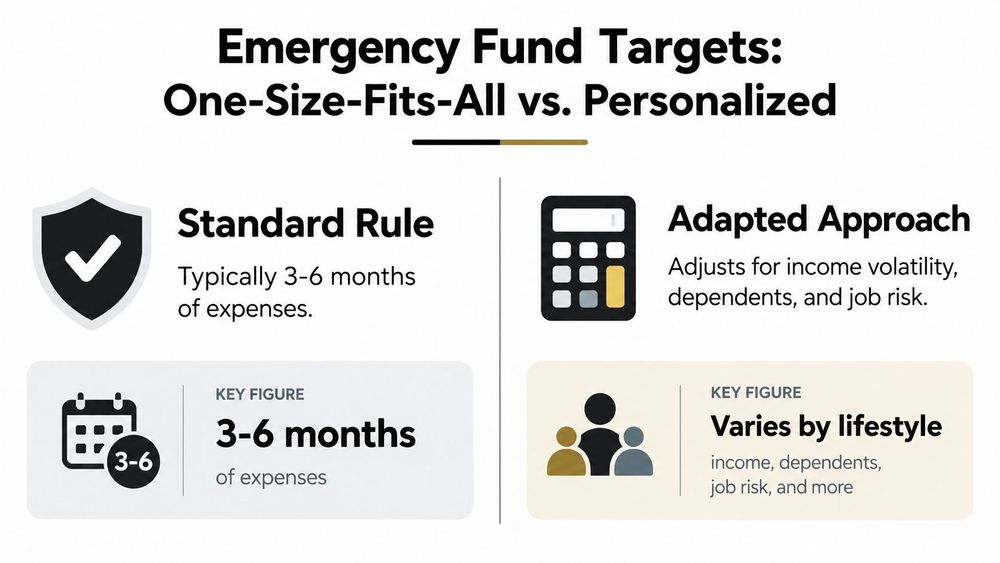
The usual advice says 3 to 6 months of expenses, but that rule is too blunt to solve every household's problem. A single earner with variable income and dependents needs a different target than a dual-income household with stable jobs and low fixed costs. The better approach is to separate fixed-dollar goals from resilience targets.
Fixed dollar target or resilience target
A fixed-dollar target works when you need a short runway for a specific purpose, like avoiding credit card debt after a job interruption. A resilience target works better when income is uneven, caregiving demands are high, or job risk is increased. In those cases, the question becomes less about a neat account balance and more about how much monthly spending pressure your savings can absorb.
The gap between ideal advice and reality is wide. The median emergency savings balance is only $600, and a 2025 survey found only about half of respondents had an emergency fund covering three months of expenses. That means many households are nowhere near the textbook target, so the smartest move is often a starter goal that you can maintain.
If a household can only contribute a small amount every month, that's still protection. A steady starter fund beats an ambitious target that never gets funded.
For some people, 3 months is enough. For others, especially those with irregular income, 9 to 12 months of essential expenses is more realistic, because the buffer has to cover longer dry spells. If you want a more specific framework for deciding your own target, Informer Money's emergency-fund guide is a useful reference point.
Build a Sample Budget to See It In Action
A sample budget only helps if it feels like your real life. Take $4,000 in net income and map it to the 50/30/20 split from the previous section.
| Category | Percentage | Monthly Amount |
| Essentials | 50% | $2,000 |
| Wants | 30% | $1,200 |
| Savings and debt repayment | 20% | $800 |
The $800 bucket is where key decisions start. If high-interest debt is still active, part of that amount should go there first. If debt is manageable, shift more toward emergency cash or a goal such as travel, a down payment, or retirement contributions.
A simple way to split the savings bucket
Split the savings line into two pieces. Put one part into emergency savings, and direct the rest to a short-term goal or retirement. That keeps the plan flexible without turning savings into a bucket that gets drained whenever spending runs high.
This split makes trade-offs visible. If essentials rise, the emergency fund share may need to grow. If income feels stable and debt is low, the goal side can take more of the monthly amount. You stop guessing and start assigning each dollar a job.
Use the $800 bucket above as a checkpoint. Adjust the split between emergency cash, debt, and goals based on your essentials and job stability. That is more useful than copying a national average and calling it a plan.
Adjust for Your Unique Situation
No two households should use the same savings target without modification. If your income is irregular, your emergency fund has to do more work, because the savings buffer needs to smooth out slow months, not just surprise expenses. If you have stable pay but high-interest debt, the right answer may be to split your monthly contribution instead of pushing everything into cash savings.
Compare the main adjustments
- Irregular income: Favor a larger emergency fund and a more conservative monthly baseline. A resilience target matters more than a neat percentage.
- High-interest debt: Keep saving, but direct part of the monthly amount to debt so you don't let interest consume progress.
- Dependents: Increase the emergency target if one disruption would affect more than one person's expenses.
- International context: Don't copy a generic benchmark without checking your local market, because household saving norms vary widely across countries.
That last point matters more than commonly thought. OECD-linked reporting shows that 2024 to 2025 household saving rates ranged from negative in some economies to about 14.7% in parts of Europe, while U.S. household saving rates were around 10.7% in 2025 on a harmonized basis (ING OECD-linked comparison). A target that makes sense in one market can be too loose or too strict in another.
Use your job stability, family load, and expense structure to set the target, not someone else's highlight reel.
If you're unsure where to start, ask one blunt question, “What monthly amount can I save without increasing stress?” That number may be smaller than you hoped, but it's often the one that sticks. Once it sticks, you can raise it.
Keep Growing Your Savings Over Time
The target you set this month shouldn't stay frozen forever. A savings plan works best when it grows with income, debt paydown, and lower fixed costs. The easiest way to keep that momentum is to automate the transfer so you're not relying on willpower every payday.
A simple maintenance routine
- Automate transfers: move money to savings on payday so it leaves checking before spending can swallow it.
- Review the budget regularly: check whether essentials, debt, or irregular costs changed.
- Increase contributions: raise the monthly amount when you get a raise or eliminate a payment.
- Separate goals: keep emergency cash distinct from longer-term investing so you don't blur the purpose.
If you want a tool that turns a savings goal into a monthly target, Toya AI savings plan is one option to compare against your own spreadsheet or calculator workflow. The product you choose matters less than whether it gives you a number you can follow.
The main idea is simple. Start with a baseline, protect it with automation, and adjust it when life gets easier or income rises. That's how a monthly savings target becomes a habit instead of a temporary burst of discipline.
Informer Money publishes practical personal finance guides, calculators, and step-by-step explainers that help readers turn broad money questions into clear decisions. If you want more tools for budgeting, saving, and setting a realistic monthly target, visit Informer Money and use the site's guides to build a plan that fits your income and goals.