

If you are asking how long to stay in a house for buying to make sense, the answer depends on your expected move date, local housing costs, and the expenses of buying and selling. A mortgage payment alone cannot show whether ownership will cost less than renting.
You will learn how to set a realistic comparison period, gather local estimates, and separate one-time transaction costs from recurring expenses such as interest, property taxes, insurance, maintenance, and repairs. You will also see how to calculate a rent-versus-buy break-even point and test what happens if you move earlier, home prices grow slowly, or ownership costs run higher than expected.
By the end, you can compare renting with buying using your own numbers and judge whether the purchase still makes sense if your plans change.
Step 1: Set your holding period and gather local estimates
There is no universal minimum stay: buying makes financial sense when its modeled financial outcome exceeds renting over the same period. Spreading transaction costs over a longer stay can help, but it does not guarantee a better result. Deciding how long to own a home before selling requires local inputs, not a generic rule.
Before calculating, gather comparable rental listings and purchase options, financing estimates, estimated ownership expenses, and the cash you have available. Financing estimates should include the down payment, interest rateThe percentage charged for borrowing money or paid for depositing it, quoted as an annual figure., loan term, and fees; ownership estimates should cover property taxes, insurance, maintenance, and any association dues. Record your expected moving date and an earlier plausible departure, such as a move prompted by a job change.
Keep location, property suitability, and the comparison period consistent when evaluating renting vs. buying over time. For example, comparing a larger purchased home with a smaller rental mixes the cost of a housing upgrade with the decision to rent or buy.
Create an input sheet with usable local estimates, noting their sources and marking uncertainties separately rather than treating guesses as firm figures.
Step 2: Separate transaction costs from ongoing housing expenses
Home buying and selling costs create a hurdle: a short stay leaves less time for ownership savings or appreciation to offset them. Include applicable purchase closing costsThe fees and prepaid items due when a property sale or refinance completes — typically 2% to 5% of the loan amount for a buyer., such as lender, title, and recording charges, plus estimated selling expenses, such as agent compensation and transfer taxes. Charges vary; use local estimates.
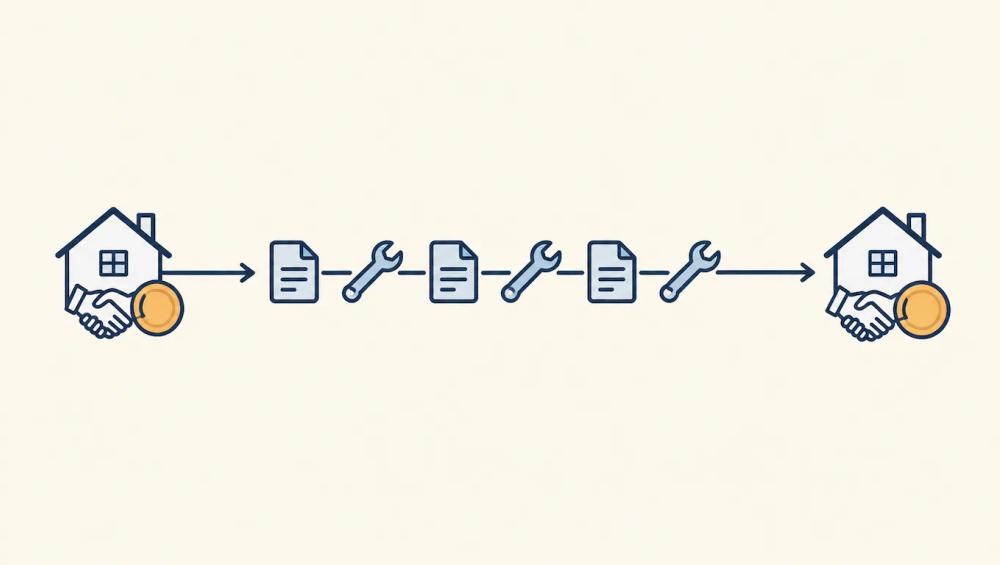
Recurring ownership expenses include mortgage interest, property taxes, insurance, maintenance, and applicable association charges. Compare these with rent, renters insurance, and utility differences. For example, rent that includes heat needs a different utility allowance than ownership where you pay separately.
Principal repayment is a cash-flow obligation, but it reduces debt rather than paying a consumed expense. Your down payment is committed capital, not automatically a loss. Both contribute to equity, although sale proceeds depend on the home's value, remaining debt, and selling costs. Likewise, a refundable rental deposit remains an asset to the extent you recover it.
Use the companion article "The True Cost of Buying a Home vs. Renting" for a detailed expense inventory. Classify each input as an upfront expense, recurring expense, or retained asset; record selling expenses separately at exit.
Step 3: Find your rent vs. buy break-even point
Your break-even point is the earliest modeled holding period when buying leaves you financially ahead of renting under consistent assumptions. It is not when your payment equals rent or your sale price exceeds your purchase price.
For each possible sale date, subtract selling expenses and the remaining mortgage balance from the home's projected value. Add the net proceeds to the buyer's other assets, then compare with the renter's assets.
Account for the down payment, closing cash, and ongoing cash-flow differences once. Principal payments reduce your mortgage balance and build equity; do not count them again as a separate benefit.
Model the down payment's opportunity costThe value of the best alternative you gave up by choosing something else — the part of a decision's cost the price tag never shows., too. Whichever household has extra cash, whether renting or buying, assume it invests that difference using the same stated return assumption. Returns are uncertain, and investments can lose money.
Hypothetical: Renting leads after three years, but buying leads after seven. A longer holding period gives equity growth and selling costs more time to affect the comparison.
Test each year. Use "Rent vs. Buy Calculator: How to Compare the Costs" for the calculation framework.
Step 4: Test an earlier move and less favorable assumptions
Your break-even estimate depends on assumptions, so test how much room you have if those assumptions prove wrong. Change one input at a time: sell earlier, reduce the projected sale price, vary rent growth, increase repairs, and change the investment return assumed for money kept invested while renting.
Suppose buying comes out ahead at your planned moving date. An earlier sale may leave too little time to recover transaction costs. Weaker home values, larger repairs, slower rent growth, or higher returns on the renter's invested savings generally push break-even later. Faster rent growth can move it earlier. These are hypothetical tests, not market forecasts.
Then combine unfavorable conditions, such as an earlier move and a major repair. Buying may never overtake renting within your tested period. If you may need your cash soon or cannot absorb repair costs and a loss on sale, do not rely on an optimistic projection.
Check whether buying remains acceptable at the earlier moving date and leaves sufficient accessible savings after repairs and selling costs. The test succeeds when you understand the downside, not when you find favorable inputs.
Avoid mistakes that make a short stay look cheaper
Missing costs and optimistic assumptions can make a short ownership period look cheaper than it is. Include selling expenses, treat appreciation as uncertain, and budget for maintenance beyond routine upkeep. For example, a roof repair before resale could erase an apparent advantage.
Count equity once. If your calculation includes sale proceeds after repaying the mortgage, adding principal payments again as a separate benefit overstates your return. Likewise, credit renters with investment growth only on money they would actually save. If they spend the monthly difference, that assumed investment balance does not exist.
Mortgage interest and property taxes do not automatically produce tax savings. Eligibility and applicable rules determine the benefit; verify your assumptions with a qualified tax professional.
Financial break-even does not establish affordability or personal suitability. Buying may compare favorably yet leave too little cash for emergencies. This is general education, not an individualized recommendation. Consult a qualified financial professional if limited liquidity or debt makes the choice difficult.
Before committing, replace uncertain inputs with documented estimates, including selling costs and maintenance allowances, and rerun the comparison.