
What Is a Sector Rotation Strategy?
When money gets tight, a household might put off buying a car. It still needs groceries and electricity, which helps explain why different kinds of stocks can take turns leading the market.
A sector rotation strategy changes how much a portfolio holds in different parts of the stock market as economic conditions change. Knowing how U.S. stock sectors have behaved across the four phases can help investors interpret those shifts and evaluate a portfolio adjustment.
Sector Rotation Strategy Across the 4 Business Cycle Phases
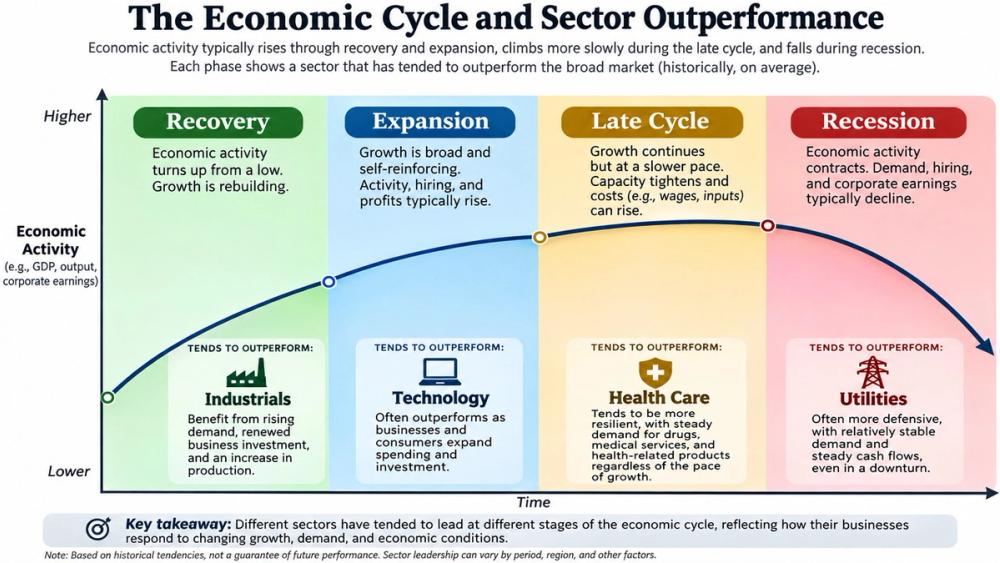
The four-phase investing framework divides an economic expansion into early, mid and late stages, followed by recession. Fidelity’s analysis of U.S. sector returns from 1962 to 2021 compares each sector with the broad market. The patterns varied in strength across sectors and phases.
Early Cycle — Recovery Favors Consumer Discretionary and Industrials
Consumer discretionary and industrial stocks have historically performed well relative to the market as the economy recovers from recession. Households may replace cars or appliances they held onto through the downturn. As sales pick up, businesses may place more orders for equipment and ship more goods. Those purchases help explain why retailers, manufacturers and freight companies can benefit from a recovery.
Mid Cycle — Steady Expansion Can Support Technology
Technology can benefit when the economy is growing steadily and businesses feel comfortable spending on software and equipment. A company that postponed a systems upgrade during a downturn may approve it once sales stabilize. Fidelity found that technology tended to fare well during this phase, with a less consistent advantage than the strongest early-cycle sectors showed.
Late Cycle — Slower Growth Can Favor Energy
Energy stocks have historically tended to outperform late in an expansion, when growth slows and inflationThe general rise in prices over time, which steadily reduces what each dollar of savings can buy. can stay elevated. Producers’ revenue depends in part on the prices they receive for oil and gas. If crude prices stay high while households cut back on optional purchases, producers and retailers face different pressures.
Recession — Consumer Staples, Health Care and Utilities Often Hold Up Better
Defensive sectors such as consumer staples, health care and utilities have historically held up better as economic activity contracts. Demand for groceries, prescriptions and electricity tends to be steadier than demand for big-ticket purchases. A defensive sector can outperform the market and still lose money. If a sector falls 5% while the market falls 10%, it outperforms by five percentage points.
How to Identify a Business Cycle Phase in Real Time
A phase estimate is stronger when several economic indicators point in the same direction. Inflation-adjusted gross domestic product (GDP) measures output across the economy. Payrolls track the number of jobs and industrial production tracks output from factories, mines and electric and gas utilities. Comparing their direction across several releases helps put an unusually strong or weak report in context.
Why Economic Data and Sector Returns Can Disagree
Economic reports describe activity that already happened and their initial estimates can change. In January 2008, the first estimate showed real GDP rising at a 0.6% annual rate in the fourth quarter of 2007. The July 2008 revision showed a 0.2% decline at an annual rate. Investors making decisions that January had only the initial GDP estimate.
Stock prices can move as investors form expectations about what comes next. If defensive stocks start leading while payrolls are still rising, the signals may point to different views of where the economy is headed.
How a Sector Rotation Strategy Works With ETFs
A sector exchange-traded fundA fund holding a basket of investments that trades on an exchange like a single stock, usually tracking an index at low cost. (ETF) trades on an exchange and holds investments focused on one sector. Adding a sector ETF to a broad-market fund creates a tilt, meaning the portfolio gives that sector more weight than the broad market does. The two funds may own some of the same companies. Their holdings determine how much exposure the portfolio adds.
A Hypothetical Sector Tilt and How to Evaluate It
Suppose a broad-market fund has 10% of its assets in industrials. A portfolio that puts 98% in that fund and 2% in an industrials ETF would have about 11.8% in industrials. The broad fund contributes 9.8 percentage points and the sector ETF adds about two more.
To evaluate the tilt, compare the portfolio’s return with the broad-market fund’s return over the same period. Account for fund fees and the bid-ask spread, which is the difference between quoted buying and selling prices. Include any tax due when selling at a gain in a taxable account.
Sector Rotation FAQ
Cycle-based investing raises questions about timing, diversificationSpreading money across many investments so that a loss in any one of them does limited damage to the whole portfolio. and what the historical results show.
Is Business Cycle Sector Rotation a Form of Market Timing?
Yes, a cycle-based tilt depends on when economic conditions change and when stock prices reflect those changes.
Do Two Quarters of Falling GDP Define a U.S. Recession?
Two quarters of falling GDP are a rule of thumb. The National Bureau of Economic Research dates recessions retrospectively using broader evidence, including employment, income and production.
Does a Sector ETF Diversify a Portfolio?
It can spread exposure across companies within one sector while increasing exposure to that sector overall.
Can Sector Rotation Reliably Beat the Market?
Researchers found modest outperformance at best in the conventional strategies they tested. Trading costs and errors in timing the cycle quickly eroded those gains.
Conclusion
A sector rotation strategy can clarify which economic conditions a portfolio is exposed to. Even a correct forecast can produce a losing tilt if stock prices already reflect it.