

Two investors can each make $5,000 selling the same stock and owe different amounts in federal tax. The difference can come down to a single day. Short-term gains generally face ordinary income tax rates, while most net long-term gains qualify for lower capital gainsThe profit from selling an asset for more than you paid, taxed at a lower rate if you held it longer than a year. tax rates. The 2026 thresholds and the example below show how to classify a gain and estimate the federal tax it adds.
What Makes a Capital Gain Short-Term or Long-Term?
You generally realize a capital gain when you sell an investment for more than its adjusted basisWhat you originally paid for an investment, adjusted over time — the figure your taxable gain or loss is measured against.. For stock you buy, that basis usually starts with what you paid, including purchase commissions. If your adjusted basis is $4,000 and your net sale proceeds are $5,000, you’ve realized a $1,000 gain. An increase in the stock’s value while you still own it is an unrealized gain.
How to Count the One-Year Holding Period
An investment held for one year or less generally produces a short-term gain or loss. Long-term treatment generally requires holding it for more than one year. For exchange-traded stock, count from the day after the purchase trade date through the sale trade date. If you bought shares on May 12, 2025, a sale on May 12, 2026 would be short-term. Selling those shares on May 13 would qualify for long-term treatment.
2026 Federal Capital Gains Tax Rates
The applicable rates depend on the holding period, your taxable income, and your filing status. The thresholds below apply to sales in the 2026 tax year for calendar-year taxpayers.
Short-Term Capital Gains Tax Rates
Net short-term gains generally add to your ordinary taxable income and face the same federal rates as wages. The 2026 ordinary income tax bracketsAn income range taxed at a particular rate — only the income inside that range is taxed at it, not your whole salary. range from 10% to 37%. A marginal rateThe rate applied to your next dollar of income — the number that matters for almost every tax decision at the margin. applies to the portion of taxable income within a particular bracket. If a gain pushes your income into a higher bracket, only the portion above that threshold faces the higher rate.
Long-Term Capital Gains Tax Rates
Most net long-term gains qualify for federal rates of 0%, 15%, or 20%. Ordinary taxable income fills the lower brackets first. Eligible long-term gains and qualified dividendsA share of a company's profits paid out to shareholders, usually in cash and usually every quarter. then use any remaining room in the preferential brackets. That means a single gain can fall into more than one bracket.
The first figure below is the upper taxable income limit for the 0% rate. The second is the upper limit for the 15% rate. The portion of an eligible gain above the second threshold faces the 20% rate.
- Single — $49,450 and $545,500.
- Married filing jointly or qualifying surviving spouse — $98,900 and $613,700.
- Head of household — $66,200 and $579,600.
- Married filing separately — $49,450 and $306,850.
Short-Term vs. Long-Term Capital Gains on a $5,000 Profit
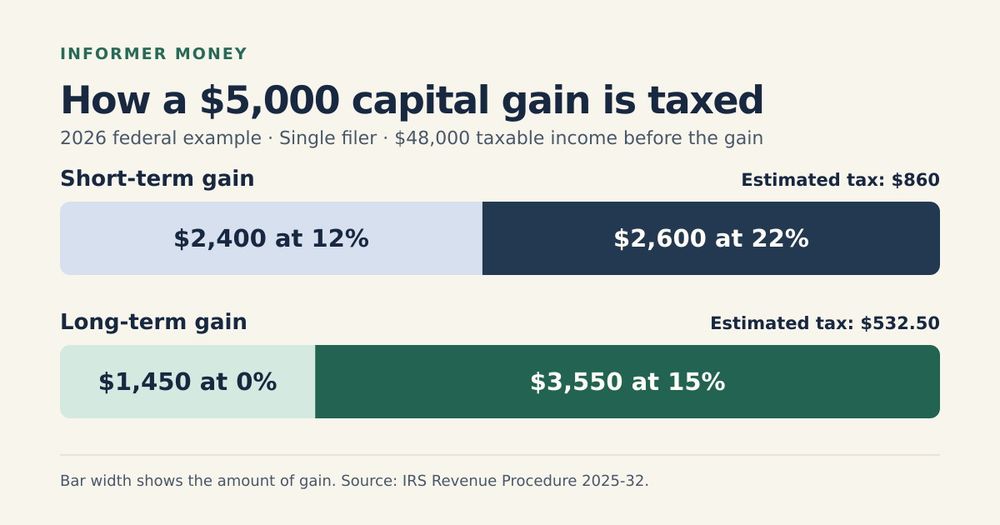
Suppose a single filer has $48,000 in ordinary taxable income after deductions and realizes a $5,000 stock gain. Assume the filer has no capital lossesThe loss from selling an investment for less than you paid, which offsets capital gains and up to $3,000 of ordinary income a year., qualified dividends, or gains subject to special rates. Applying the 2026 brackets directly shows how much regular federal income tax the gain would add in each scenario.
How the Same Gain Falls Into Different Brackets
- Short-term. The 12% ordinary income bracket for single filers ends at $50,400. The first $2,400 of the gain adds $288 in tax at 12%. The remaining $2,600 adds $572 at 22%, for an estimated total of $860.
- Long-term. The 0% long-term capital gains bracket for single filers ends at $49,450. The first $1,450 of the gain fits in that bracket. The remaining $3,550 faces the 15% rate, for an estimated total of $532.50.
How Capital Losses and Special Rates Change the Calculation
Capital losses can reduce the gains you owe tax on. First, offset short-term losses against short-term gains and long-term losses against long-term gains. Then combine the two net results to determine your overall gain or loss. If a net loss remains, you can generally deduct up to $3,000 against other income, or $1,500 if married filing separately. Unused losses generally carry forward to future tax years.
Net long-term gains on collectibles can face a maximum federal rate of 28%. Certain real estate gains tied to prior depreciationThe decline in an asset's value over time from age and use — and, for businesses, the tax deduction that tracks it. can face a maximum rate of 25%. The separate 3.8% Net Investment Income Tax can apply to gains from either holding period when modified adjusted gross incomeYour total income minus a specific set of adjustments — the figure most tax breaks are measured against, not your salary. exceeds the threshold for your filing status.
Frequently Asked Questions About Capital Gains Tax
Do I owe capital gains tax if I reinvest the proceeds?
Selling stock at a gain in a taxable brokerage account generally creates a reportable gain even if you immediately reinvest the proceeds. The new purchase has its own basis and holding period.
Where do I report stock sales on my tax return?
Most stock sales go on Form 8949, which records the proceeds, basis, and gain or loss for each sale. Schedule D summarizes capital gains and deductible capital losses. Some eligible sales can go directly on Schedule D.
Are inherited investments short-term if I sell them right away?
Gains or losses on inherited investments generally receive long-term treatment. That rule usually applies even if you sell shortly after inheriting the investment.
Conclusion
To apply the right capital gains tax rates, verify the holding period and calculate the net gain. Then use the federal brackets for the sale year and your filing status.
For advice specific to your circumstances, consult a qualified tax professional.