
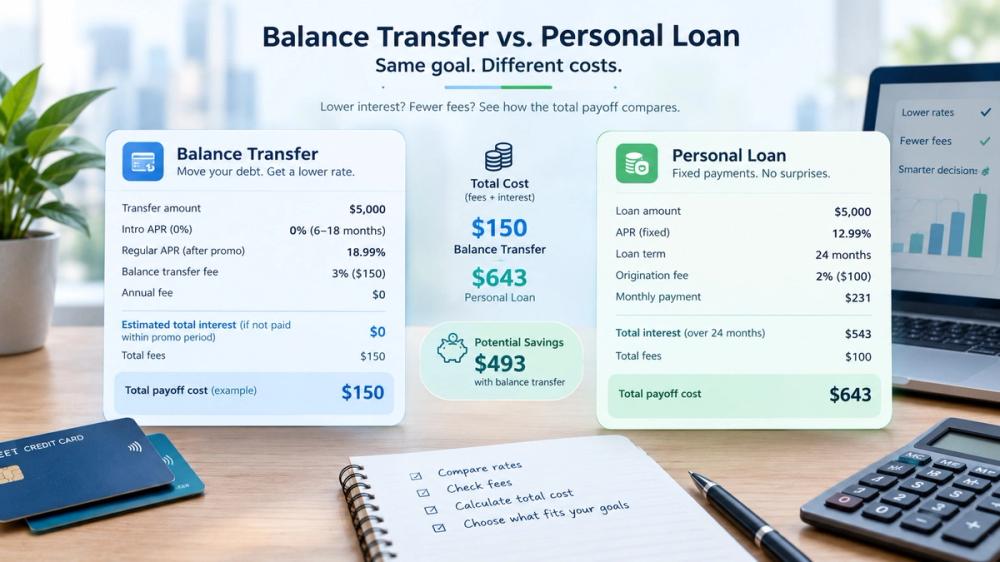
A balance-transferMoving credit card debt onto a new card with a promotional low or 0% rate, so payments attack the balance instead of the interest. card may cost less if its fee is modest and you can repay the transferred balance before the introductory rate ends. A personal loan may be easier to budget around because it has a fixed payment and payoff date, but interest and fees can make the total cost higher. Compare the dollars you would pay under each offer, not just the advertised APRThe yearly cost of borrowing, expressed as a percentage that includes the interest rate plus most lender fees..
Your result depends on the transfer fee, promotional period, loan APR, origination fee, approved amount, and how quickly you can repay. The examples below are illustrations, not current offers or personalized financial advice.
What you are comparing
A balance transfer moves credit-card debt to another card. The new card may offer a low or 0% introductory APR for a limited time, and the issuer may charge a transfer fee. The Consumer Financial Protection Bureau explains that a balance-transfer fee can apply even when the offer has a 0% rate. Check the transfer deadline, fee, promotional period, post-promotion APR, and credit limit in the current terms.
A personal installment loan gives you a fixed amount that you repay in scheduled installments. The payment and end date are generally set by the loan terms. Origination and other charges may add to the cost, so review the lender's disclosures. The CFPB lists common personal installment loan fees and recommends checking the loan documents before agreeing.
A side-by-side example
Suppose you have $6,000 in credit-card debt and can clear it in 18 months. Assume a balance-transfer card charges a 3% fee and offers 0% APR for all 18 months. For comparison, assume a personal loan has a fixed 12% APR, an 18-month term, and no origination fee.
| Option | Assumptions | Approximate monthly payment | Approximate total paid |
| Balance transfer | $6,000 balance, 3% fee, 0% APR for 18 months | $343.33 | $6,180 |
| Personal loan | $6,000 borrowed, 12% APR, 18 months, no fee | $365.89 | $6,586 |
In this illustration, the transfer costs about $406 less if the full balance is paid within the promotional period. The balance-transfer total includes the $180 fee. The loan total includes about $586 in interest. The comparison assumes the full $6,000 can be transferred, the loan has no fees, and every payment is made on schedule. Actual offers and payment schedules may differ.
Informer Money's balance-transfer card guide uses the same $6,000 debt and 3% fee example to show how the transfer fee changes the starting balance. This article adds the loan comparison so you can evaluate another payoff route without repeating the card-by-card guide.
How to compare your actual offers
1. Start with the amount you can move or borrow
A transfer limit may not cover your entire balance. If only part of the debt qualifies, calculate the cost of the remainder at its current APR too. For a loan, confirm the amount you will receive after any fee is deducted and whether it is enough to pay the intended balances.
2. Add every fee to the payoff cost
For a balance transfer, calculate the fee as a percentage of the amount transferred, while checking for a minimum fee. For a personal loan, include origination or documentation fees and any optional add-ons you would actually choose. Comparing APRs can help, but make sure you are comparing APR to APR and then check the full payment schedule and fee disclosures. The CFPB explains how APR helps compare borrowing costs.
3. Match the payoff timelines
Divide the transfer balance plus fee by the number of promotional months to estimate the monthly amount needed to finish before the standard APR applies. Do not rely on the minimum payment to clear the balance. For a loan, use the disclosed payment and total of payments over its full term. A longer term can lower the monthly bill while increasing the total interest.
4. Stress-test the plan
Ask what happens if a transfer is delayed, your approved credit limit is smaller than expected, or your budget cannot support the planned payment. Review the post-promotion APR and the loan's late-payment terms. A 0% introductory offer has a limited duration, and the issuer must disclose how long it lasts and what rate follows it, as the CFPB explains in its guide to introductory balance-transfer rates.
When each option may fit better
A balance transfer may be worth comparing when you qualify for enough credit, the fee is lower than the interest you expect to avoid, and you can repay the amount during the promotional period. Keep new purchases separate while paying down the transferred balance, and confirm how the card treats purchases and promotional balances.
A personal loan may be worth comparing when its disclosed total cost is lower than the card's cost, you need a predictable payment schedule, or the transfer limit would leave too much debt behind. A fixed payment does not make the debt disappear, and using a loan to pay off cards can leave those cards available for new spending. Consider whether your budget can support the loan payment without rebuilding the balances.
Neither option is automatically the better choice. Compare your written offers using the same balance and payoff timeline, then choose the one whose total cost and payment fit your circumstances.
Frequently asked questions
Does a 0% balance-transfer offer mean there is no cost?
Not necessarily. The issuer may charge a transfer fee even when the promotional APR is 0%. The fee, transfer deadline, and post-promotion rate are in the offer terms.
Is a personal loan always cheaper than credit-card debt?
No. The APR, fees, repayment term, and amount you can borrow all affect the total. Compare the loan's total of payments with the card's transfer fee, interest during the payoff period, and any balance remaining after a promotion.
Should I close the old credit card after a transfer or loan?
There is no one-size-fits-all answer. Review the card's fees and terms, and make a plan that limits new borrowing while you repay the debt. This comparison is educational and is not individualized financial advice.